The transformative power of translation
Language Log 2024-07-26
"Not Lost In Translation: How Barbarian Books Laid the Foundation for Japan’s Industrial Revolution", by Alex Tabarrok, Marginal Revolution (July 22, 2024)
I am grateful to Alex Tabarrok and his colleague Tyler Cowen at Marginal Revolution University of George Mason University's Mercatus Center for introducing me to what is one of the most mind-boggling/blowing papers I have read in the last decade.
First, here is Tabarrok's introduction, and that will be followed by selections from the revolutionary paper to which I am referring.
Japan’s growth miracle after World War II is well known but that was Japan’s second miracle. The first was perhaps even more miraculous. At the end of the 19th century, under the Meiji Restoration, Japan transformed itself almost overnight from a peasant economy to an industrial powerhouse.
After centuries of resisting economic and social change, Japan transformed from a relatively poor, predominantly agricultural economy specialized in the exports of unprocessed, primary products to an economy specialized in the export of manufactures in under fifteen years.
In a remarkable new paper, Juhász, Sakabe, and Weinstein show how the key to this transformation was a massive effort to translate and codify technical information in the Japanese language. This state-led initiative made cutting-edge industrial knowledge accessible to Japanese entrepreneurs and workers in a way that was unparalleled among non-Western countries at the time.
Here’s an amazing graph which tells much of the story. In both 1870 and 1910 most of the technical knowledge of the world is in French, English, Italian and German but look at what happens in Japan–basically no technical books in 1870 to on par with English in 1910. Moreover, no other country did this.
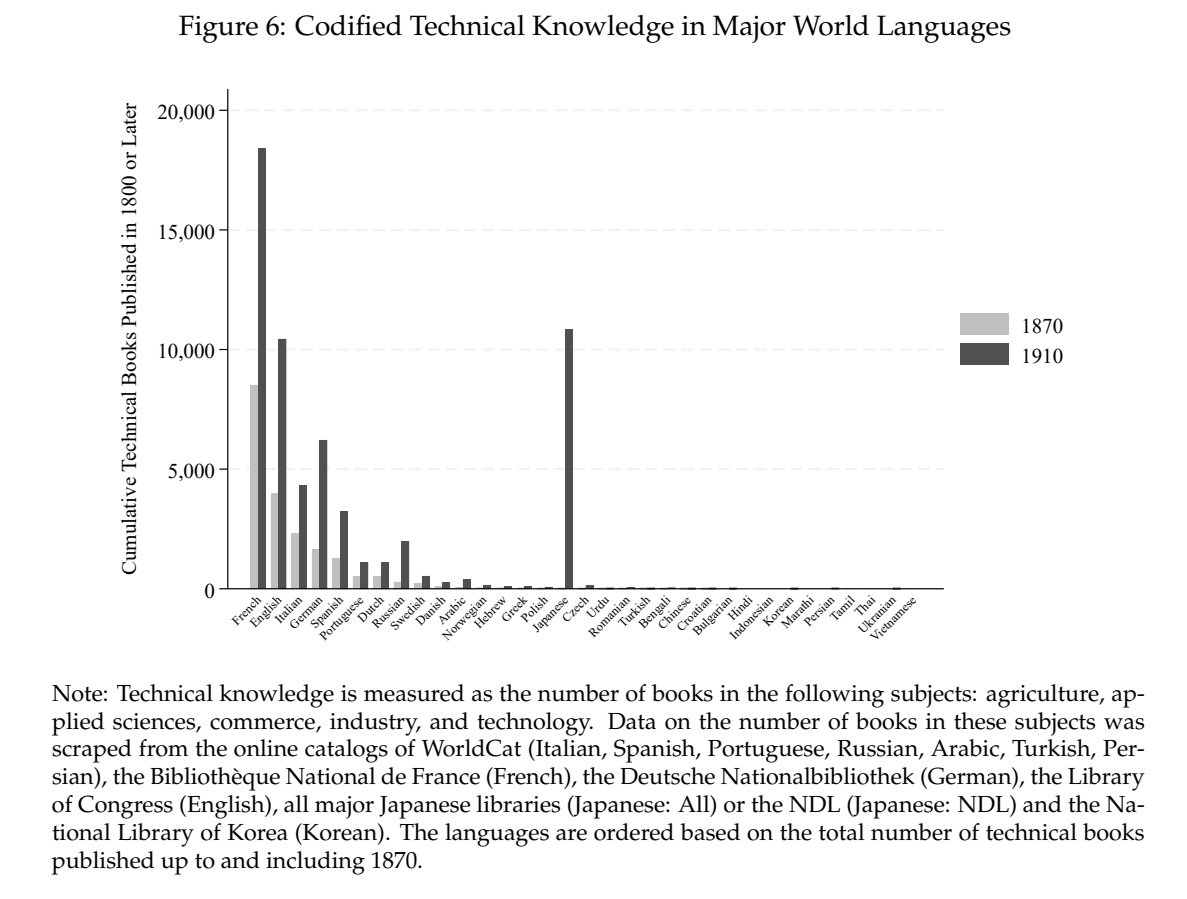
[Click to embiggen for easy reading]
Translating a technical document today is much easier than in the past because the words already exist. Translating technical documents in the late 19th century, however, required the creation and standardization of entirely new words.
…the Institute of Barbarian Books (Bansho Torishirabesho)…was tasked with developing English-Japanese dictionaries to facilitate technical translations. This project was the first step in what would become a massive government effort to codify and absorb Western science. Linguists and lexicographers have written extensively on the difficulty of scientific translation, which explains why little codification of knowledge happened in languages other than English and its close cognates: French and German (c.f. Kokawa et al. 1994; Lippert 2001; Clark 2009). The linguistic problem was two-fold. First, no words existed in Japanese for canonical Industrial Revolution products such as the railroad, steam engine, or telegraph, and using phonetic representations of all untranslatable jargon in a technical book resulted in transliteration of the text, not translation. Second, translations needed to be standardized so that all translators would translate a given foreign word into the same Japanese one.
Solving these two problems became one of the Institute’s main objectives.
Here’s a graph showing the creation of new words in Japan by year. You can see the explosion in new words in the late 19th century. Note that this happened well after the Perry Mission. The words didn’t simply evolve, the authors argue new words were created as a form of industrial policy.
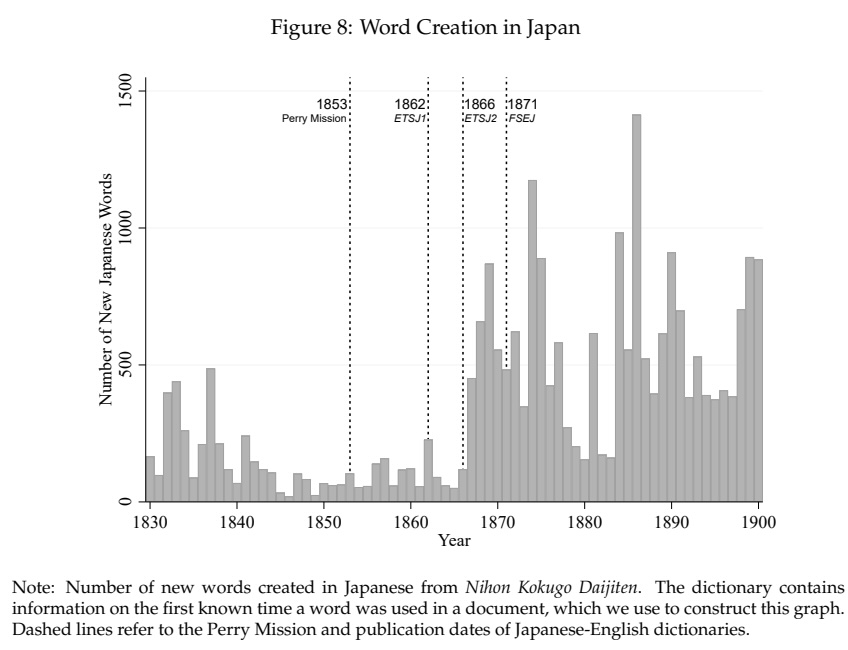
[Click to embiggen for easy reading]
By the way, AstralCodexTen points us to an interesting biography of a translator at the time who works on economics books:
[Fukuzawa Yukichi {1835-1901}] makes great progress on a number of translations. Among them is the first Western economics book translated into Japanese. In the course of this work, he encounters difficulties with the concept of “competition.” He decides to coin a new Japanese word, kyoso, derived from the words for “race and fight.”* His patron, a Confucian, is unimpressed with this translation. He suggests other renderings. Why not “love of the nation shown in connection with trade”? Or “open generosity from a merchant in times of national stress”? But Fukuzawa insists on kyoso, and now the word is the first result on Google Translate.
[*VHM: I think this explanation may be confusing to some readers. Fukuzawa's neologism for "competition" is kyōsō 競争, which may also mean "rivalry, contest, emulation, tournament, strife". 競 by itself may mean "compete" and 争 by itself may mean "contest".]
There is a lot more in this paper. In particular, showing how the translation of documents lead to productivity growth on an industry by industry basis and a demonstration of the importance of this mechanism for economic growth across the world.
The bottom line for me is this: What caused the industrial revolution is a perennial question–was it coal, freedom, literacy?–but this is the first paper which gives what I think is a truly compelling answer for one particular case. Japan’s rapid industrialization under the Meiji Restoration was driven by its unprecedented effort to translate, codify, and disseminate Western technical knowledge in the Japanese language.
If you have time, many of the comments that follow the post are illuminating in their own right and worth delving into.
Now, on to the original paper:
"CODIFICATION, TECHNOLOGY ABSORPTION, AND THE GLOBALIZATION OF THE INDUSTRIAL REVOLUTION", by Réka Juhász, Shogo Sakabe and David Weinstein, NATIONAL BUREAU OF ECONOMIC RESEARCH Working Paper 32667 (July, 2024)
Abstract
This paper studies technology absorption worldwide in the late nineteenth century. We construct several novel datasets to test the idea that the codification of technical knowledge in the vernacular was necessary for countries to absorb the technologies of the Industrial Revolution. We find that comparative advantage shifted to industries that could benefit from patents only in countries and colonies that had access to codified technical knowledge but not in other regions. Using the rapid and unprecedented codification of technical knowledge in Meiji Japan as a natural experiment, we show that this pattern appeared in Japan only after the Japanese government codified as much technical knowledge as what was available in Germany in 1870. Our findings shed new light on the frictions associated with technology diffusion and offer a novel take on why Meiji Japan was unique among non-Western countries in successfully industrializing during the first wave of globalization.
Telling prefatory quotation
“At present, the learning of China and Japan is not sufficient; it must be supplemented and made complete by inclusion of the learning of the entire world… I would like to see all persons in the realm thoroughly familiar with the enemy’s conditions, something that can best be achieved by allowing them to read barbarian books as they read their own language. There is no better way to enable them to do this than by publishing [a] dictionary.”
Shozan Sakuma (1811-1864), 1858, quoted in Hirakawa (2007, p. 442, emphasis added) Hirakawa, S. (2007). Japan’s turn to the West. In J. W. Hall, M. B. Jansen, M. Kanai, and D. Twitchett (Eds.), The Cambridge History of Japan: The Nineteenth Century, Volume 5, pp. 432–498. New York: Cambridge University Press.
N.B.: Already in the middle of the 19th century, Japanese were thinking of an East Asian co-prosperity condominium with China.
As to why the trajectory of scientific change was so radically different in Japan from what it was elsewhere outside of Europe, the authors have their own hypotheses and draw their own conclusions, which are basically centered on economic realities and grounded in "technical literacy / knowledge", i.e., "the codification of engineering, commercial, and industrial practices"
Fair enough, but neither this team of brilliant analysts nor any other scholars I know of attribute Japan's meteoric rise to the fact that, despite their being sealed off from the rest of the world until Commodore Matthew C. Perry (1794-1858) with his Black Ships forced the Japanese empire to open its ports and gates (1852-54), their possession of a flexible script (phonetic kana plus morphosyllabic kanji) was operative. In my estimation such a writing system would have played a significant role in their lexicographic borrowing and epistemological foundations.
Selected readings
William C. Hannas, Asia's Orthographic Dilemma (Honolulu, Hawai'i: University of Hawai'i Press, 1997).
William C. Hannas, The writing on the wall: How Asian orthography curbs creativity (Philadelphia, PA: University of Philadelphia Press, 2003).
[Thanks to Ben Benzon]