Does handwriting still matter?
Language Log 2025-01-28
It's a subject that won't go away.
When I was in high school, I concocted an embarrassingly sophomoric signature:
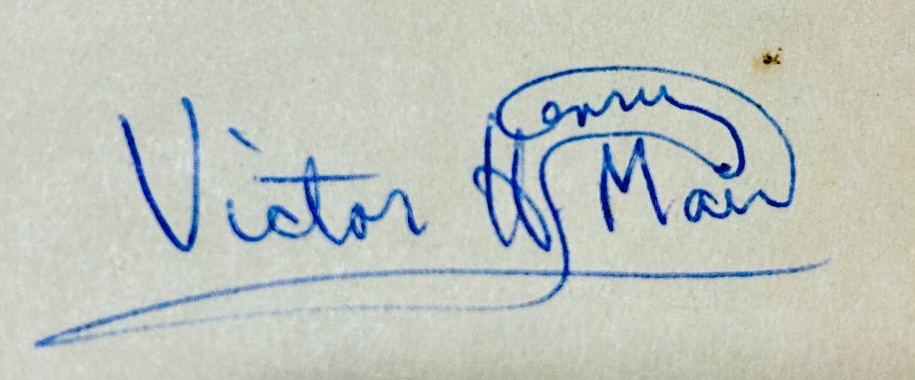
I wrote that iteration of my youthful signature on the front flyleaf of my beloved Webster's New Collegiate Dictionary (1960), which, from that year till today has been one of my most precious possessions.
When I went away to college in 1961 and ever since, I adopted a signature that was the exact antithesis of that early one:
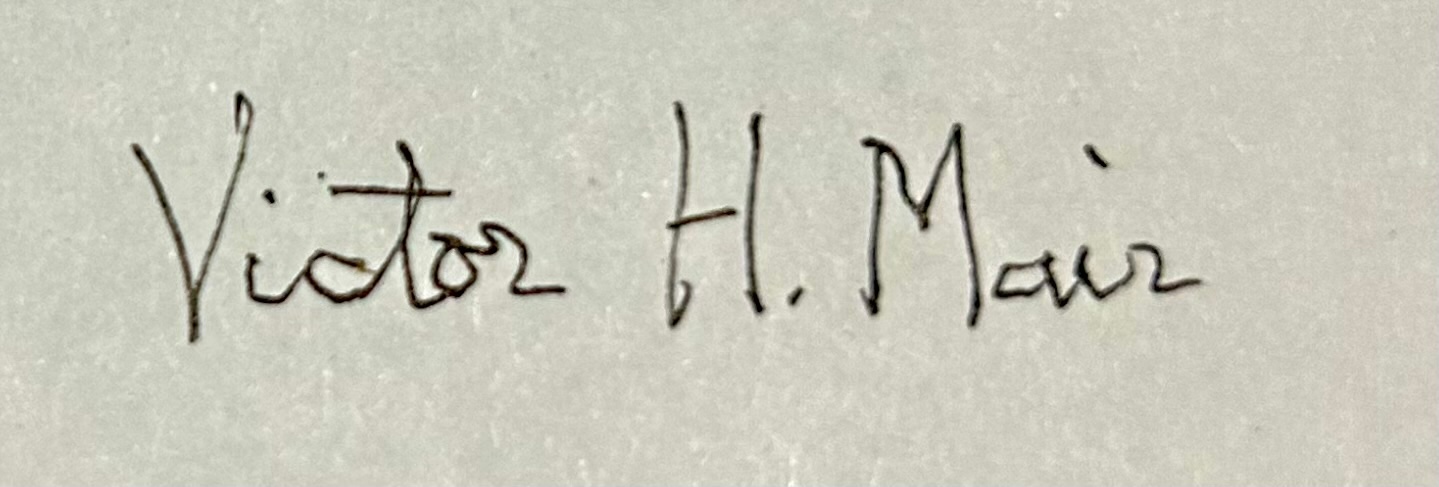
It was / is mechanical and measured, with no flourishes whatsoever.
Most people I know have one of three basic types of signatures:
1. extravagant, fast, illegible — these are usually "important" people who have to sign their signature scores of times each week; doctors; lawyers; executives; entertainers….
2. beautiful, well-composed, flowing, legible — my sisters, most women
3. crotched, cramped, crooked, angular, unesthetic, slow — my brothers and me, engineers, scientists, who write with what I call "chicken scratches"
The question of handwriting is more than just a matter of the appearance and propriety of one's signature. The cognitive and psychological implications of handwriting are plumbed in this new article by Christine Rosen:
"Signature moves: are we losing the ability to write by hand?" We are far more likely to use our hands to type or swipe than pick up a pen. But in the process we are in danger of losing cognitive skills, sensory experience – and a connection to history", The Guardian (1/21/25).
…
Our mixed feelings about machine-made signatures make plain our broader relationship to handwriting: it offers a glimpse of individuality. Any time spent doing archival research is a humbling lesson in the challenges and rewards of deciphering the handwritten word. You come to know your long-dead subjects through the quirks of their handwriting; one man’s script becomes spidery and small when he writes something emotionally charged, while another’s pristine pages suggest the diligence of a medieval monk.
…
The Common Core State Standards for education in the US, which outline the skills students are expected to achieve at each grade level, no longer require students to learn cursive writing. Finland removed cursive writing from its schools in 2016, and Switzerland, among other countries, has also reduced instruction in cursive handwriting. One assessment claimed that more than 33% of students struggle to achieve competency in basic handwriting, meaning the ability to write legibly the letters of the alphabet (in both upper and lower case).
…
As a practical skill in the digital world, handwriting seems useless. There is a term in Chinese, tibiwangzi, which means “take pen, forget character”. It describes how more frequent use of computers and smartphones has discouraged the use of traditional Chinese handwriting, including the ability to write traditional characters. Chinese children pick up a pen to write (“take pen”) but experience a kind of “character amnesia” when it comes to putting pen to paper (“forget character”).
…
What does it mean to live without handwriting? The skill has deteriorated gradually, and many of us don’t notice our own loss until we’re asked to handwrite something and find ourselves bumbling as we put pen to paper. Some people still write in script for special occasions (a condolence letter, an elaborately calligraphed wedding invitation) or dash off a bastardised cursive on the rare occasions when they write a cheque, but apart from teachers, few people insist on a continued place for handwriting in everyday life.
But we lose something when handwriting disappears. We lose measurable cognitive skills, and we also lose the pleasure of using our hands and a writing implement in a process that for thousands of years has allowed humans to make our thoughts visible to one another. We lose the sensory experience of ink and paper and the visual pleasure of the handwritten word. We lose the ability to read the words of the dead.
In a general survey of the ramifications of handwriting in contemporary life, it's hard to avoid mentioning prescriptions dashed off by physicians.
In 2000, physicians at Cedars-Sinai hospital in Los Angeles took a remedial handwriting course. “Many of our physicians don’t write legibly,” the chief of the medical staff explained to Science Daily. And unlike many professions, doctors’ bad writing can have serious consequences, including medical errors and even death; a woman in Texas won a $450,000 award after her husband took the wrong prescription medicine and died. The pharmacist had misread the doctor’s poorly handwritten instructions. Even though many medical records are now stored on computers, physicians still spend a lot of their time writing notes on charts or writing prescriptions by hand.
In such circumstances, perhaps it might be better to require certain types of critical specialists not to write by hand.
Clarity in handwriting isn’t merely an aid to communication. In some significant way, writing by hand, unlike tracing a letter or typing it, primes the brain for learning to read. Psychologists Pam Mueller and Daniel Oppenheimer compared students taking class notes by hand or on a laptop computer to test whether the medium mattered for student performance. Earlier studies of laptop use in the classroom had focused on how distracting computer use was for students. Not surprisingly, the answer was very distracting, and not just for the notetaker but for nearby peers as well.
Mueller and Oppenheimer instead studied how laptop use affected the learning process for students who used them. They found that “even when laptops are used solely to take notes, they may still be impairing learning because their use results in shallower processing”. In three different experiments, their research concluded that students who used laptop computers performed worse on conceptual questions in comparison with students who took notes by hand. “Laptop note takers’ tendency to transcribe lectures verbatim rather than processing information and reframing it in their own words is detrimental to learning,” they wrote. In other words, we retain information better when we write by hand because the slower pace of writing forces us to summarise as we write, as opposed to the greater speed of transcribing on a keyboard.
The researchers studying how technology transforms the way we write and learn are akin to ecologists who warn of species decline or environmental pollution. We face a future without handwriting. Researchers worry that abandoning the pen for the keyboard will lead to any number of unforeseen negative consequences. “The digitisation of writing entails radical transformations of the very act of writing at a sensorimotor, physical level and the (potentially far-reaching) implications of such transformations are far from properly understood,” notes Anne Mangen, who studies how technology transforms literacy. Writing on a keyboard with the words appearing on the screen is more “abstract and detached”, something she believes has “far-reaching implications, educationally and practically”. Like species decline, skills decline gradually.
Rosen's article delves into many other — some quite unexpected — manifestations of personal, physical activity as compared to robotic, machine productions, from Montaigne's descriptions of flatulence to the mastery of an Austin, Texas bootmaker. For a newspaper article, this one (much abridged here) is extraordinarily long, complex, and meditative. It's no wonder that it is an edited extract from the author's book titled The Extinction of Experience: Reclaiming Our Humanity in a Digital World, published by the Bodley Head in 2024. I would suggest that an alternative title might be, following Epictetus (c. 50-135 AD), An Enchiridion* for the Contemporary World.
*The word "Enchiridion" (Ancient Greek: ἐγχειρίδιον) is an adjective meaning "in the hand" or "ready to hand". The word sometimes meant a handy sword, or dagger, but coupled with the word "book" (biblion, Greek: βιβλίον) it means a handy book or hand-book. Epictetus in the Discourses often speaks of principles which his pupils should have "ready to hand" (Greek: πρόχειρα). Common English translations of the title are Manual or Handbook
(source)
Epictetus' classic was published c. 125 AD.
Selected readings
- "A letter writer of / for the 20th and 21st century" (1/13/25)
- "The benefits of handwriting" (9/16/19)
- "Exercising the brain: handwriting vs. typing" (6/21/24)
- "Handwriting Shows Unexpected Benefits Over Typing", by Denis Storey, Psychiatrist.com (1/30/24)
- "Writing characters and writing letters" (11/17/18)
- "The Miracle of Western Writing" (1/31/23)
- "Handwriting legibility" (10/19/15)
- "Cursive" (3/30/14)
- "Cursive and Characters: Dying Arts" (4/29/11)
- "'They're not learning how to write characters!'" (11/5/21) — with long bibliography
- "Cursive" (3/30/14)
- "Character Amnesia" (7/22/10) — (with 140 comments) Language Log has discussed "character amnesia" in many posts since I first invented the term sometime before 2010. A long, but not exhaustive, bibliography, may be found following this post:
- "Character amnesia yet again: game (almost) over" (4/28/22)
- "Dumpling ingredients and character amnesia" (10/18/14) — one of the classics
[h.t. Philip Taylor and Hu Jing]