Split infinitives: Federal Circuit divides on Indefiniteness
Patent – Patently-O 2022-01-28
by Dennis Crouch
Nature Simulation Systems v. Autodesk (Fed. Cir. 2022)
We have an interesting split decision focusing on the doctrine of indefiniteness in the context of an “examiner’s amendment.” Judge Newman wrote for the majority and favored the patentee; Judge Dyk wrote in dissent and concluded that the patent claims were indefinite. The judges particularly differed on what level of deference should be given to USPTO examiners with the majority holding that “[a]ctions by PTO examiners are entitled to appropriate deference as official agency actions.” The dissent argued instead that deference has no role in the definiteness inquiry:
The test …is whether the claims ‘inform those skilled in the art about the scope of the invention with reasonable certainty,’ Nautilus, not whether the claim language was added by a patent examiner or was not indefinite to the examiner.
Slip op. (Dyk, J. in dissent).
You likely know about Boolean logic operations such as AND, OR, and NOR. In CAD software, Boolean operators are similarly used to recognize intersection of geometric objects, using alternative terminology such as INTERSECT, UNITE, and SUBTRACT. Mathematical methods for performing these operators have been known for decades–as developed by “Watson.” NSS created a new version that it calls the “modified Watson method.”
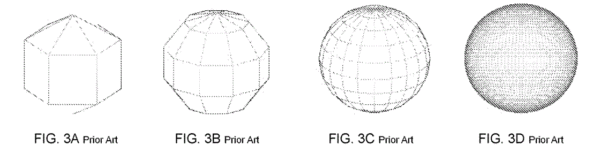
During prosecution, the examiner rejected the claims as indefinite, but then withdrew the rejection based upon his own examiner’s amendment. The original claim required use of the “modified Watson method,” but the examiner suggested that was not definite enough, and suggested adding additional definitional requirements:
wherein the modified Watson method includes removing duplicate intersection points, identifying positions of end intersection points, and splitting portion of each triangle including an upper portion, a lower portion, and a middle portion;
Exr. Amendment found in Notice of Allowance.
Later, NSS sued Autodesk for infringement, and the defendant responded that the language added by the examiner was actually indefinite and created confusion as to what is actually included within modified Watson. The parties consented to have the local Magistrate Judge (Sallie Kim) hear their case, and Kim sided with the defendant. The Magistrate opinion is notable in that it does not cite to the leading precedent on definiteness – Nautilus v. Biosig (2014). Rather, the court appeared to primarily rely upon Gen. Elec. Co. v. Wabash Appliance Corp., 304 U.S. 364 (1938) or no precedent at all. The district court’s approach appears to be looking for “unanswered questions” of claim scope:
Thus, the question is thus: if the PTO issues a patent after amendment to clarify an indefinite term, but an expert later opines that a POSITA would not understand the term, how does the Court determine whether the term is indefinite? The only way to do so here is to look at each argument to see if Autodesk raises any unanswered questions.
[Nature_Simulation_Systems_Inc._62]. The Magistrate clearly missed the mark on its explanation and application of the law of definiteness. (Although Judge Dyk calls the opinion detailed and thorough).
Since indefiniteness is seen as a question of law, the court also took the second step of determining whether the erroneous application of law also led to an erroneous outcome. Yes it did. On this point, Judge Newman pointed to the specification’s offering of two algorithmic charts showing the modified Watson method and also the patent examiner’s specific determination on this very point.
The district court gave no weight to the prosecution history showing the resolution of indefiniteness by adding the designated technologic limitations to the claims. . . .
Actions by PTO examiners are entitled to appropriate deference as official agency actions, for the examiners are deemed to be experienced in the relevant technology as well as the statutory requirements for patentability.
Slip Op (majority). The court has written on this very point in some prior cases — perhaps most pointedly in Tinnus Enters., LLC v. Telebrands Corp., 733 F. App’x 1011, 1020 (Fed. Cir. 2018) (“We presume that an examiner would not introduce an indefinite term into a claim” with an examiner’s amendment). Judge Newman cited Tinnus, but did not mention that the case was non-precedential.
For his part, Judge Dyk argues that the test for indefiniteness is an objective test based upon the understanding of those skilled in the art “not whether the claim language was added by a patent examiner or was not indefinite to the examiner.” The majority responded to this criticism by noting that an examiner is presumptively a person of skill in the art.