Turning a source of noise into an error-correcting qubit
Ars Technica » Scientific Method 2014-02-04
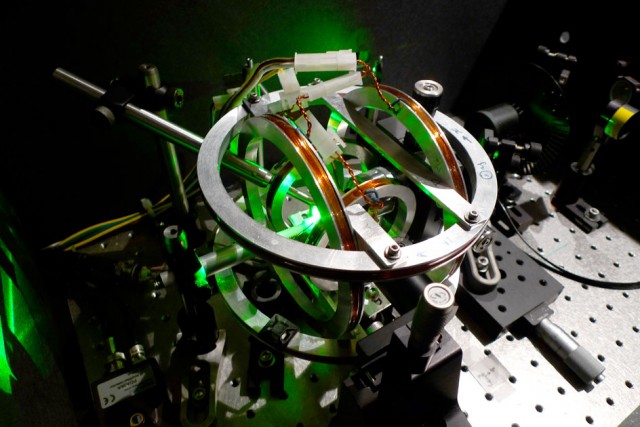
When you set a bit in a normal computer, you expect it to stay set; computers rely on a variety of technologies to ensure it does. The challenge of maintaining a bit is substantially harder in a quantum computer, where any interactions between a qubit and its environment can change the value stored in the qubit. As a result, most quantum bits have a lifetime on the order of milliseconds or less.
Now, researchers have figured out how to turn a source of noise into a solution for maintaining quantum memory. By individually addressing some of the atoms surrounding a qubit, they've turned each into an additional form of storage. By storing a single value in the qubit and its neighbors, they've created a form of error correction for quantum memory.
The research team, a collaboration between Delft University of Technology and the University of Iowa, was focusing on one of the standard forms of qubit storage: a nitrogen vacancy in diamond. Since nitrogen can only form three covalent bonds (instead of carbon's four), it ends up with unpaired electrons when present in the regular matrix of a diamond. Those electrons can then be addressed as qubits, with their state set and read using light of the appropriate wavelength.
Read 7 remaining paragraphs | Comments


