Should Private Firms Be Involved in Cooling the Planet?
Legal Planet: Environmental Law and Policy 2025-11-11
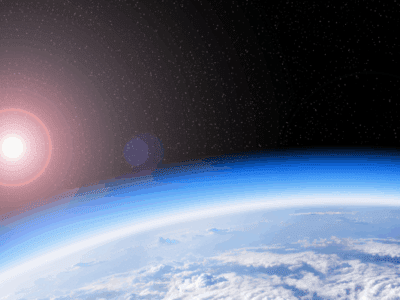

A story at Heatmap News last month reported that an Israeli-American startup firm, Stardust Solutions, has received $60 million in venture funding for a new type of particle they propose can be used to inject in the stratosphere to reflect a little sunlight and (temporarily, imperfectly) reduce global-average heating from greenhouse gases. The company aims to patent their new particle and sell the technology to governments, which would presumably develop the other technology needed to deploy stratospheric aerosol injection, or SAI, (high-flying, full-payload aircraft, distribution methods, ways to monitor injections and their effects, etc.) and decide whether, and if so when and how, to do so. Stardust says their new particle will avoid the known environmental impacts of sulfuric acid, the naturally occurring aerosol most often considered for this use.
The announcement triggered a sharpening of long-standing concerns among experts who research these interventions about the involvement of private firms and patented technology in the field — not helped by subsequent reports that Stardust had hired a lobbying firm that failed to make the required disclosure. The main concerns are about private interests biasing or corrupting research into whether such interventions are effective and safe. The analogy to clinical trials of new drugs or medical treatments is apt. Firms developing these have enormous financial incentives for the research to yield favorable results, and these incentives are the reason clinical trials are subject to such tight regulatory oversight. Concern about such distortion of debate is the main reason many people working in this field have called for research on these interventions to be conducted in publicly funded, transparent and accountable research programs.
The field of what’s typically referred to as solar geoengineering has been evolving rapidly since 2017, when I started the Geoengineering Governance project at the UCLA Emmett Institute. This month, we expanded and renamed this effort. The Project for Earth System Intervention Law and Policy (or ESI Project) at the UCLA Emmett Institute is a world-leading initiative for legal and policy issues presented by interventions in the Earth System in response to escalating climate risk. These legal and policy issues are only becoming thornier by the day.
Ironically, those who have opposed interventions research have been explicit — and particularly effective — in rejecting research in just such publicly accountable settings. With public programs denounced and resource-starved, it’s unsurprising that private resources have come into the space – initially private philanthropies, the large majority of whom have proceeded responsibly and transparently, although the Stardust announcement is a signal that it’s now becoming a more mixed bag. Carefully governed public programs are now fortunately growing. NOAA’s stratospheric program was a notable early example, the ARIA program on exploring climate cooling in the UK a notable recent addition.
It’s not that there can be no useful role for private enterprises or privately held technology in climate interventions. Once decisions have been made about what role, if any, stratospheric aerosols will have in climate response, by legitimate and accountable public actors — governments and international organizations — it seems likely and largely unobjectionable that private firms might be involved in implementation and monitoring, under legitimate, competent, and non-corrupt processes of contracting and oversight. If decisions are made that include some degree of SAI deployment, there are potential roles in the resultant system that resemble private firms building and repairing the highways.
The problem with Stardust’s plans is that no such legitimate decisions about whether and how to use SAI have been made, nor is there even a framework of authorities to coordinate research and assess its implications for feasible goals and tradeoffs to guide policy decisions. These are not processes in which it is acceptable for private incentives to promote particular technologies to play any role. This would be worse than giving pharma companies control over clinical trials, worse than letting firms that profit from building highways take control over decisions where and how many highways to build: it would be like letting them define the entire system of goals and decisions within which clinical trials or highway-building decisions are conducted.
Moreover, Stardust isn’t the only private firm doing or saying things related to aerosol interventions. There are at least three others to some degree in public view, possibly others that are not. These are highly variable and the differences among them are quite instructive, with wide variation in what kind of problems, of what severity, they present to the ambition for responsible public decision-making on interventions. I arrange these from most benign to worst.
First, there is another firm that appears to be planning to distribute reflective material on a smaller scale for adaptation purposes. Their web information is short on specifics so I’m speculating from the benefits they claim — “stopping heat waves and extreme heat … to save burning cows, crops, and cities.” Their business model appears to be selling local cooling to vulnerable people and places — literally a sunscreen, as per their name. This suggests they are planning some relatively localized intervention in the lower atmosphere, perhaps something similar to Marine Cloud Brightening (MCB) or cloud-seeding as used for local weather modification. Assuming this speculation is correct — and assuming whatever they’re proposing to do works, is safe, customers know what they’re getting with no misrepresentation, and their intervention doesn’t just move risks around, from someone who’s paying for the intervention to someone else nearby who isn’t — this sounds like a plausible approach to climate-change adaptation. Under those assumptions, this is an area in which there are no systematic reasons to reject private firm involvement.
Second, there is Make Sunsets, about which I’ve blogged before. This is a two-person startup firm, operating for several years, which releases weather balloons with about one kilogram of SO2 (sulfur dioxide) inside, for which they sell online “cooling credits” based on an approximation that one gram of sulfur in the stratosphere cools by an amount roughly similar to that of one ton of CO2 in the lower atmosphere. They acknowledge that what they’re doing can’t have any significant impact on the global climate, and their method — weather balloons – cannot scale to a level that could. Rather, they say that they’re giving people the opportunity to do something, even if entirely symbolic, and dramatizing the possibility of cooling the climate by injecting sulfur in the stratosphere (about a billion times more per year than one of their balloons) — and of course, they’re making a little money. You see a lot of them in the forthcoming documentary film Plan C for Civilization. They have now tightened up their act from the clown show you see in some sequences, such that they can now link the credits they sell for each balloon to verification that the balloon actually reached the stratosphere before bursting. There’s a wide range of views in the interventions community on whether these guys are helping or hurting. I was initially with those who thought it was terrible, but now I could see it going either way. If the worst they’re doing is making money off innumerate or gullible online buyers who can’t distinguish a symbolic action from a real one, then they’re no worse than carbon offsets, and dramatizing possible interventions might bring needed attention and resources to the issue. On the other hand, if they claiming – or through their publicity the belief starts spreading – that tiny interventions like this can make a difference, or scale enough to do so, then they could worsen confusion on an issue that already has far too much.
Continuing toward the worst, the next up is Stardust. I see several problems with what they’re doing. First, their super-duper new particle is a secret. They won’t disclose any research on it, or even say what it is, so it’s impossible to do an independent assessment of their claims that it’s more benign than sulfuric acid. Moreover, as my colleagues David Keith and Daniele Visione point out in MIT Technology Review, their claims that their aerosol is benign because it’s chemically inert can’t be true in the stratosphere. The higher-energy sunlight up there makes it a highly reactive environment, where even things that are entirely inert at the surface get broken up into highly reactive fragments. That’s how CFCs, which are completely inert at the surface, deplete the ozone layer. Claiming otherwise suggests serious ignorance about the environmental conditions where their technology would be deployed, which calls their other assurances into question. And in any case, the most serious problems related to stratospheric aerosols are all about law and policy – how it would be controlled, by whom, with what aims. Stardust commissioned a report on these issues by the former UN diplomat and interventions governance expert Janos Pasztor, but appear not to have taken his recommendations. What would happen if some government licensed their technology? Which government will they try to sell it to? Anyone? Would the purchaser share or disclose information about the technology or control over its use? Would the rest of the world trust the purchasing government to use it responsibly and report honestly? I can envision many bad scenarios following their attempts to sell their tech. Finally — perhaps not the most important problem, but the most maddening and the most illustrative of the problems of for-profit activity in this space: Even if their technology works just as described and somehow avoid the problems in the stratosphere that Keith and Visioni identified, it solves the least important problem with stratospheric aerosols, the environmental impacts of using sulfur. The reason everyone focuses on sulfur is not that they think it has no environmental impacts, but that these are so well understood based on a host of experience with naturally occurring atmospheric sulfur and other pollution that there is good basis for confidence it will not have the kind of “unknown unknown” impacts that are the obvious concern with any alleged super-duper secret new particle.
Perhaps Stardust’s plans present the worst problems of anything real, but if we expand the space to include vaporware and idle remarks by plutocrats, there are worse. Recently, Elon Musk tweeted “A large solar-powered AI satellite constellation would be able to prevent global warming by making tiny adjustments in how much solar energy reached Earth.” Maybe this was intended as a prank, but it raises the most serious concerns about discussing interventions – that SAI or similar interventions might be mistaken or mis-portrayed as complete solutions to climate change, when they can’t — for basic reasons related to offsetting longwave heating with shortwave cooling — be more than a stopgap to buy time to make the needed deep cuts in emissions and scale other responses. Worse, the tweet blends current AI hype and perennial space hype to make a claim that is risible. There is long-standing interest in putting a screen at a gravitationally stable point between the Earth and Sun (the “Lagrange 1” point) to cool the planet, but this is widely believed to be decades away from feasibility due to issues of technology maturity and cost as well as governance (Governance challenges for a space-based intervention would be worse than those for a stratospheric intervention.) But the tweet speaks of a constellation of satellites, i.e., things orbiting the Earth, presumably in low earth orbit like Skylink’s constellation. But cooling interventions to meaningfully reduce or slow climate change involve on order 1% reduction in sunlight reaching the Earth. Enough satellites to shade 1% of the Earth’s surface would make it awfully crowded in LEO. So perhaps rather than a “constellation” of satellites, we should think of a “traffic jam” of satellites — or, given the likelihood of collisions, perhaps a “train wreck” of satellites. Whether Musk meant this or something else, stratospheric aerosols might be a viable response to severe near-term climate-change risks, but sunshades in space are not
In conclusion: in a hypothetical future world in which legitimate public bodies have supported and assessed research and decided on some role for interventions to reflect sunlight in climate response, there are various plausibly constructive roles for private business. But claiming or advocating deployment at this stage, except in roles that look straightforwardly like adaptation — including what Stardust is trying to do — are not among them.