Can Anyone Stop The Kennedy Center Abomination?
Legal Planet: Environmental Law and Policy 2025-12-22
 New signage, The Donald J. Trump and The John F. Kennedy Memorial Center for the Performing Arts, is unveiled on the Kennedy Center, Friday, Dec. 19, 2025, in Washington. (AP Photo/Jacquelyn Martin)
A friend wrote to me on Friday, asking: isn’t Trump’s “renaming” of the Kennedy Center obviously illegal?”
I couldn’t help responding: “what is this ‘illegal’ of which you speak?”
Trump has broken so many laws with impunity, and been given a pass by a MAGAt Supreme Court and a supine Congress that such questions do seem quaint.
For the record, the renaming is clearly illegal. 20 U.S.C. Section 76(h) reads in relevant part:
There is established in the Smithsonian Institution a bureau, which shall be directed by a board to be known as the Trustees of the John F. Kennedy Center for the Performing Arts (hereafter in this subchapter referred to as the “Board”), whose duty it shall be to maintain and administer the John F. Kennedy Center for the Performing Arts and site thereof as the National Center for the Performing Arts, a living memorial to John Fitzgerald Kennedy.
You really can’t get much clearer than that, but for the slow learners in the Oval Office, the rest of the statute makes it very clear that the building and the Center have one name and one name only: The John F. Kennedy Center for the Performing Arts. This is transparently illegal.
But in this case, there is a genuine question of who can sue? The standing doctrine enunciated by the Supremes under prodding from attorney John Roberts has indeed shielded the executive from accountability in hundreds of areas – which of course is exactly the way the Supremes want it. Of course, this never applies when a Democrat is President.
Standing 101: in order to bring an action against the Executive Branch one needs:
1) injury-in-fact, which is concrete and not speculative;
2) caused by the Executive action, that:
3) can be redressed by overturning the action.
In the Kennedy Center case, the first prong is the hardest: Trump’s actions is grotesque and disgusting, but who actually suffers injury-in-fact?
Well, maybe this woman: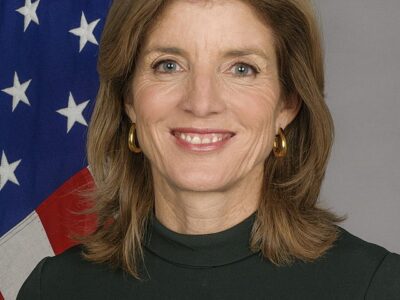
Caroline Kennedy was five days short of her sixth birthday when her father was assassinated. She was old enough to understand when Congress endowed a new performing arts center a couple of months later. If anyone suffers an actual concrete injury from seeing her father’s name submerged and diluted, it’s her. (Causation and redressability are obvious).
The “gist of the question of standing,” the Supreme Court noted decades ago, is whether the party seeking relief has “alleged such a personal stake in the outcome of the controversy as to assure that concrete adverseness which sharpens the presentation of issues upon which the court so largely depends for illumination of difficult constitutional questions.” That is hardly an issue here: does anyone doubt that Caroline Kennedy has a personal stake in the outcome of whether her father’s name gets shunted aside?
Nor does it necessarily matter that Caroline Kennedy’s would receive no tangible benefits by upholding the law and restoring the Center’s mandated name. Even Sam Alito, in Spokeo v Robins, conceded that the requirement of “concrete” injury is not “necessarily synonymous with ‘tangible.’” (Spokeo).
So far, so good. But we shouldn’t think that this is a slam dunk. The Spokeo court noted that:
In determining whether an intangible harm constitutes injury in fact, both history and the judgment of Congress play important roles. Because the doctrine of standing derives from the case-or-controversy requirement, and because that requirement in turn is grounded in historical practice, it is instructive to consider whether an alleged intangible harm has a close relationship to a harm that has traditionally been regarded as providing a basis for a lawsuit in English or American courts.
How does that cut in this case? It isn’t clear that Congress had any judgment about whether a family member could sue if a President unilaterally decided to excise someone’s name from a federal building, but it never occurred to anyone that a President would actually do it. History might cut against Caroline Kennedy’s action: family members cannot, for example, sue for defaming their dead relatives. You can’t defame the dead.
But once again, the problem is that this sort of case has never really happened before. The closest that I have been able to find are the lawsuits brought by descendants of Confederate veterans over the removal of Confederate statues – in particular, McMahon v Fenves, a case from the Fifth Circuit in which descendants of Confederate veterans objected to the City of San Antonio and the University of Texas removing Confederate statues. But this is where the merits and the jurisdictional questions get mixed: the Fifth Circuit made quick work of the plaintiffs’ arguments that removal of the statues violated their First Amendment rights:
Plaintiffs claim to have standing because moving these monuments injured their free-speech rights. But even if Plaintiffs allege a concrete free-speech interest—i.e., if moving these monuments even implicates the First Amendment—they fail to show that the violation of this interest is, in fact, an injury to their rights. This is because, though these ties might give Plaintiffs strong reasons to care about these monuments, Plaintiffs fail to explain how these ties give Plaintiffs a First Amendment-based stake in the outcome of this litigation. They claim that these monuments are their speech, but fail to plausibly allege how these ties make that so.
All very true, but this to my mind conflates the standing question – does the plaintiff have an injury-in-fact – with the merits – are there any First Amendment issues at stake here? Similarly, later in the opinion the Court states:
Plaintiffs…care deeply about preserving monuments that convey a viewpoint that they support and that, they believe, their ancestors donated for their benefit. And Plaintiffs believe that these ties give them unique reasons for caring about these monuments, which means that their allegedly unconstitutional removal caused Plaintiffs a particularized injury—it is particular to them because only they have these alleged ties. But that is not how particularity works. Plaintiffs confuse having particular reasons for caring about these monuments with having a particularized injury.
There is no citation in this paragraph, and there is a reason for that: the distinction between “having particular reasons for caring about these monuments with having a particularized injury” is a very slippery one, and while I am no expert on standing, it seems false.
Consider a standard way to achieve environmental standing: plaintiff is someone who enjoys a national park and wants to have it preserved. If the government allows some sort of activity in it, then the plaintiff will suffer injury. That has traditionally been good enough for standing. It doesn’t matter that conceivably there are thousands of other people who also enjoy the park and could sue but aren’t. The plaintiff in this case has a particularized injury even though tens of thousands of others have the same injury.
What the Fifth Circuit was really doing here was moving to the merits and casting it as a standing decision. Having the government not speak in the way you want it to is not a First Amendment violation no matter how much you scream about some Lost Cause (which was actually a Cause To Hold People In Bondage). This was so obvious that the Fifth Circuit just melded everything together.
In any event, if you are looking for a particularized injury, someone’s only daughter is about as particular as you can get. Literally no one else in the universe would have that injury.
Which leads me to the other problem. Even thought Caroline Kennedy might have an injury-in-fact, she might not have a cognizable legal claim: in other words, she isn’t the person being protected by the statute.
Consider this scenario familiar to environmental law nerds: Takings exactions under Nollan v California Coastal Commission. Nollan famously held that there must be an essential nexus between the harm of a development project and the exaction required. One might think that this could actually scotch a lot of mutually beneficial deals.
Suppose that someone wants to build a McMansion on a beach. The Coastal Commission wants an exaction to allow for people to see the beach from the road. But it won’t work: you can’t get good viewing with the McMansion.
Then someone says, “hey, look: this landowner has some undeveloped property in another part of the City. Why don’t they just dedicate that to us for a park and we’ll give him the permit/” And the landowner is fine with it. Deal done. Everyone is happy.
Everyone, that is, except for the guy next door, who is pissed that suddenly he has a McMansion casting shadows over him. And he sues, saying, “Hey! I’ve got an injury in fact, and this exaction has No Essential Nexus. The property dedication has no nexus to the McMansion. Gimme the injunction!”
I have no doubt that any Court would toss this out in a minute – not because he didn’t have standing but because he doesn’t have a cognizable legal claim. His interest is not the interest protected by the Takings Clause here. It’s protecting the property owner who is being exacted, not his next door neighbor. He would lose. But not because he wouldn’t have standing, but on the relationship of the law to his situation.
And that is what a Court might say to Caroline Kennedy: “yeah, it’s illegal, and yeah, you have an injury, but this statute isn’t for you.”
But the fact of the matter is that we don’t know. As mentioned above, in Biden v Nebraska the Court granted standing to Nebraska to sue President Biden even though it suffered no injury at all. The whole issue is a mug’s game.
Which brings us back to the Bill Clinton principle.
 Bill Clinton: Get Caught Trying
Clinton knows a thing or two about American politics. And one of his principles is that the American public doesn’t necessarily expect you to always succeed but it does expect you to get caught trying. In this case, anyone who cares about the Rule Of Law – which I very much hope includes Caroline Kennedy – needs to Get Caught Trying to re-establish the Rule Of Law. If the United States Supreme Court wants to hold that Caroline Kennedy doesn’t have an injury-in-fact or legal interest in making sure that a transparently illegal act that betrays her martyred father doesn’t hold, it can.
And the rest of us will see it. It will be one more reason for people to see that this Court isn’t a Court at all: it’s a group of MAGA political operatives ready to rule for its master in the Oval Office. The 30-second ad writes itself: “these bozos thought that Caroline Kennedy had no interest in the Kennedy Center!”
And that might be good enough.