The Scent of Spring vs the Stench of Black Rain
Legal Planet: Environmental Law and Policy 2026-03-12

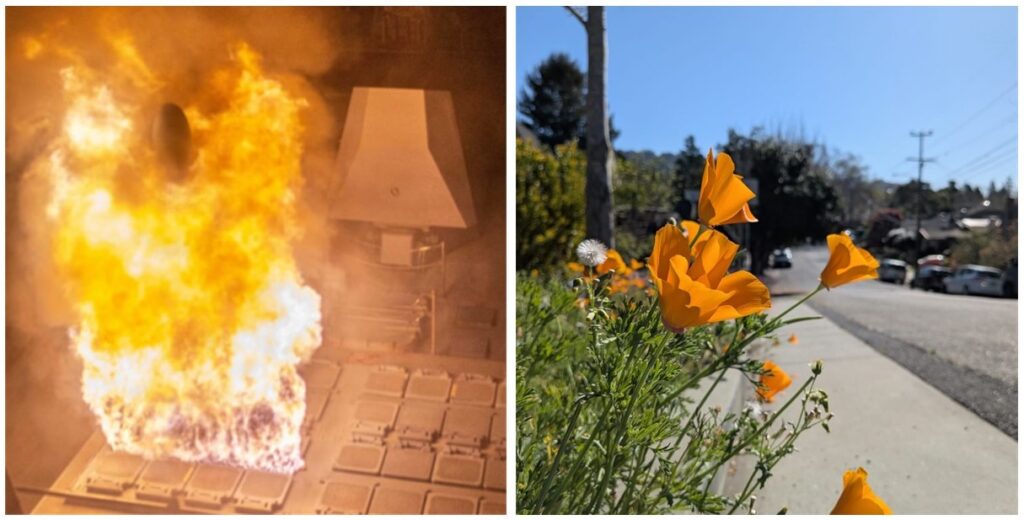 Tehran’s smokey skies vs Berkeley’s spring: The stark reality of who breathes clean air and who is forced to choke on the environmental fallout of war. Missiles in the eastern Mediterranean Sea, photo credit- US Navy (left), Shruti Sarode (right).
Here in the Bay Area, the air quality is pristine today. The sky is a clear, uninterrupted blue, and the sweet scent of blooming jasmine catches on the breeze. It’s a picture of absolute peace. Yet, the country I live in is currently orchestrating a devastating war on the other side of the world, a conflict whose impacts are falling on people who had no hand in starting it. These impacts are not just military and economic, but profoundly ecological.
Since the US and Israel launched major military strikes, contravening international public law and the rules of warfare, against Iran late last month, the escalation has been relentless. Recent airstrikes have targeted oil and energy infrastructure in and around Tehran. The immediate result? A dark, toxic haze hanging over the city. Emergency workers are battling massive refinery fires, and residents are sheltering indoors as thick, black, oil-saturated rain falls from the sky. Black Rain they call it.
When my dad called from India this morning to ask if I was safe, the sheer, uncomfortable privilege of my reality hit me, as I was sitting in the sunshine gazing at cherry blossoms. He asked: “Are you and other climate researchers at Berkeley thinking of writing a letter to the president about the environmental impacts of war? Maybe that will have an impact.”
I told him that the immediate human cost and the glaring environmental justice impacts of the war are so staggeringly high that, frankly, I don’t even have the mental bandwidth to think about the broader impacts on the planet. My mind is consumed by the people caught in the crossfire, the communities actively suffocating under toxic smog while the nations dropping the bombs breathe clean air.
But the fallout doesn’t stop at the blast radius. The toxic clouds from those refinery fires don’t respect borders; the Pakistan Meteorological Department (PMD) recently cautioned that pollution from the attacks on Iran’s oil sites is drifting east, threatening to severely worsen air quality in western Pakistan. My family member mentioned that they have run out of their cooking gas cylinders, and with the Strait of Hormuz effectively blockaded, replacements are simply nowhere to be found. Next door, Pakistan just hiked petrol prices by a massive 20% (gas prices are up by 21% in the US as well). The scarcity isn’t limited to energy, either. Experts are warning that the war could lead to severe regional food shortages, with residents across Lebanon, Gaza, and Iran already reporting disrupted supplies and soaring grocery prices as the conflict drags on.
Everyone’s daily lives in these countries are being affected by the war. The media often brushes these off as mere “economic ripple effects,” but we must call them what they actually are: an environmental justice crisis. At its core, environmental justice demands that marginalized and vulnerable communities not be disproportionately burdened by toxic pollution and ecological destruction. Yet, this conflict is doing exactly that, devastating the health and ecosystems of Iranian civilians—many of whom already live in poverty—while simultaneously forcing inescapable, life-threatening air pollution onto neighboring countries. Developing nations, already staggering under the weight of global climate change, are now being forced to absorb the collateral damage of a war they did not choose.
It’s a deeply unsettling contrast to live in the US, smelling spring flowers while your tax dollars fund black toxic rain halfway across the globe. For true environmental justice, we must hold our governments accountable for the devastation they export to the middle east and global south.