The Promise of Non-Pipeline Alternatives to Gas Lines
Legal Planet: Environmental Law and Policy 2026-04-07

This post was co-written by Guest Contributor Maeve Anderson (J.D. Candidate 2026, UCLA School of Law).
California’s transition away from natural gas is accelerating, with new policy tools emerging to speed the shift and ease the financial burden on ratepayers. In February 2026, California Assemblymember Marc Berman introduced the Home Energy Choice Act (AB 2313), a bill that would require utilities to offer customers a financial incentive to electrify their homes rather than replace aging gas service lines. In exchange, participating customers would forgo gas service, avoiding costly pipeline replacements and reducing overall costs for ratepayers. This bill comes as utilities plan to invest a combined $43 billion in gas distribution infrastructure over the next twenty years. Without intervention, these investments risk becoming stranded costs burdening a generation of future ratepayers. AB 2313 represents a step toward mitigating that risk.
To accompany the legislation, our new brief evaluates that proposal within the broader context of available tools for the clean energy transition, including non-pipeline alternatives (NPAs) to service line replacements. Such NPAs are designed to avoid or defer investments in gas infrastructure, and offer a uniquely cost-effective and scalable pathway for incremental electrification. Because the incentive offered to customers would be set below the average cost of replacing a gas service line, each participating household generates net savings for the broader ratepayer base.
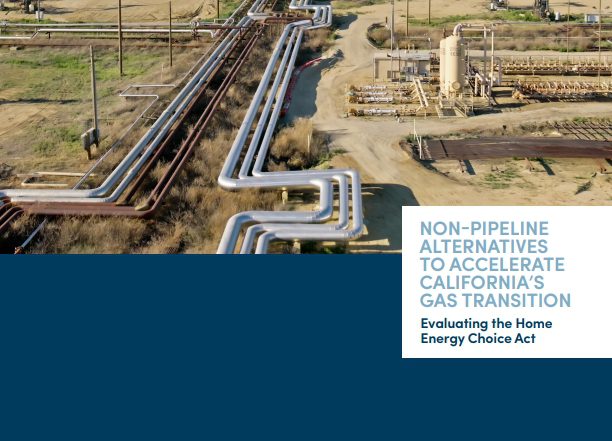
Drawing on lessons from a similar program in New York, the brief highlights how this form of NPA is viable and cost-effective, even at small scales. To ensure the successful implementation of AB 2313, this brief recommends that the legislature:
- Clarify that utilities would be relieved of their obligation to serve participants in the NPA program.
- Encourage utilities to streamline their various electrification incentive programs, including by harmonizing eligibility requirements, and offer an integrated application for all utility-run incentive programs.
- Define how communication and implementation costs related to the NPA program would factor into cost-effectiveness calculations of the program
- Consider adding an incentive payment mechanism to align incentives faced by utilities with the public interest in decarbonization and energy affordability.
Ultimately, this brief finds that an all-of-the-above approach to electrification—including zonal decarbonization under SB 1221, non-pipeline alternatives, and proactive planning to ensure all-electric new construction—is necessary for the state to achieve its transition away from gas. NPAs can play a vital role in reducing costs, empowering customers, and accelerating the state’s path to electrification.
Download the full brief here.