Does More Energy Reporting = Less Climate Reporting?
Legal Planet: Environmental Law and Policy 2026-06-10


If you are one of the many loyal readers of E&E News, big change is coming to your daily routine. POLITICO announced it is shuttering E&E, the standalone, subscription-based reporting outfit that it bought in 2020. “Beginning in September, we are modernizing how we deliver our energy and environmental policy journalism and launching a more focused, high-impact portfolio of daily news and intelligence products,” POLITICO’s CEO Goli Sheikholeslami and Global Editor-in-Chief Jonathan Greenberger said in a statement this week.
For years, Politico left E&E alone and kept it chugging away at the savvy, insidery, policy reporting it was known for under the banners of “Greenwire,” “Climatewire,” “Energywire,” etc. This reporting was indispensable during the Biden-era Inflation Reduction Act as a way to follow the money and then for different reasons during the DOGE-era dismantling of the IRA as a way to follow the mayhem. It grew from about a dozen journalists in 2005 to 70 or so by 2020. Buyouts were offered several months ago, but there was no talk of actually shutting the six daily E&E publications, according to PEN Guild union leaders. Now the plan is to cease their publication and instead package that reporting into POLITICO’s branded newsletters. The change does not involve any additional staff layoffs, Max Tani reported at Semaphor.
This move is the result of a realignment that started back in February when leadership announced it was unifying the POLITICO Energy and E&E News reporting teams into a single, global unit under editorial director Debra Kahn. Kahn has helped develop POLITICO’s California Climate newsletter into a must-read daily dispatch. In the Golden State, POLITICO has expanded across several beats, recruiting top talent from the always-shrinking Los Angeles Times with a reporting emphasis on the intersection of politics and business. This includes Liam Dillon, Melanie Mason, and Daniel Miller.
If you get your daily dose of climate news from their California Climate newsletter, change is coming there too. It’s been rebranded as “California Currents” as of yesterday. “We’ll have a name which better reflects the conversations around energy, climate, the environment and transportation shaping California today,” the Monday newsletter read. “You’ll continue to get the same original reporting and insight, now under a banner that better captures the full scope of our coverage.”
So, will all this translate to less climate reporting? It could mean more climate politics and less climate policy. It will undoubtedly mean less daily coverage of committee hearings and policy briefs — at a time when Washington is not making policy that way. Instead, readers can expect more muscular coverage of energy politics, market disruptions, and global newsmaker events. One way to think about it is that the frame has shifted from “how climate change is affecting the world of politics” to “how politics is affecting the world of energy.” The refocus will be on display today when POLITICO convenes an Energy Summit in Washington featuring EPA Administrator Lee Zeldin, Sen. Shelley Moore Capito of West Virginia and other Republican energy personalities who would not be caught dead attending any conference with “climate” in the title.
It’s likely not a coincidence that the New York Times is making a similar change at the exact same time. Lisa Friedman, a NYT climate reporter focused on energy (and former E&E editor), announced this week she’s moving to the Business Desk covering global energy. “My beat will focus on Europe and the Persian Gulf (so I’ll be all-Strait-of-Hormuz-all-the-time for the foreseeable future),” she wrote on LinkedIn. “I’ll write about everything from oil and gas companies to OPEC to the Trump administration’s pressure on Europe to scale back its clean energy ambitions.”
Not everyone is a fan of the change in strategy. Folding E&E is confirmation that Politico newsroom leaders “aren’t committed to the specialized reporting that E&E’s readership wants” longtime EV correspondent and ex-E&E reporter David Ferris writes at LinkedIn. “So, farewell to a great publication that didn’t have to die. It was killed.”
Welcome to The Drain, a weekly roundup of environmental and climate news from Legal Planet. “Our song of the week is “I Feel a Change Coming,” by Sonic Boom. My Climate Playlist is on Spotify and Apple Music
California Governor’s Race
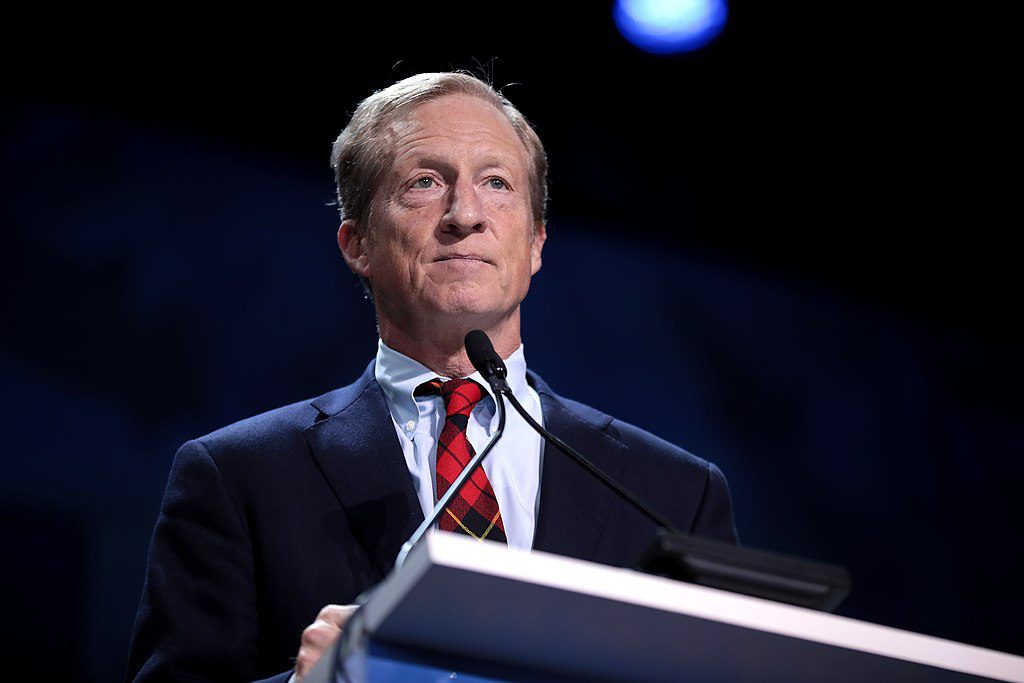 Tom Steyer. Photo: Gage Skidmore (CC BY-SA 2.0)
The gubernatorial election in November will also see less climate policy than it might have. Republican Steve Hilton, a former Fox News commentator, has edged out billionaire climate activist Tom Steyer to secure the second spot in the primary contest as of yesterday afternoon, meaning he will challenge Democrat Xavier Becerra.
Democrats from Steyer to Katie Porter to Governor Gavin Newsom all congratulated and endorsed Becerra. Steyer also said he was “proud of the enemies we made” during his campaign, including Chevron, PG&E and Meta, which spent lots of money to influence the race.
When Steyer announced last November, I wrote here that “his entrance will get a lot of media coverage that focuses on how his personal wealth will reshape the race, but it’s just as notable for how Steyer will occupy a climate lane in the race and inject a different type of debate about energy affordability.” For several months, pundits and political reporters were convinced Steyer would downplay his climate activism. That’s not what happened.
The fact that a progressive running toward—not away from—the climate crisis won nearly 2 million votes for governor is worthy of applause. Too bad a Trump-endorsed Republican got 2.1 million. The general election could have been a real and vigorous debate about what can make life healthier and more affordable.
Climate Politics & Communications
Speaking of folks who keep arguing, based largely on vibes, that Democrats should stop talking about climate change to win elections, new polling suggests otherwise in this crucial midterm election year.
Most voters – 67% of registered voters – think global warming is affecting the cost of living in the United States and 64% think it is affecting their own cost of living, according to new polling from Yale Program for Climate Change Communications. And 58% of registered voters say they prefer to vote for a candidate who supports action on global warming, while 14% prefer to vote for a candidate who opposes action.
A nationwide survey from Data for Progress and the Center for Climate Integrity found that 65% of likely voters oppose federal legislation to shield oil and gas corporations from climate laws and lawsuits — that’s 73% of Democrats, 71% of Independents, and 53% of Republicans, so not so popular.
The League of Conservation Voters Victory Fund put out a new memo, shared with Axios, describing an “energy bill voter” strategy to mobilize specific pockets of voters in House, Senate and governor’s races.
‘Pratt Summer’ is over before it even began! In the Los Angeles mayor’s race, Councilmember Nithya Raman will face Mayor Karen Bass after overtaking Spencer Pratt. If you need a reminder, Pratt’s political rise was built on an AI-fueled misinformation campaign to kill a state bill that would have helped Altadena and the Palisades rebuild better from wildfire.
The journal Nature says in a new article that the future of science communication is not journal articles, but instead short-form videos on social media. That’s why Nature is now on TikTok. Of course, the future of science communication is more than one thing and TikTok is not a silver bullet.
Would total strangers work together to address climate change? Sounds like a weird reality show but it’s the gist of a research project in the journal Science that used large-scale, globally representative data to answer questions in experiments that randomly paired two strangers within the same country. “The participants earned money for a climate change charity and could either cooperate or defect; the highest charity payout was offered when both mutually cooperated,” the abstract reads. “Globally, over two-thirds of people were cooperative but pessimistically underestimated strangers’ willingness to cooperate.”
Sammy Roth has a dispatch from the Hollywood Climate Summit, where comedians Esteban Gast and Joanna Hausmann put Big Meat and Big Dairy on trial and marine biologist Ayana Elizabeth Johnson pitched a romcom starring a hot shirtless rooftop solar installer. He covered the summit and its significance for his Climate-Colored Goggles newsletter.
Lawmakers in New York passed the NY FAIR News Act which “mandates that news organizations operating in the state provide clear disclaimers on content substantially or wholly generated by artificial intelligence. It now heads to Gov. Kathy Hochul’s desk for signature.
And for years, STAND-LA has been fighting in the streets, in City Hall, and in LA neighborhoods to protect people from aging oil wells. Now the coalition has a STAND-LA Substack newsletter.
Extreme Weather
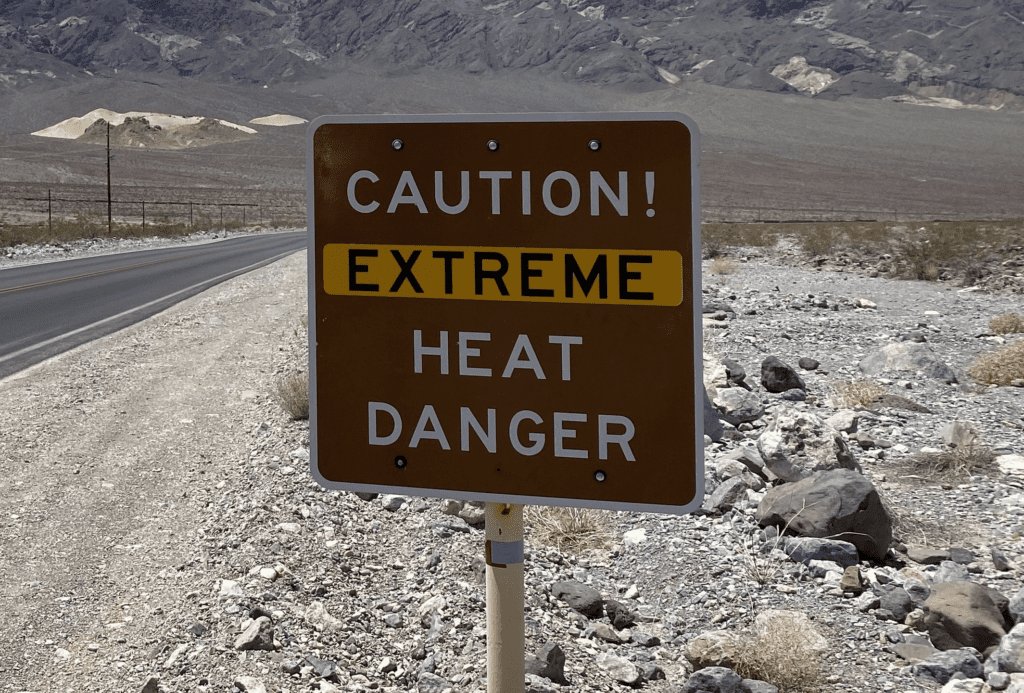
Forecasters have warned for weeks that a powerful El Niño weather pattern could form later this year, with a chance of becoming one of the strongest in three decades.
Trump canceled lots of grants and adaptation programs that address extreme heat. Now, as we gear up for summer heat that usually kills more people than all other disasters, heat officials say they’re “learning how to work within a system that rejects their agendas,” Chelsea Harvey reported for E&E. Harvey also shared on social media while finishing the article they got word that a friend vacationing in Arizona had died after overheating on a hike.
Get ready for a smoky summer. By all accounts, it’s already been an historic year for wildfires and a bad year for snow melt. “Even if your community doesn’t burn, you might still be in for hazy air,” writes Jeva Lange at Heatmap News.
Good news for transparency in LA: Emergency room visits during heat waves will now be made available to the public in ‘near-real time’ in L.A. County, Blanca Begert reports at the Los Angeles Times.
Bad news: A new study finds that the coming 15 years could see a doubling in hospitalizations throughout the U.S. due to heat-related illnesses. The study looked at 53 of the US’s largest metropolitan areas and projected heat-related illnesses from now until 2040 under a range of different scenarios for levels of planet-heating emissions, Oliver Millman reports for the Guardian.
The Courts

The decade-long clash between Energy Transfer and Greenpeace entered a new phase in late May when “a state court in North Dakota barred Greenpeace International, which is based in Europe, from making certain claims against Energy Transfer in a Dutch court,” Karen Zraick reports for the New York Times. “That’s wild,” one litigation expert said.
Last year, a U.S. jury handed Energy Transfer a victory against Greenpeace for supposedly defaming the oil company during Dakota Access Pipeline protest campaigns.
Federal leases to drill for oil in the Arctic National Wildlife Refuge already face uncertainty thanks to long-simmering litigation originally brought by 13 environmental groups in 2020 contesting the first Trump administration’s lease sale within the refuge. The groups filed an amended and supplemental complaint in the US District Court for the District of Alaska.
The U.S. Supreme Court issued a short order directing a lower court to rethink a ruling that upheld Biden-era efficiency regulations for commercial water heaters and consumer furnaces. The decision is a win for the American Gas Association and other industry groups, Niina Farrah writes at E&E News.
A federal judge in Denver has blocked Trump from breaking up Boulder’s National Center for Atmospheric Research by handing over a renowned supercomputing center to the University of Wyoming, in the form of a “38-page injunction raking the Trump administration for enacting political revenge on Colorado,” Michael Booth reports for the Colorado Sun.
My UCLA Law colleague Alex Camacho wrote a persuasive essay for The Conversation about the Supreme Court taking up the Suncor case and whether state courts should weigh climate-related damages. “This effort misreads the U.S. Constitution, misunderstands judicial precedent and misrepresents the role of courts in a federal system.”
And surprising no one, Trump has officially nominated his toady Todd Blanche to be Attorney General. Trump’s former personal lawyer has continued to do his bidding as deputy AG.
Methane
The EDF is challenging the recent EPA rule loosening methane emissions standards for the oil and gas industry in the D.C. Circuit.
A recent piece of sponsored content promoted in POLITICO’s pages by ExxonMobil misrepresents the impact of methane rules on the EU’s energy system. “The claim that Europe could lose 43 percent of its gas supply is based on flawed premises,” Esther Bollendorff, Fossil Free Program Manager at Climate Action Network (CAN) Europe, writes in response.
A team at Oxford University’s Climate Policy Monitor recently identified more than 100 methane policies across 32 jurisdictions (good) but fewer than one-third of these policies are mandatory (bad). And four major countries – India, Indonesia, Thailand and Tanzania – had no identifiable methane policies at all. “This is concerning as India and Indonesia together account for more than 12% of global methane emissions.” Helena Wright at Oxford writes at The Conversation.
The Darvaza crater, also known as the “Gates to Hell,” is the pit of constantly burning fire fed by methane gas in an isolated desert inside the Central Asian nation of Turkmenistan. Now the gates of hell are burning out, Jenny Gross reports for the New York Times.
Old Dirty Coal
New money for old energy! Last week, Trump’s Department of Energy said it would spend up to $425 million to expand the capacity of at least 13 coal plants; give $75 million to build a new coal export facility at the West Gateway Terminal Project in Oakland; and unveiled another $350 million to support construction of new coal plants in Alaska and W. Virginia.
“Starting this summer, the West Gateway project will break ground, and by summer 2028, over 12 million tons of clean beautiful coal per year will be shipped to countries all around the world,” Trump said about the West Oakland coal terminal.
In response, California lawmakers are pushing back on that planned subsidy for the long-delayed coal export terminal in Oakland, saying it would harm air and water quality and increase electricity costs. Environmental advocates in Oakland have been strategizing new ways to block the construction of a terminal.
In Florida, coal is being kept alive under Trump orders. The coal-fired Stanton Energy Center in Orlando had been scheduled for retirement in 2025. Florida joins Colorado, Indiana, Michigan and Washington, according to Amy Green at Inside Climate News.
Other Energy
The U.S. added 7.8 gigawatts of new solar capacity in the first quarter of 2026, surpassing 6 million cumulative installations as solar remained the leading source of new power added to the grid, SEIA announced. It finds solar energy overtaking coal for the first time in the U.S. electricity mix.
Tennessee is the first state in the nation with its own regulatory framework for nuclear fusion plants. On Tuesday, Tennessee updated its rules and regulations, establishing licensing for fusion machines.
The average electricity bill in Hawaii shot up to $248 in May, compared to an already-high $203 in April, according to the latest data in Heatmap and MIT’s Electricity Price Hub, released Monday
New milestone for clean energy: On June 1, a project in Kern County became the first major battery installation in the U.S. that can discharge power for up to eight hours at a time, which Julian Spector reports is twice as long as typical energy-storage facilities.
Connecticut’s governor signed HB 5340, an energy policy bill that extends the state’s long-running Renewable Energy Solutions programs through 2035, launches a successor community solar program, requires automated residential solar permitting and establishes new rules to allow for residential use of portable, plug-in solar panels, PV Magazine reports.
The UN’s academic arm the United Nations University put out a report finds that on “current trajectories,” data center power demand could be “nearly triple” the combined annual electricity use of Pakistan, Bangladesh, and Nigeria by 2030.
Under an agreement unveiled this week, Google is buying sustainable aviation fuel “certificates” from American that help offset the higher purchase cost compared to conventional jet fuel — 35 million gallons of sustainable aviation fuel over three years.
That follows news that airline leaders are now admitting that the aviation industry’s landmark pledges to be net zero by 2050 will probably not be achieved.
This current era of oil market disruption has launched what the New York Times is calling “the era of me-first energy,” because players from South America to Southeast Asia “are being forced to look inward and take steps to harness what they can domestically.”