California’s Density Bonus Works! And That’s Actually The Problem
Legal Planet: Environmental Law and Policy 2026-06-19
Two contradictory things have been true of the YIMBY revolution in California land use law:
1) The California Legislature has been perhaps the most aggressive of any state in pre-empting local discretion to block housing, and giving new incentives to build; and
2) It doesn’t seem to have done much good so far.
The classic example here is SB 9, which allowed property owners in single-family neighborhoods either to put a duplex on their lot by-right or split the lot into two parcels. Hysterical NIMBYs screamed that this would lead to “Manhattanization” – since as we all know, Manhattan is the City of Duplexes – and YIMBYs countered that this was absolutely necessary and could create hundreds of thousands of new units.
And then…basically nothing happened. Very few SB 9 units have been created, and while a chunk of that stems from local resistance, a bigger chunk stems from the insistence upon owner-occupancy, which means that flippers are basically blocked from the market. In any event, it has certainly not had the impact that supporters and opponents have wanted.
Pretty much the law that has really changed the landscape (literally!) has been the legalization of ADUs – nearly 100,000 have come online since the Legislature mandated ADUs by-right statewide in 2016.
But now the ADU law appears to have a companion: the Density Bonus.
The Density Bonus idea is straightforward: if a developer includes a certain number or percentage of deed-restricted affordable units in its project, then it gets to build more market-rate units than the zoning would otherwise allow. The idea, says Circulate, is that it would be a “win-win” – developers get more revenue-generating units, and more deed-restricted affordable homes are built.
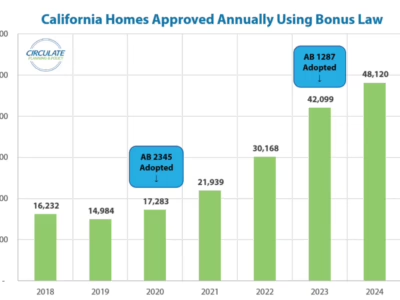
California has had a density bonus law literally for decades, but it was underused. In 2005, the Legislature mandated it statewide, but it produced few units. So in 2020, and again in 2023, the Legislature made it more generous.
And now, a new study from Circulate Planning and Policy shows that these fixes appear to have worked. According to the study, after the reforms, the Density Bonus Law has been used to approve
- More than 140,000 homes overall
- More than 69,000 deed restricted affordable homes;
- In 2024, 47% of all homes approved in multifamily projects; and
- In 2024, 78% of all homes in 100% affordable projects.
(The Circulate Report says that it has produced more new units than all other state reforms combined that are “tracked by the state,” which is a weasel phrase: the ADU law(s) have generated more, but the numbers are not tracked by the state.).
But still, that seems to be quite a record. And at one level, it is really quite simple: the increases in housing production derived from basically juicing the bonus: it used to be only 20% (up to 35% for deeper affordability), but the 2020 law raised it to 50%, and then in 2023 added a second stackable 50% bonus if there were even more affordable units. This isn’t rocket science.
This often happens with development. Developers will insist that they must have a certain density in order to make projects pencil out, and cities (and neighborhood groups) say that that is too much, and they go back and forth. Here, the extra density that the old law had just wasn’t enough, and practice showed it. Sometimes that is true and sometimes it isn’t.
So – if the data checks out (and kudos to Circulate for making it public and transparent), then we’ve got a real win here. Fabulous! Wonderful!
But uh oh.
Let’s assume that each year, because of this Density Bonus, the state is producing 50,000 more units than it otherwise would, with half of them being deed-restricted. That would be more than even Circulate projects the law could do, but okay.
That’s really a drop in the bucket. Consider that in the City of Los Angeles, according to the state Department of Housing and Community Development (and the city’s Housing Element), the city needs more than half a million new units with nearly half of them being deed-restricted by 2029. So the increase here doesn’t even cover Los Angeles. What about the other 90% of the state?
That’s no knock on the Density Bonus. One reform can’t solve everything, and that’s the whole point. We have a half-century of negligence to make up for. And that’s where it will get harder.
The Circulate report notes approvingly that the Density Bonus law does not affect single-family neighborhoods, and that is one reason for the relative ease with which it was passed and implemented. But low-hanging fruit will only take you so far. In Los Angeles, roughly 75% of the residential land area is officially zoned exclusively for single family use. It is similar or even greater in most California municipalities. Meeting the state’s housing goals requires opening them up for the Missing Middle. And that means making laws like SB 9 work. Duplexes and triplexes are not going to destroy neighborhoods, and we should not pretend that we can avoid this fight.
Put another way, the cliché is true: there is no magic bullet. The Circulation Report is very good news, but we should be wary of thinking we can solve this the easy way.