"Mexican Pink"
Language Log 2025-09-11
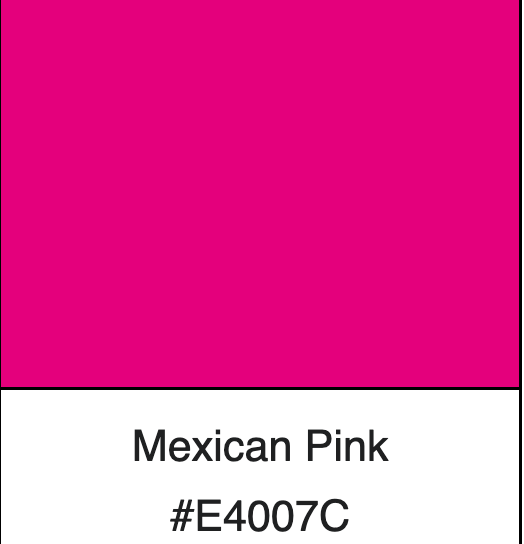 There's a restaurant in the western suburbs of Philadelphia called "Rosa Mexicano", one of one of a chain by that name. Since the first time I saw it, I've known enough Spanish to wonder why Mexicano is a masculine adjective, given that the noun rosa "rose" is feminine. But thanks to a Spanish friend, I've recently learned that the noun rosa has another sense, referring to the color "pink" — and in that sense the noun is masculine.
Furthermore, the phrase rosa mexicano has a particular meaning and pattern of historical usage — as Wikipedia explains
Mexican pink (Spanish: rosa mexicano) is a purplish pink tone of the color rose, vivid and saturated, similar to the colors called fuchsia or magenta. It has been compared with the color of the bracts of ornamental climbing plant called bougainvillea, that is, Trinity and Santa Rita bougainvillea. Its origin is that this color is used in traditional clothing such as serapes and is used in the craft art and fine art of traditional Mexican culture.
Mexican pink became known as such through the efforts of the journalist, painter, cartoonist and fashion designer Ramón Valdiosera. In the mid-1940s, Valdiosera made a long research trip across Mexico where he made contact with different ethnic groups and collected suits and dresses typical of different regions. Interested in traditional Mexican clothing being adapted to contemporary fashion, on his return to Mexico City he set up a sewing workshop and there devoted himself to move the fabrics, colors and traditional styles to sophisticated forms of fashion at that time.
The color frequently appears in the work of Luis Barragan, one of Mexico's best-known architects. It was also used in the 2023 movie Barbie.
Maybe the Barbie link is widely known, but it was news to me: "‘Barbie’ Honors This Pink Used in Mexico for Centuries — Here Are All the Details".