Intentional for good
Language Log 2025-10-05
Marie Solis, "When Did Everything Become So ‘Intentional’?", NYT 9/29/2025:
Dating, walking, working out, watching a movie at home, watching a movie in the theater, thrift shopping, grocery shopping, meal prepping, playing trivia, making coffee, drinking coffee, consuming alcohol, making friends, making plans with friends, playing the guitar, journaling, arguing, reading, thinking, scrolling, breathing.
You can just do all of these things. Or you can do them “intentionally,” as a growing chorus of lifestyle gurus, influencers and perhaps slightly overtherapized people you may know personally are preaching lately. […]
A close linguistic relative to mindfulness, living intentionally suggests being present and self-aware. Your words and actions are in near-perfect alignment. Possibly, you’ve meditated recently. True to its literal definition, being “intentional” also implies a series of deliberate choices.
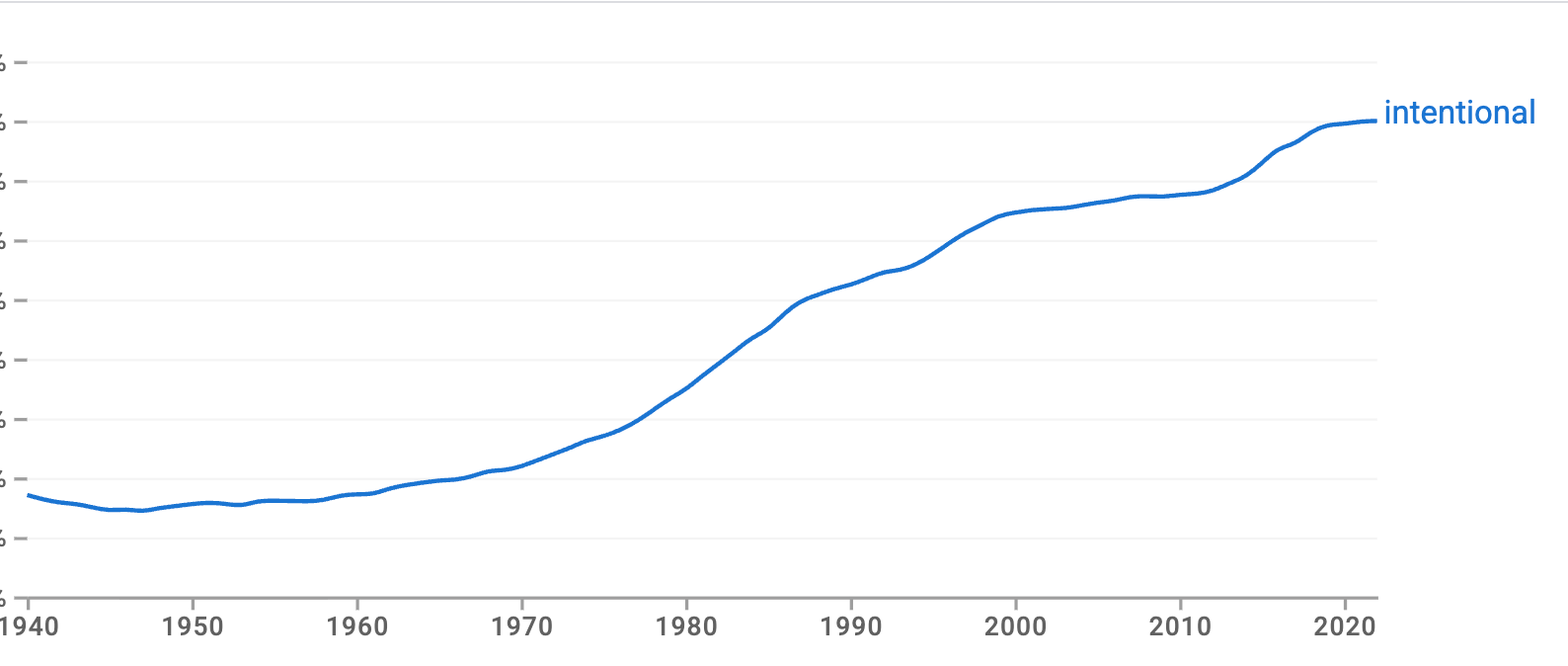
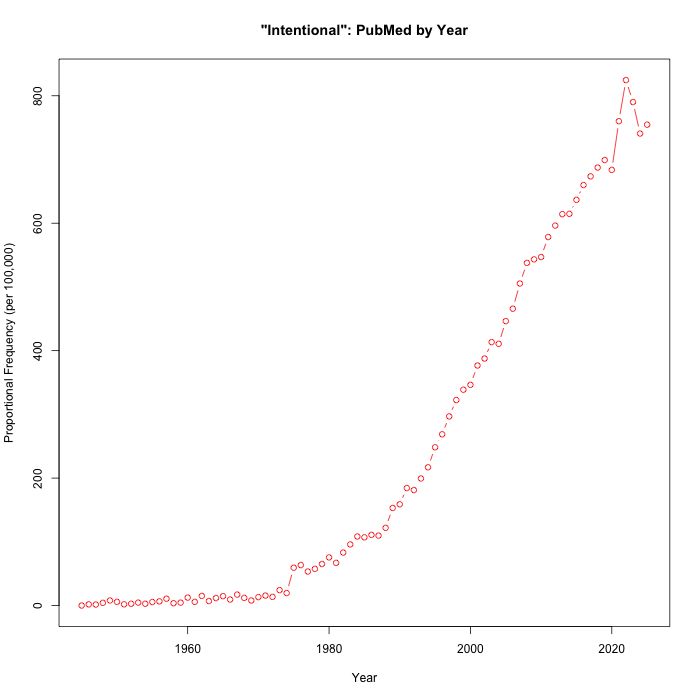
Independent of changes in meaning, the word intentional has certainly gotten more common. We can see this quantitatively in Google Ngrams
…and in esperr's PubMed tallies:
I've also noticed intentional used in contexts where I didn't expect it. For example, this article describes a situation in which Eagles QB Jalen Hurts responded to a series of questions about his relations with head coach Nick Siriani, and ended by saying "I think he's been great in the messages he's delivering to the team. Trying to be very intentional in what he's saying." The sportswriter characterizes this negatively ("Seems to me Hurts dialed up quite a bit of word soup to avoid paying a compliment to Sirianni."), but Hurts' evaluation of Siriani's communication intentions was at least technically positive. In any case, it wasn't a lexical choice that I expected to see in an NFL press conference.
And the use of intentional in this positively-evaluated way is new, at least statistically.
The Corpus of Historical American English has 67 instances of intentional from the decade starting in 1880, and 66 of them involve negative intentions, e.g.
Doubtless, this neglect has been intentional.
Glanvill mentions melees, blows, and wounds, — all forms of intentional violence.
There is more, however, in this history than freedom from intentional perversion of the truth.
She looks very quiet now," remarked Violet, "and if she did the mischief it was certainly not intentional.
After giving the matter some thought, but not until he was thoroughly convinced that an intentional slight was put upon Princeton College, Dr. McCosh wrote to the Secretary of the committee which had had charge of the arrangements and from whom he had received his invitation.
In experiments with magnetism and hypnotic suggestion, many delusions beset the experimenters, and there is more or less intentional foolery on the part of the subjects.
The single case where intentional is used in reference to a positively-evaluated intention occurs in an article from the Century in May 1889, entitled "Recollections of Jean Francois Millet":
Soon after Millet himself entered, and examined with interest the engraved portion of the work. The drawing was made with the sharp point of a crayon, directly upon the block; every touch seemed intentional and full of expression. It represented a middle-aged man resting both hands and partly leaning upon the handle of his spade, his bare foot resting upon his sabot. I said to Millet that I admired the drawing exceedingly, and thought it as a picture complete.
When we turn to the entries in that collection from the decade starting in 2010, the cited intentions are positively evaluated in a large fraction of cases:
I needed a community that was intentional and more personal than the churches I hopped to each Sunday.
Let England Shake, the latest from British rocker PJ Harvey, is an ethereal eulogy for her homeland: songs about militarism, death, and ambivalent patriotism delivered with uncharacteristic lightness. "That was very intentional," she says.
Letter writing does slow the communication process; it's true. It's intimate and intentional. In a world of 140-character tweets and abbvted txts, a letter says someone has taken the time to step away from an impersonal device and give you his full attention.
Most art historians and theorists would define art as a way to creatively engage people's thoughts and emotions, and food absolutely fits within that realm, "because you're expressing yourself through an intentional combination of flavors and textures," he says.
Be intentional, through goal setting, budgeting and smart spending, and you will get the most out of your resources, time and money. After all, your future's up to you now.
But their approach to child rearing is, in fact, uncommonly intentional. "We want to help our children figure out who they are," Kenneth says, "and then do everything we can to help them nurture that."
Let's enter into Collins' first reaction of awe by being intentional about how we live.
A second change is that the adjective intentional is now sometimes applied to people or groups rather than to actions. This is not very common, but it's striking when it occurs — as it does in a few of the examples above, as well as in Hurts' "Trying to be very intentional in what he's saying".
It's interesting that the definitions as given in dictionaries (e.g. Wiktionary and Merriam-Webster) are consistent with both the old and new patterns of use. The moral evaluation of attitudes and actions, and the distinction between actors and actions, seem to have shifted while lurking beneath the lexicographic surface.