Canting Crew words
Language Log 2025-11-25
As promised, here are a few fun words that I learned by skimming a 17th century slang dictionary.
Rantipole, a rude wild Boy or Girl.
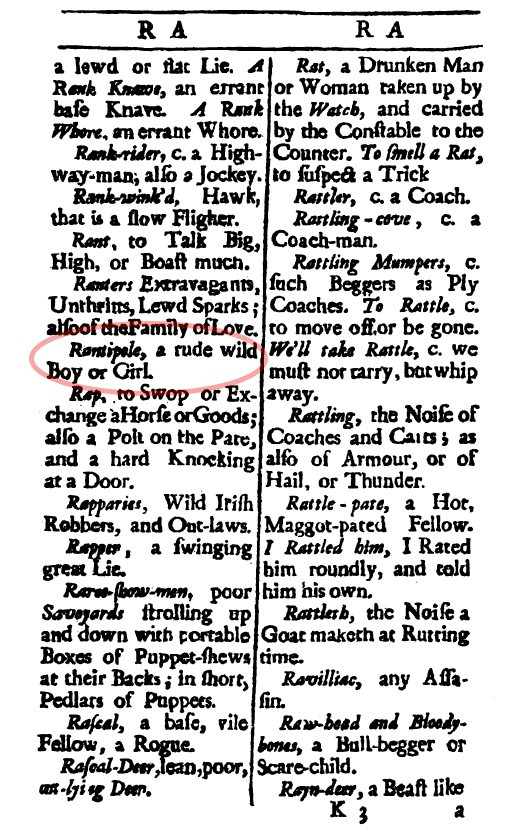
The OED gives a less age-limited gloss for rantipole: "A wild, ill-behaved, boisterous, or disorderly man or woman; a roisterer, a rogue; a rake; a minx."
The earliest citation, from 1679, is "My Lord Whimsey lost five Hundred, Sir Thomas Rantipol lost six Hundred, Sir Nicholas Whachum won two Hundred" — but the most interesting one is from W.S. Gilbert's 1892 libretto for The Mountebanks, which includes this passage, featuring some linguistic terminology as well as the symptoms of an alchemist's potion:
Exeunt all the Monks except ARROSTINO, GIORGIO, and LUIGI.
ALFREDO (to ARROSTINO). May I ask if you are the Prior of this monastery? ARROSTINO. Well, I am and I am not. That is, I am now, but I wasn't an hour ago. ALFREDO. I see – a recent appointment. ARROSTINO. Yes, for an hour. Present tense, I am a Prior. Imperfect tense, I was a rollicking young rantipole. Future tense, I shall be a rollicking young rantipole – in an hour. I hope I make myself clear? ALFREDO. Perfectly. (Aside.) Very like my own case. (Aloud.) I found this poor old lady almost insensible at the foot of the mountain. She had just strength enough to beg me to bring her here to you. ARROSTINO. Exactly. You call her an old lady. Well, she is an old lady, and she isn't an old lady. Present tense, she is an old lady. Imperfect tense, she was a young lady. ALFREDO. Of course she was. ARROSTINO. Ah! but, Future tense, she will be a young lady again – in an hour. That's the curious part of it. (To MINESTRA.) Go in, my dear – is should say my aged sister – and we will take every care of you.
LUIGI carries MINESTRA into monastery.
ALFREDO. You are very good. ARROSTINO. Well, I am, and I am not. Present tense, I am very good. Imperfect tense, I was confoundedly bad. Future tense, I shall be confoundedly bad again – in an hour. ALFREDO. We are fortunate in having dropped in upon you during your virtuous phase.
LUIGI re-enters.
ARROSTINO. Particularly so. It's altogether a curious state of things. I'm such a creature of habit that I find it difficult to remember that I am no longer a rantipole. For instance, I see you have a watch. Perhaps it is a valuable watch. Don't tell me it is; I would rather not know. Now, you can't imagine how difficult I find it not to take that watch. Oh, I know it's wrong; but then I always knew that. (Adopting a clerical manner.) By the way, I am collecting a few gold watches to send out to the poor naked savages of — (Aside.) No, hang it all, let the man alone; you ought to be ashamed of yourself! (Aloud.) Pardon me, your handkerchief's hanging out. Will you oblige me by putting it out of sight? (ALFREDO does so.) Thank you, thank you so much! Temptation, you know, temptation! We are all weak, and it is sometimes difficult to resist.
Ramp, a Tomrig, or rude Girl. To Ramp, to Play rude Horse-Play.
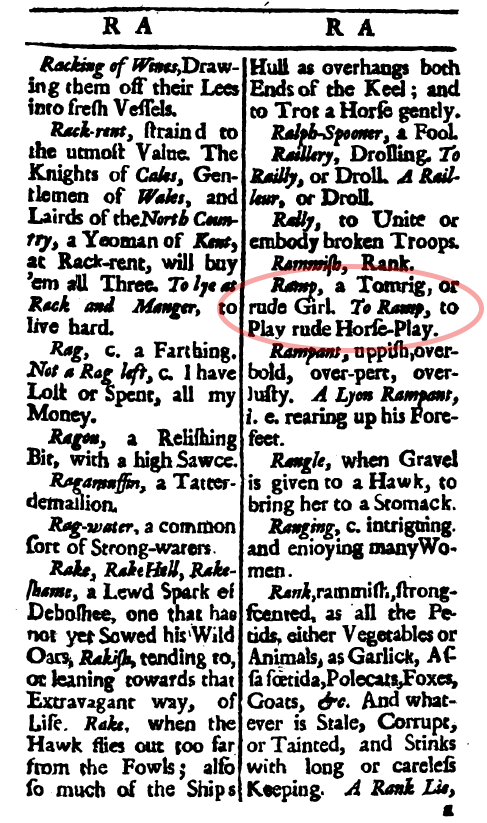
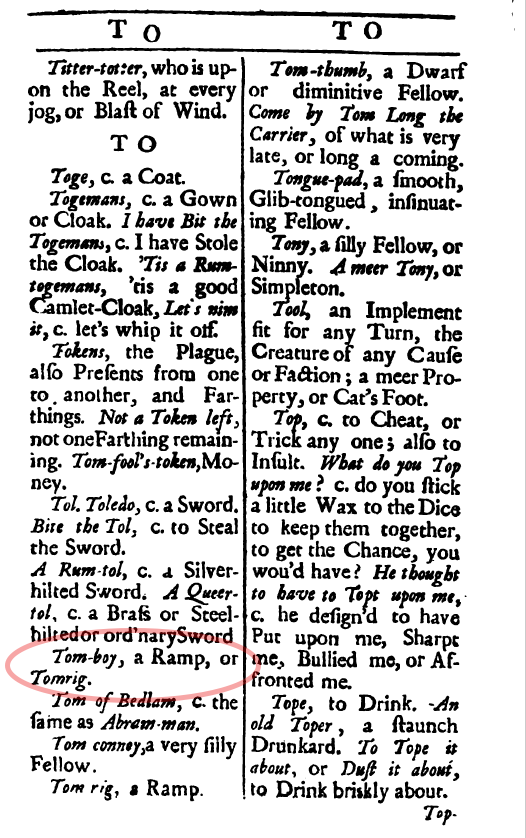
The OED's gloss for ramp is "A bold, wanton, or lively woman; a tomboy", with citations like these:
1548 [She] was a rampe of suche boldnesse, that she would course horses and ride theim to water.
1622 Of such short-haired Gentlewomen I find not one example either in Scripture or elsewhere. And what shall I say of such poled rigs, ramps and Tomboyes?
1669 That long-legg'd Ramp, that daggle-tail'd she-Ranger.
1728 The Author..represents her likewise a fine, modest, well-bred Lady:..And yet in the very next Canto she appears an arrant Ramp and a Tomrigg.