Talking horse
Language Log 2025-12-30
No, this is not about Mister Ed. The OED glosses to talk horse as "to talk the language of ‘the turf’; to talk big or boastfully", with quote from T.C. Halliburton's 1855 collection Nature & Human Nature:
Doctor, I am a borin’ of you, but the fact is, when I get a goin’ ‘talkin’ hoss,’ I never know where to stop.
But Sam Slick, the speaker of that fictional quote, is actually talking about a horse-riding incident, which would fit perfectly well in the current equestrian podcast Talk Horse. And I asked the OED about the "talk horse" phrase because of a quote in a collection of 1852-53 articles about Emma Snodgrass: Cross dresser, for which the "talk big or boastfully" sense might be more appropriate.
The context is an apparently regular column ("Letter from Boston") in the Daily Alta California, 7 Feb 1853, which includes this paragraph:
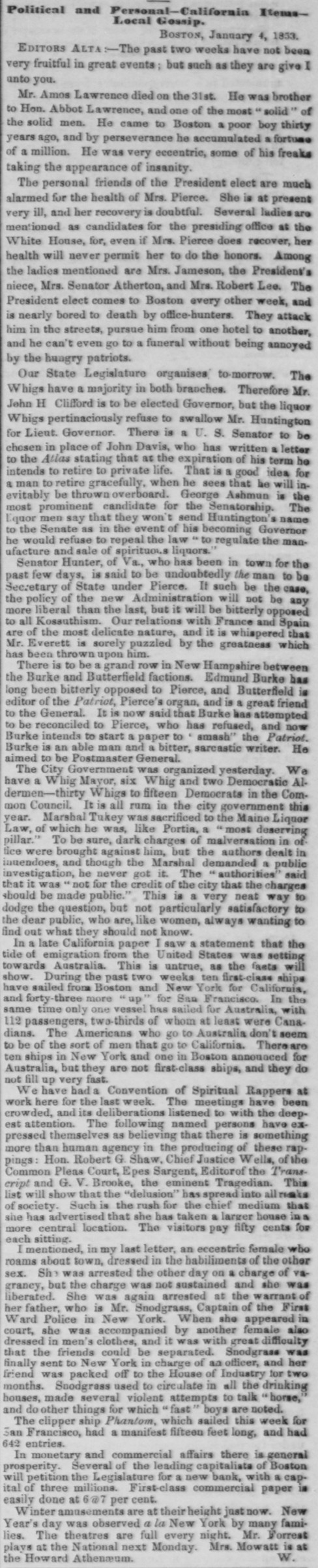
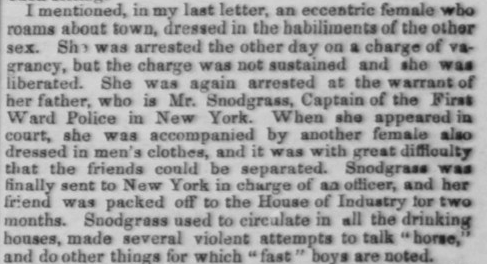
I mentioned, in my last letter, an eccentric female who roams about town, dressed in the habiliments of the other sex. She was arrested the other day on a charge of vagrancy, but the charge was not sustained and she was liberated. She was again arrested at the warrant of her father, who is Mr. Snodgrass, Captain of the First Ward Police in New York. When she appeared in court, she was accompanied by another female also dressed in men's clothes, and it was with great difficulty that the friends could be separated. Snodgrass was finally sent to New York in charge of an officer, and her friend was packed off to the House of Industry for two months. Snodgrass used to circulate in all the drinking houses, made several violent attempts to talk 'horse,' and do other things for which 'fast' boys are noted.
The linguistic interest here is the loss of an idiom whose cultural support is mostly gone. That hasn't happened to "put the cart before the horse", "beat a dead horse", "get off one's high horse", "stalking-horse", "straight from the horse's mouth", "swap horses in midstream", "look a gift horse in the mouth", or many others. In fact, Wiktionary's entry for horse has 453 derived terms, but "to talk horse" isn't one of them. It's also absent from the 119 derived terms in the entry for talk.
Just as words and word-senses come and go, so do idiomatic phrases (and also fixed expressions where the meaning of the whole is perfectly compositional). And each of us may well know a larger number of such phrases and expressions than we know simple words, especially if separate senses are not counted.
For more about the Emma Snodgrass case, see this recent New England Historical Society article.