Portuguese words in Japanese, and beyond
Language Log 2023-01-08
Len Leverson sent me his unpublished paper titled "O 'pão' Português Conquista o Mundo" about how the Portuguese word for bread spread across the globe. That got me to thinking about how many words of Portuguese origin are in Japanese. I'll focus on "pão" more squarely in a moment, but first just a quick list of some important and interesting words of Portuguese origin in Japanese.
The first one that pops into my mind (for obvious reasons since I spent a couple of decades studying the mummies of Eastern Central Asia) is mīra ミイラ ("myrrh") because, when the Portuguese were selling Egyptian mummies to the Japanese as medicine, they often mentioned myrrh as one of the preservatives, and the Japanese took the part for the whole.
Starting in 1543, the Portuguese were the first modern Europeans to visit Japan. Consequently, many words of Portuguese origin entered the Japanese vocabulary. Surprisingly, such a quintessentially Japanese dish as tempura derives from Portuguese (cf. tempero ["seasoning"]).
The Japanese word for "pants; trousers") is a little bit more complicated. Portuguese jibão ("underwear") led to Japanese juban / jiban ("underwear for kimonos"), but its cognate in French, jupon, led to zubon in Japanese.
Likewise, kappa ("raincoat") derives from Portuguese capa (nowadays yielding to reinkōto).
A few more:
Jap. manto < Port. manto ("cloak")
Jap. chokki < Port. jaque ("jacket; vest")
Jap. kurusu < Port. cruz ("cross")
Jap. rozario < Port. rosario ("rosary")
Japn. fetisshu < Port. feitiço ("spell; charm; sorcery"), though I suppose this may have come via English
So, the next time you go to a Japanese restaurant wearing a cape or cloak, vest, and trousers (well, underpants) to have tempura with bread, you can thank the Portuguese who brought these items and words to Japan. But avoid the mummies in Japanese museums, for they might cast a fetish upon you, causing you to run for your rosary and cross.
Now, let's look more closely at Portuguese "pão":
From Old Portuguese pan, from Latin pānem, accusative singular form of pānis, possibly from a derivative of Proto-Indo-European *peh₂- (“to feed, graze”). (compare Catalan pa, French pain, Galician pan, Italian pane, Romanian pâine, Spanish pan).
(source)
Descendants
- Guinea-Bissau Creole: pon
- Kabuverdianu: pom
- Korlai Creole Portuguese: pãw
- Kristang: pang
- Papiamentu: pan
- → Bengali: পাঁউরুটি (pãuruṭi)
- → Burmese: ပေါင်မုန့် (paungmun.) (compounded with မုန့် (mun., “snack”))
- → Gujarati: પાઉં (pāũ)
- → Hindi: पाव (pāv)
- → Japanese: パン (pan) (see below for further descendants)
- → Kadiwéu: paon
- → Makalero: paun (“bread”)
- → Marathi: पाव (pāv)
- → Sinhalese: පාන් (pān)
- → Thai: ปัง (bpang)
- → Tetum: paun
(source)
Zeroing in on Japanese pan パン ("bread"; also "pastries, any baked good with a crust [a type of food]"):
Usage notes
- The kanji spellings 麺麭, 麺包, and 麪包 are examples of jukujikun. Use of these spellings is extremely rare in modern Japanese.
- While usually translated as 'bread', the term also covers a wide variety of baked goods that would not be called bread in English. This includes bread-like sweets like brioche, filled puff pastries and similar items, as well as various Asian steamed dough dumplings.
Descendants
- → Ainu: パン (pan)
- → Amis: epang
- → Bunun: paang
- → Hakka: 麭 (pháng)
- → Korean: 빵 (ppang)
- → Minnan: 麭 (pháng)
- → Paiwan: pang
- → Rukai: pange
- → Saaroa: pangʉ
(source)
Zooming in on the Minnan word, unless you are literate in Sinographic Taiwanese, chances are that you will not recognize the non-Unicode character in the name of the shop run by the Taiwanese master baker Wu Pao-chun 吳寶春:
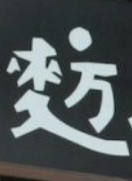
That's  (semantophore mài 麥 ["wheat"] + phonophore fāng 方 ["square; topo-"]).
Another lesson in how words, plus the things and ideas they designate, travel around the world. In my estimation, neither the things and ideas, nor the words to represent them, would traverse such vast expanses unless people took them.
Selected readings
- "The politics and linguistics of bread in Taiwan and China" (12/13/18)
- "Magi, myrrh, and mummies" (12/24/14)
- "Early Indo-Europeans in Xinjiang" (11/19/08)
- Victor H. Mair, ed., The Bronze Age and Early Iron Age Peoples of Eastern Central Asia (Washington, D.C.: Institute for the Study of Man Inc. in collaboration with the University of Pennsylvania Museum Publications, 1998). 2 vols.
- J. P. Mallory and Victor H.Mair,The Tarim Mummies: Ancient China and the Mystery of the Earliest Peoples from the West(London: Thames & Hudson, 2000).