More on Feudal Security
Schneier on Security 2013-06-13
Summary:
Facebook regularly abuses the privacy of its users. Google has stopped supporting its popular RSS feeder. Apple prohibits all iPhone apps that are political or sexual. Microsoft might be cooperating with some governments to spy on Skype calls, but we don't know which ones. Both Twitter and LinkedIn have recently suffered security breaches that affected the data of hundreds of thousands of their users.
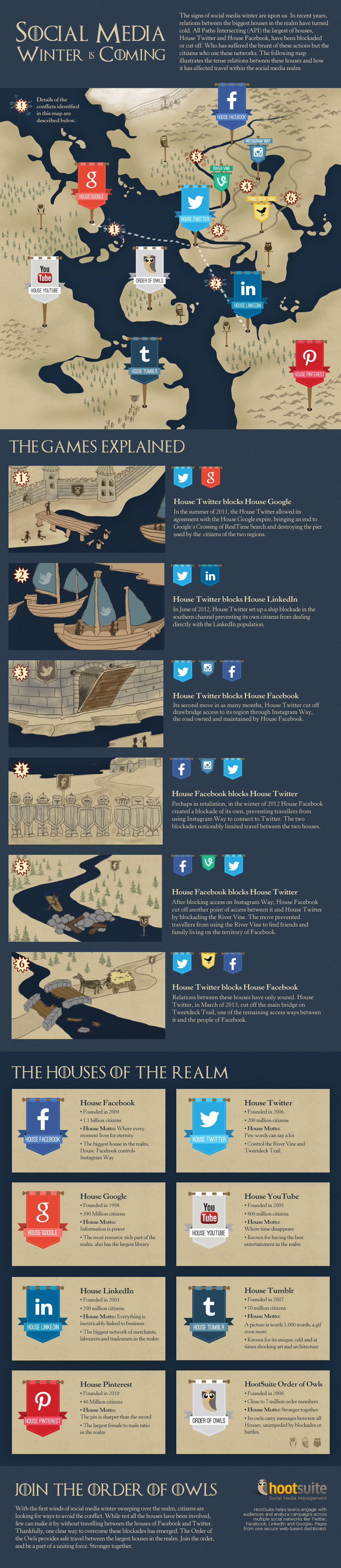
If you've started to think of yourself as a hapless peasant in a Game of Thrones power struggle, you're more right than you may realize. These are not traditional companies, and we are not traditional customers. These are feudal lords, and we are their vassals, peasants, and serfs.
Power has shifted in IT, in favor of both cloud-service providers and closed-platform vendors. This power shift affects many things, and it profoundly affects security.
Traditionally, computer security was the user's responsibility. Users purchased their own antivirus software and firewalls, and any breaches were blamed on their inattentiveness. It's kind of a crazy business model. Normally we expect the products and services we buy to be safe and secure, but in IT we tolerated lousy products and supported an enormous aftermarket for security.
Now that the IT industry has matured, we expect more security "out of the box." This has become possible largely because of two technology trends: cloud computing and vendor-controlled platforms. The first means that most of our data resides on other networks: Google Docs, Salesforce.com, Facebook, Gmail. The second means that our new Internet devices are both closed and controlled by the vendors, giving us limited configuration control: iPhones, ChromeBooks, Kindles, BlackBerry PDAs. Meanwhile, our relationship with IT has changed. We used to use our computers to do things. We now use our vendor-controlled computing devices to go places. All of these places are owned by someone.
The new security model is that someone else takes care of it -- without telling us any of the details. I have no control over the security of my Gmail or my photos on Flickr. I can't demand greater security for my presentations on Prezi or my task list on Trello, no matter how confidential they are. I can't audit any of these cloud services. I can't delete cookies on my iPad or ensure that files are securely erased. Updates on my Kindle happen automatically, without my knowledge or consent. I have so little visibility into the security of Facebook that I have no idea what operating system they're using.
There are a lot of good reasons why we're all flocking to these cloud services and vendor-controlled platforms. The benefits are enormous, from cost to convenience to reliability to security itself. But it is inherently a feudal relationship. We cede control of our data and computing platforms to these companies and trust that they will treat us well and protect us from harm. And if we pledge complete allegiance to them -- if we let them control our email and calendar and address book and photos and everything -- we get even more benefits. We become their vassals; or, on a bad day, their serfs.
There are a lot of feudal lords out there. Google and Apple are the obvious ones, but Microsoft is trying to control both user data and the end-user platform as well. Facebook is another lord, controlling much of the socializing we do on the Internet. Other feudal lords are smaller and more specialized -- Amazon, Yahoo, Verizon, and so on -- but the model is the same.
To be sure, feudal security has its advantages. These companies are much better at security than the average user. Automatic backup has saved a lot of data after hardware failures, user mistakes, and malware infections. Automatic updates have increased security dramatically. This is also true for small organizations; they are more secure than they would be if they tried to do it themselves. For large corporations with dedicated IT security departments, the benefits are less clear. Sure, even large companies outsource critical functions like tax preparation and cleaning services, but large companies have specific requirements for security, data retention, audit, and so on -- and that's just not possible with most of these feudal lords.
Feudal security also has its risks. Vendors can, and do, make security mistakes affecting hundreds of thousands of people. Vendors can lock people into relationships, making it hard for them to take their data and leave. Vendors can act arbitrarily, against our interests; Facebook regularly does this when it changes peoples' defaults, implements new features, or modifies its privacy policy. Many vendors give our data to the government without notice, consent, or a warrant; almost all sell it for profit. This isn't surprising, really; companies should be expected to act in their own self-interest and not in their users' best interest.
The feudal relationship is inhe