Survey Statistics: irrelevant alternatives ?
Statistical Modeling, Causal Inference, and Social Science 2026-04-14
Choice models are useful for modeling elections (or RuPaul’s Drag Race).
Consider vote choice with candidates C = {Left, Right, Other}. “Other” can be a third party, not voting, or “don’t know” in a survey.
A common choice model is multinomial logit:
P[voter i chooses candidate c from C] = exp(f(X_ic)) / sum_c’ exp(f(X_ic’))
Where X_ic are various chooser and choice covariates. This model implies independence from irrelevant alternatives (IIA): ratios of probabilities don’t depend on choice set. (Homework for the reader !)

For example, in a two-round voting system, folks choose from C in round 1 and then choose from {Left,Right} in the runoff. (In a survey, folks choose from C in question 1 and from {Left,Right} in a “push” question.) IIA says that the ratio of Left-vs-Right preference is the same in round 1 (question 1) as in the runoff (“push” question):
P[i chooses Left from C] / P[i chooses Right from C] = P[i chooses Left from {Left,Right}] / P[i chooses Right from {Left,Right}]
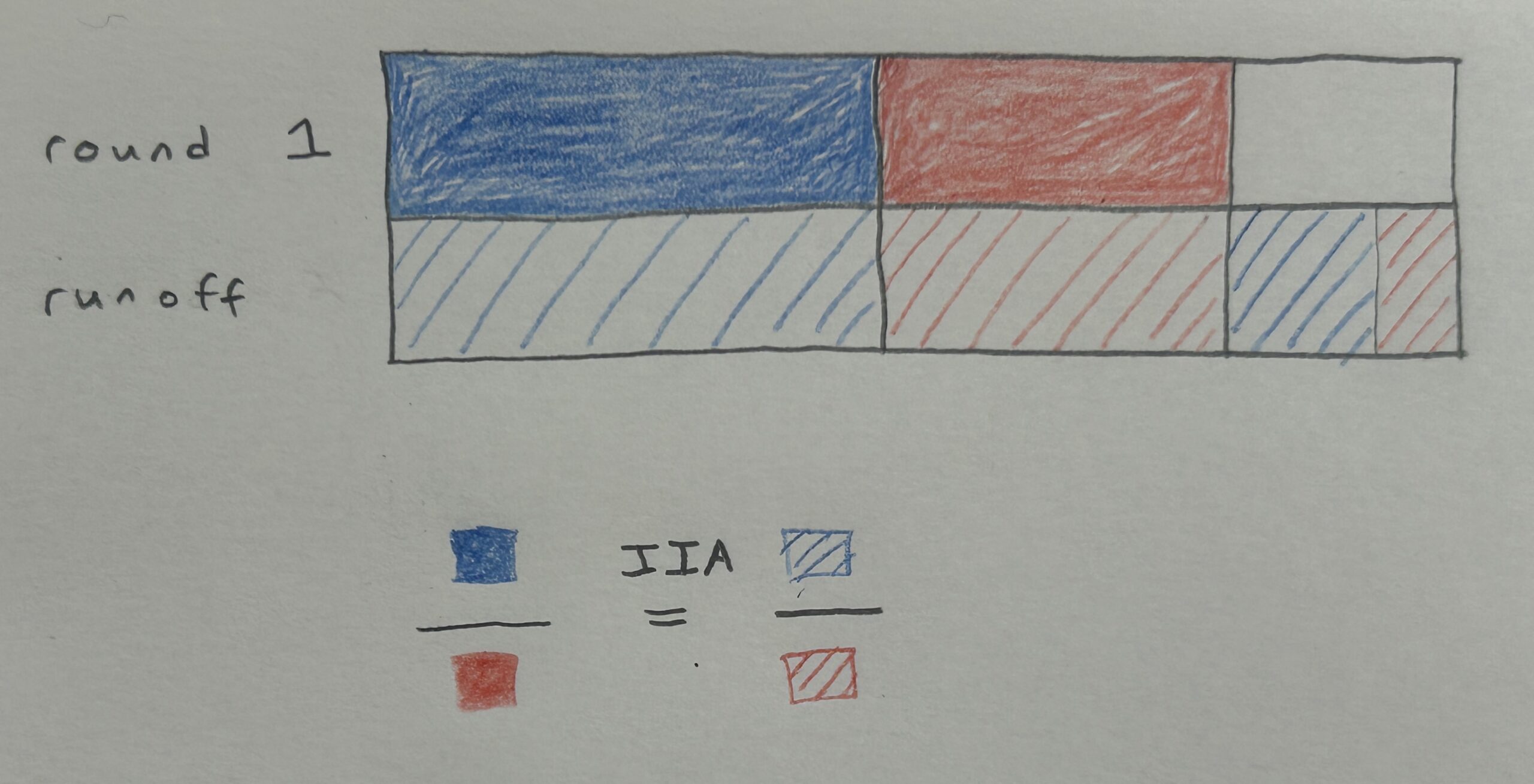
In fact, not only does logit model –> IIA (your homework to show), but IIA –> logit model. The latter direction is harder to show, see Luce (1959). For more, see Train (2009).
