The new rule in economics: One star is p < 0.20, two stars is a set of steak knives, three stars is you're fired.
Statistical Modeling, Causal Inference, and Social Science 2026-06-22
Someone pointed me to a series of applied economics papers:
1. George Borjas and Nate Breznau, Ideological bias in the production of research findings:
Our study exploits an opportunity to observe 158 researchers working independently in 71 teams during an experiment. After being asked their position on immigration policy, they used the same data to answer the same empirical question: Does immigration affect public support for social welfare programs? . . . teams composed of pro-immigration researchers estimated more positive impacts of immigration on public support for social programs, while anti-immigration teams estimated more negative impacts. The differences arise because different teams adopted different model specifications. . .
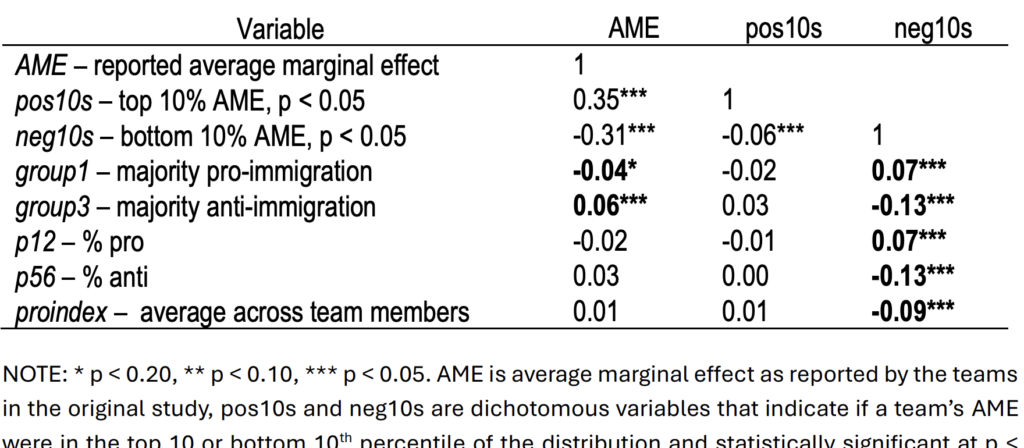
The results include an unusual labeling of statistical significance:

Usually it’s one star for p < 0.05, two stars for p < 0.01, as here:

or here:
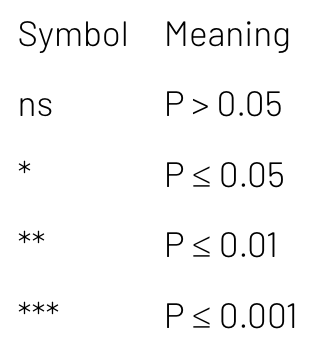
These are not intended to be authoritative references; they just turned up in a quick search. The point is that 0.05 is the usual standard. Using 0.10 is a way of manufacturing a “statistically significant” result when you don’t have it in your data (as here). In the case of the Borjas and Breznau paper, the data were too variable to get a conventionally strong result, but they still wanted to get it published, and so they shifted the stars. I’m surprised that the reviewers didn’t catch it!
Don’t get me wrong. I don’t think people should be using statistical significance, at any level, as a threshold. To get a sense of my perspective you can read our paper, Abandon Statistical Significance. Even if you have an estimate that’s just one standard error from zero, that’s still evidence of the direction of the effect, as long as no selection is going on.
2. Katrin Auspurg and Josef Brüderl, Fragile Evidence for an Ideological Bias in the Production of Research Findings: Comment on Borjas and Breznau:
Although we were able to reproduce B&B’s numerical results, our reanalysis shows that the reported association is not robust. Specifically, the association hinges on a coding error. Data from four teams that contradict the ideology hypothesis were excluded from the analysis due to idiosyncratic variable coding. Correcting this error renders the ideology effect no longer statistically significant. Also, B&B employed a different outcome variable and weighƟng scheme to that used in a previous paper based on the same data. These two analytical decisions further contribute to the observed ideology effect. Correcting the coding error or using the same specification as in the previous paper renders the ideology effect indistinguishable from zero. . . .
They also go with the 10% significance level, I guess to be consistent with the original paper?
3. Nate Breznau and George Borjas, A Lack of Robustness in Robustness Checking from Auspurg and Brüderl:
In our published paper, we explicitlyacknowledged the limitations of our findings which are based on secondary data and a small sample. After examining Auspurg and Brüderl’s claims, we conclude that they have not presented any new evidence that warrants any correction to our conclusions. . . .
This rejoinder includes the table at the top of this post, in which the significance level has now crept up to 0.20.
I’m anticipating a few more rounds of this, culminating in a table by Breznau and Borjas in which anything with a two-sided p-value of less than 0.5 is given a star. Everybody’s a winner!
P.S. Just kidding in the title of the post. This “p < 0.20" thing isn't really the new rule in econ; it's just something from this one paper. It may be that its authors got some special exemption from the 0.05 threshold.