Turning chaotic sensitivity from a bug into a feature: Using physical modeling and deep learning to alter the paths of storms and mitigate extreme weather events
Statistical Modeling, Causal Inference, and Social Science 2026-07-06
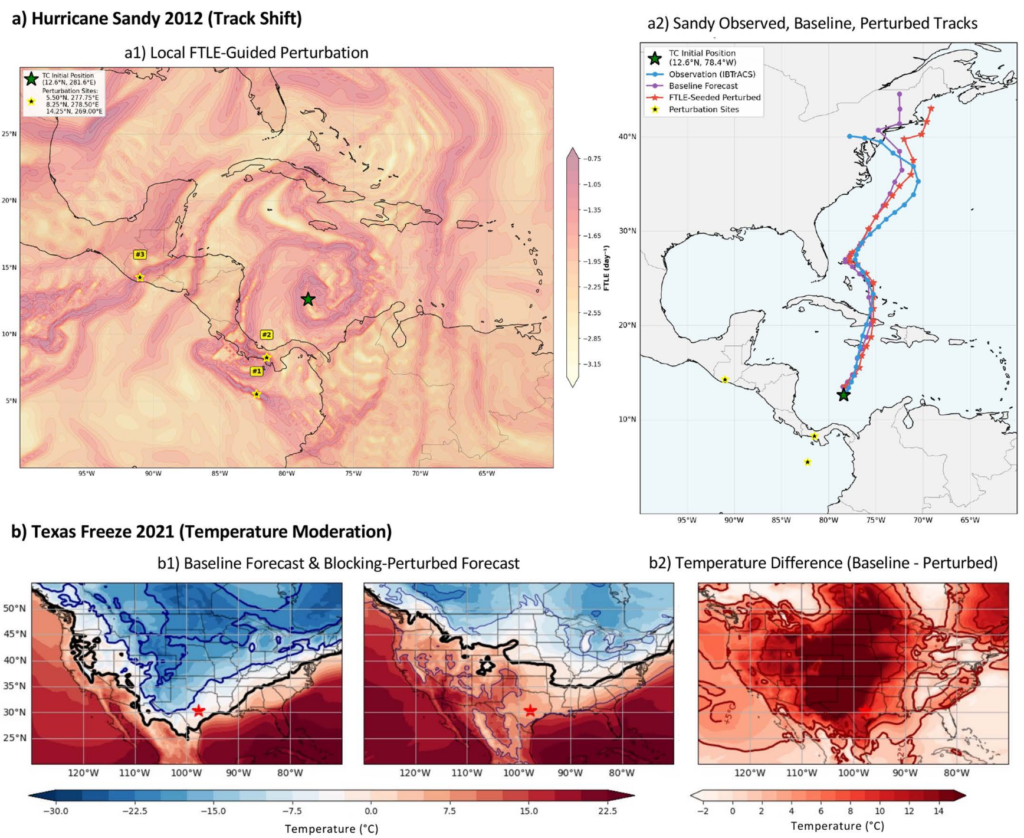
Qin Huang, Moyan Liu, and Upmanu Lall write:
Extreme weather events, e.g., droughts, floods, heatwaves, and freezes, are increasing in frequency and intensity, posing severe socio-economic impacts as growing populations heighten exposure to risks that conventional infrastructure cannot fully address. We propose supplementing disaster management with Weather Jiu-Jitsu: a strategy that exploits the chaotic sensitivity of mid-latitude atmospheric dynamics to redirect destructive weather trajectories through small, precisely timed perturbations guided by Finite-Time Lyapunov Exponent (FTLE) diagnostics and deep learning forecast models.
They continue:
Proof-of-concept experiments using the Aurora deep-learning Earth system model show that FTLE-guided nudges applied days before peak impact can shift a hurricane track to avoid landfall on a major city, weaken the peak intensity of a blocking-driven cold extreme, and reduce atmospheric river moisture transport under favorable upstream conditions. Control inputs remain below 2% of total system energy in idealized models, though real-world implementation will require advances in monitoring, attribution, and international governance.
There are some cool ideas here. The big ideas are:
1. Small interventions early on can shift the later progression of a storm, and
2. Chaotic unpredictability can be reduced using high-tech machine learning models.
Both these two things are necessary. The first step is needed to allow this to be done with reasonable cost; the second step is needed to give it a good chance of working.
The other cool thing involves cloud seeding. As I understand it, a big hope of the 1950s was idea of seeding clouds to get rain when you want it–but it didn’t really work, because you can’t get it to rain when the water isn’t there. (I’m sure I’m butchering the science here; sorry!) But this new plan is different because you’d be seeding the clouds over the ocean, and the point is not to get it to rain right there but rather to slightly shift where the rain falls.
I can also anticipate political challenges. For example, suppose a storm is headed toward a major city, but if it were diverted it would destroy a resort frequented by rich and powerful people. This is on top of the existing moral hazard by which owners of property near the water expect to be bailed out after natural disasters.
Here are the research papers backing up the idea:
Targeted adaptive chaos control of regimes and eddy strength in two Lorenz models, by Moyan Liu, Qin Huanga, and Upmanu Lall, Chaos, Solitons and Fractals (2026).
Regime identification and control of extremes in the nonautonomous Lorenz model with chaos and intransitivity, by Moyan Liu, Qin Huanga, and Upmanu Lall, Physical Review E (2026).
Upmanu is a water engineer with big ideas. A bunch of years ago he floated the plan to expand Manhattan’s west side by a few hundred meters by taking the silt that is continuously being dredged from the Hudson River and depositing it on the shore as landfill. That never happened but it still seems like a good idea to me. It’s kind of crazy how they’ll spend billions on a single bridge or remodeled train station or whatever but whiff on the big infrastructure projects.