Mean residual time
The Endeavour 2013-06-17
If something has survived this far, how much longer is it expected to survive? That’s the question answered by mean residual time.
For a positive random variable X, the mean residual time for X is a function eX(t) given by

provided the expectation and integral converge. Here F(t) is the CDF, the probability that X is greater than t.
For an exponential distribution, the mean residual time is constant. For a Pareto (power law) distribution, the mean residual time is proportional to t. This has some interesting consequences, known as the Lindy effect.
Now let’s turn things around. Given function a function e(t), can we find a density function for a positive random variable with that mean residual time? Yes.
The equation above yields a differential equation for F, the CDF of the distribution.
If we differentiate both sides of

with respect to t and rearrange, we get the first order differential equation

where
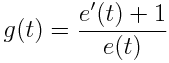
The initial condition must be F(0) = 0 because we’re looking for the distribution of a positive random variable, i.e. the probability of X being less than zero must be 0. The solution is then

This means that for a desired mean residual time, you can use the equation above to create a CDF function to match. The derivative of the CDF function gives the PDF function, so differentiate both sides to get the density.