Tit for Tat – Axelrod tournament style competitive simulation
R-bloggers 2013-04-09
(This article was first published on Econometrics by Simulation, and kindly contributed to R-bloggers)
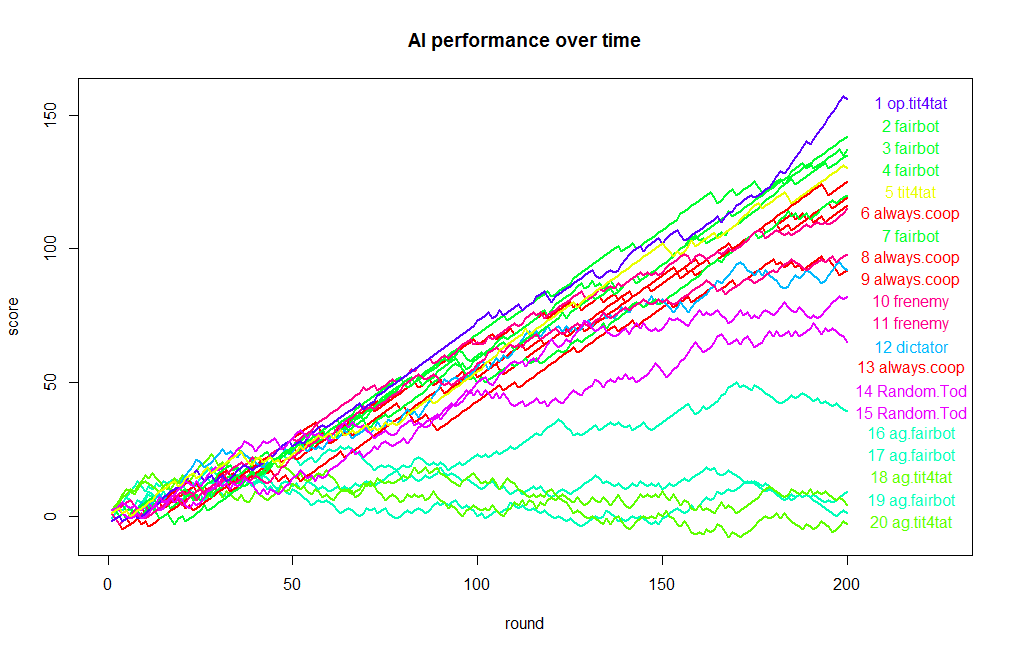
# I have been reading the Moral Animal by Robert Wright and it has gotten me interested in putting together a simulation which is modeled after the classic Robert Axelrod's tournament style influential simulations. So here it is! Hope you enjoy it. # You can also find a link to the code in full here. # I would like to simulate multi-agent a micro-economy in which agents perform the prisoner's dimemma repeatedly. # Games like this have been important as evidence for an evolutionary psychological explanation of social cooperation.  See how differing strategies perform against each other # Returns for: # cooperate coop.coop = 1 # you cheat but opponent cooperates cheat.coop = 2 # You cooperate but opponent cheats coop.cheat = -2 # Both cheat cheat.cheat = -1 # This function turns the parameters into returns. returns = function(you,opponent) { ret = 0*you ret[(you==1)&(opponent==1)] = coop.coop ret[(you==0)&(opponent==1)] = cheat.coop ret[(you==1)&(opponent==0)] = coop.cheat ret[(you==0)&(opponent==0)] = cheat.cheat ret } # For example, if you cheat but your opponent cooperates for the first two rounds returns(c(0,0,0),c(1,1,0)) # Thus the game is defined as a zero sum game when players interact randomly with each other. But a greater than zero sum when players are systematically cooperating and less than zero sum when players are systematically cheating. # Number of rounds: n.rounds = 200 # Number of agents. This number must be even to ensure every agent is matched. n.agents = 20 # Basic framework. # Each round agents meet other agents. # Each agent has access to knowledge of the other agents previous behavior (either cheat or cooperate) # Let's define the types of agents. # Agents get fed input h which is the list of prior history with other agent. # The argument they return is their action. # The stupid agents are. always.coop = function(h) 1 always.cheat = function(h) 0 # Random Tod Random.Tod = function(h) 1==rbinom(1,1,.5) # tit4tat says that if the most recent action the opponent took was cheat then cheat otherwise cooperate. tit4tat = function(h) { # When the length of h = 0 then that means there is no history. if (length(h)==0) T else rev(h)[1]==1 } # initially agressive tit4tat ag.tit4tat = function(h) { if (length(h)==0) F else rev(h)[1]==1 } # opportunist tit4tat op.tit4tat = function(h) { if (length(h)==0) T else ((n # This is a somewhat tricky action behavior. # It states that play tit for tat up to the point near when the game ends. # Then start cheating because the game is coming to an end. } # fairbot is defined such that fairbot will only cheat if on average the previous actions the opponent cheated more fairbot = function(h) { if (length(h)==0) T else mean(h,na.rm=T)>=.5 } # Initially agressive fair bot ag.fairbot = function(h) { if (length(h)==0) F else mean(h,na.rm=T)>=.5 } # Coward dictator. If opponent on average cooperates then cheat, if opponent on average cheats then cooperate. dictator = function(h) { if (length(h)==0) T else mean(h,na.rm=T)<=.5 } # Aggressive dictator ag.dictator = function(h) { if (length(h)==0) F else mean(h,na.rm=T)<=.5 } # Frenemy frenemy = function(h) { if (length(h)==0) T else mean(rev(h)[1:2],na.rm=T)==1 # Frienemy is friendly until you have two interactions in which you cooperate with it then it cheats before turning friendly again if you cooperate twice then it turns ugly again. } agent.list = c("always.coop", "always.cheat", "tit4tat" , "ag.tit4tat", "fairbot" , "ag.fairbot" , "dictator", "ag.dictator", "op.tit4tat" , "Random.Tod" , "frenemy") # First I will draw a random draw of agents. agents = sort(sample(agent.list, n.agents, replace=T)) # Now let's generate the agent history matrices for each player. agent.number = matrix(NA, ncol=n.agents, nrow=n.rounds) # The agent actions matrices are agent.actions.recieved = matrix(NA, ncol=n.agents, nrow=n.rounds) agent.actions.given = matrix(NA, ncol=n.agents, nrow=n.rounds) # Agent point history (the total is the sum of the columns) agent.points = matrix(NA, ncol=n.agents, nrow=n.rounds) # Let's start the simulation: n = 1 for (n in 1:n.rounds) { # This while loop ensures that every agent is matched with another agent while (sum(is.na(agent.number[n,]))>0) { # In each round each agents gets randomly paired up with another agent. unpaired = 1:n.agents # Loop through all of the agents while (length(unpaired)>1) { # Select the first element of the unpaired list as a starting place. i = unpaired[1] # Remove agent i from the unpaired list unpaired = unpaired[unpaired!=i] # This randomly selects a single agent to match i to. # I threw the repeate function in there because when unpaired gets down to # only a single number in length then sample starts functioning differently. # Thus the rep keeps it from ever being length 1. i.match = sample(rep(unpaired,2), 1) # Remove i.match from unpaired list unpaired = unpaired[unpaired!=i.match] # Assign to agent i and i.match their match values agent.number[n,i] = i.match agent.number[n,i.match] = i } # This loop matches agents } # There should be no NAs in this list if the previous matching loops worked properly. sort(agent.number[n,]) for (i in 1:n.agents) { # Define each agent's history from previous encounters with the current counterpart a.faced = agent.number[n,i] a.numbers = agent.number[,i] a.actions = agent.actions.recieved[,i] # Select h as the history of actions with the current rival # excluding this round. h = a.actions[(a.numbers==a.faced)&(n>1:n.rounds)] # Feed history into response function response = get(agents[i])(h) print(h) print(response) # Save the response to the actions agent.actions.given[n,i] = response agent.actions.recieved[n,a.faced] = response # print(i) } } # Calculate scores by round: scores.round = returns(agent.actions.given, agent.actions.recieved) # Final results are: cbind(agents,apply(scores.round, 2, sum)) # Let's map out the social networks inherent in this exchange: require(igraph) # Let's first create out edge list # Specify a number less than the total number of rounds to map since the total number of rounds is probably a little too large. map.rounds = 7 x = cbind(1:n.agents, agent.number[1,]) for (n in 2:map.rounds) { x = rbind(x, cbind(1:n.agents, agent.number[n,])) } # We will use the statnet package to plot the social network require(statnet) g = network(x) plot(g, label=agents, main="A social network graph does not help")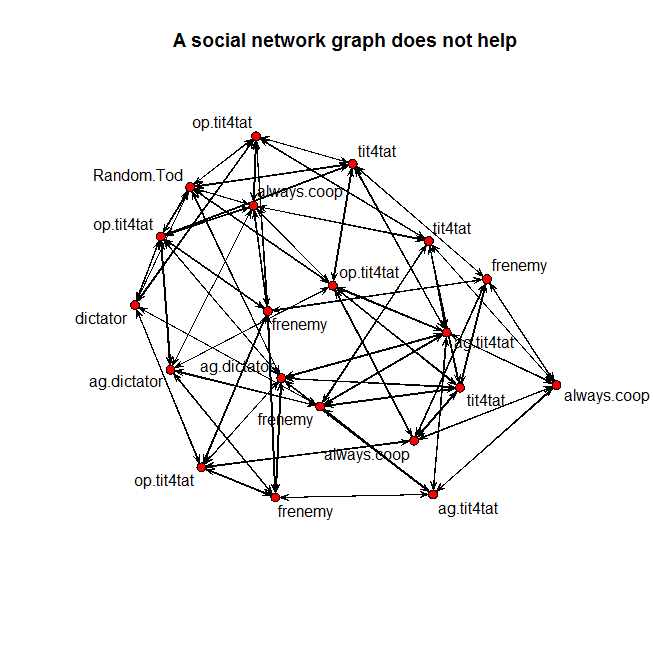
To leave a comment for the author, please follow the link and comment on his blog: Econometrics by Simulation.
R-bloggers.com offers daily e-mail updates about R news and tutorials on topics such as: visualization (ggplot2, Boxplots, maps, animation), programming (RStudio, Sweave, LaTeX, SQL, Eclipse, git, hadoop, Web Scraping) statistics (regression, PCA, time series,ecdf, trading) and more...