Railway population
R-bloggers 2026-01-04
Want to share your content on R-bloggers? click here if you have a blog, or here if you don't.

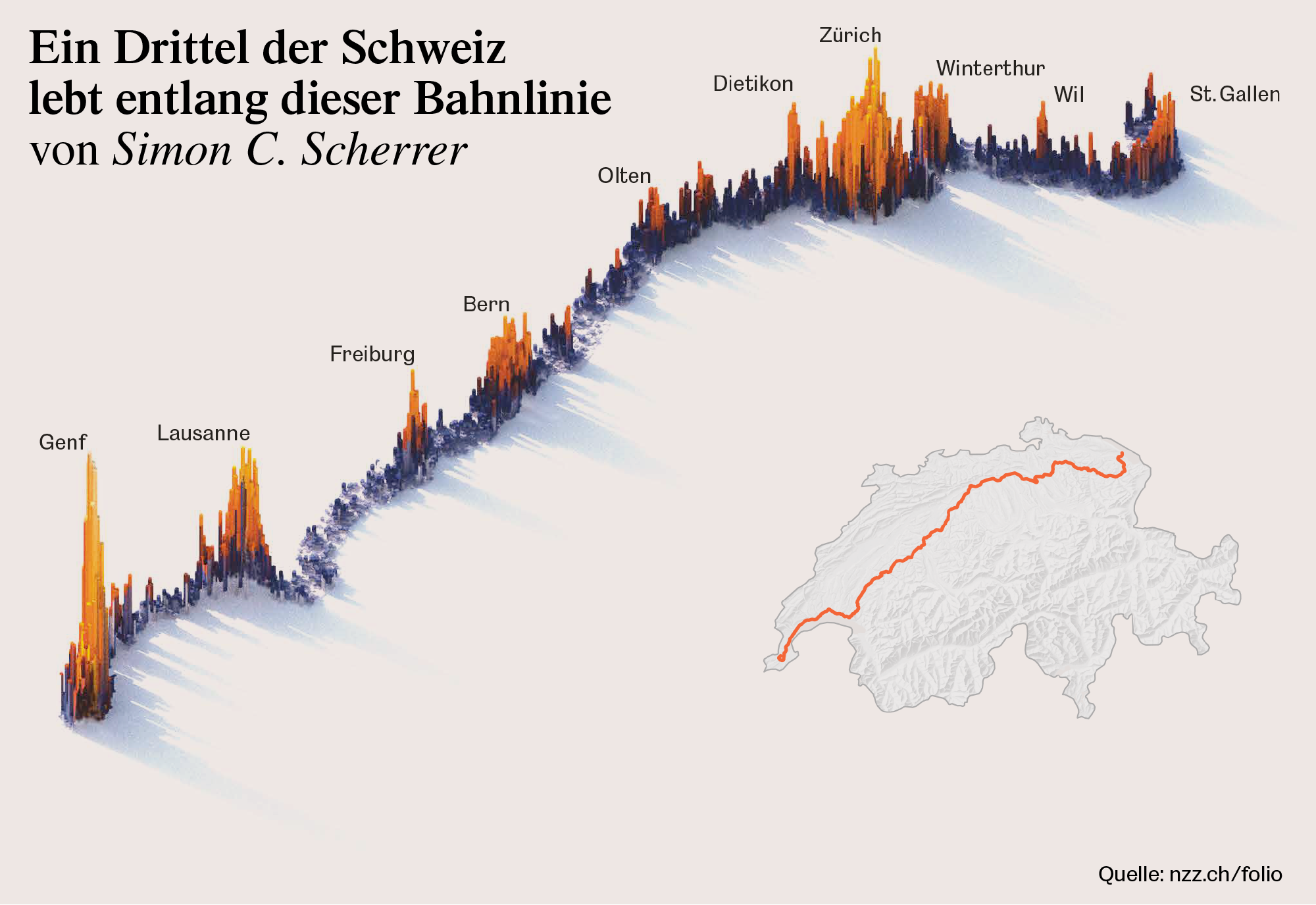
The following map from 2024 by Simon C. Scherrer (via @freakonometrics) indicates that one-third of the Swiss population lives in a five-kilometer-wide strip on either side of the Intercity 1 railway line.
What is the situation in France?
I didn’t easily find the statistics per line, but I guess a similar configuration —main line (whatever it means), main cities, many passengers, crossing the country— would be the discontinued Eurostar (London)–Calais–Lille–Marne-la-Vallée–Lyon–Marseille or the current TGV inOui Lille-Lyon-Marseille. However they don’t stop at Paris intra muros, so we miss a good part of the population.
Config
library(sf)library(glue)library(dplyr)library(osmdata)library(purrr)library(httr2)library(rnaturalearth)library(stringr)library(ggplot2)sf_use_s2(FALSE)
A 7z system binary is also required
Data
Railway
We can get the railway geometry from the OSM relation with {osmdata} and an Overpass API query.
osm <- r"([out:xml][timeout:6000];relation(5951791);(._;>;);out body;)" |> osmdata_sf() eurostar <- osm |> pluck("osm_multilines")stations <- osm$osm_points |> filter(railway == "stop", uic_ref %in% c("8775100", "8772319", "8711184", "8722326"))fr <- ne_countries(scale = "large") |> st_intersection(eurostar |> st_bbox() |> st_as_sfc() |> st_buffer(4.5, joinStyle = "MITRE", mitreLimit = 10))eurostar |> ggplot() + geom_sf(data = fr, color = "darkgrey") + geom_sf(color = "red", linewidth = 0.5, alpha = 0.8) + geom_sf(data = stations) + geom_sf_text(data = stations, aes(label = str_wrap(name, width = 15, whitespace_only = FALSE)), size = 3, hjust = 1.1) + labs(title = "London-Marseille", caption = glue("data: OpenStreetMap contributors Natural Earth https://r.iresmi.net - {Sys.Date()}")) + theme_void() + theme(plot.caption = element_text(size = 7, color = "grey40"), plot.background = element_rect(fill = "white"), plot.margin = unit(c(.2, .2, .2, .2), units = "cm"))

Population
Population comes from INSEE 2015 200 m grid.
The 7z file is itself zipped!
if (!file.exists("carreaux_200m_met.gpkg")) { pop_file <- "Filosofi2019_carreaux_200m_gpkg.zip" if (!file.exists(pop_file)) { request(glue("https://www.insee.fr/fr/statistiques/fichier/7655475/\\ {pop_file}")) |> req_perform(pop_file) } unzip(pop_file) system("7z e Filosofi2019_carreaux_200m_gpkg.7z carreaux_200m_met.gpkg") system("rm Filosofi2019_carreaux_200m_gpkg.*")}pop <- read_sf("carreaux_200m_met.gpkg")Results
Within 5 km
pop_5km <- pop |> st_filter(eurostar |> st_transform("EPSG:2154") |> st_buffer(5000)) |> st_drop_geometry() |> summarise(pop_tot = sum(ind, na.rm = TRUE)) |> pull(pop_tot)pop_fr <- pop |> st_drop_geometry() |> summarise(pop_tot = sum(ind, na.rm = TRUE)) |> pull(pop_tot)- Total population: 62,971,073
- Population within 5 km: 4,163,426
So only 6.6 % of the french (metropolitan) population is within 5 km of this railway line.
Within 50 km
If we extend to 50 km, we’ll capture most part of Paris…
pop_50km <- pop |> st_filter(eurostar |> st_transform("EPSG:2154") |> st_buffer(50000)) |> st_drop_geometry() |> summarise(pop_tot = sum(ind, na.rm = TRUE)) |> pull(pop_tot)- Population within 50 km: 25,696,130
So 40.8 % of the french (metropolitan) population is within 50 km of this railway line. Not bad, but the question could be now: does the train stop at a station near you? This is left as an exercise to the reader (spoiler: less and less…).
eurostar |> ggplot() + geom_sf(data = fr, color = "darkgrey") + geom_sf(color = "red", linewidth = 0.5, alpha = 0.8) + geom_sf(data = eurostar |> st_transform("EPSG:2154") |> st_buffer(50000), fill = "red", alpha = 0.2) + geom_sf(data = stations) + geom_sf_text(data = stations, aes(label = str_wrap(name, width = 15, whitespace_only = FALSE)), size = 3, hjust = 1.1) + labs(title = "London-Marseille", caption = glue("data: OpenStreetMap contributors Natural Earth https://r.iresmi.net - {Sys.Date()}")) + theme_void() + theme(plot.caption = element_text(size = 7, color = "grey40"), plot.background = element_rect(fill = "white"), plot.margin = unit(c(.2, .2, .2, .2), units = "cm"))

R-bloggers.com offers daily e-mail updates about R news and tutorials about learning R and many other topics. Click here if you're looking to post or find an R/data-science job.
Want to share your content on R-bloggers? click here if you have a blog, or here if you don't.