Searching the cosmos from under the ice of Antarctica
Ars Technica 2016-07-22
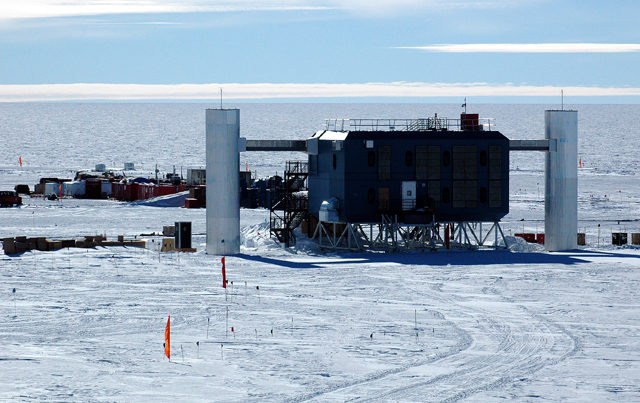
The building that houses the IceCube servers. (credit: USAP.gov)
Neutrinos have precious little mass and no charge, meaning the usual ways of accelerating particles won't work on them. Yet something, somewhere out in space pushed one to energies a thousand times higher than we can reach in the Large Hadron Collider. And we only know that because we finally built a detector that could spot high-energy neutrinos when they travel through the Earth.
In a recent paper in the journal Nature Physics, Francis Halzen, the principal investigator for the IceCube detector, discussed current efforts to learn about the Universe using neutrinos. As it turns out, neutrinos are surprisingly informative about the origins of cosmic rays and potentially about dark matter as well.
Neutrinos are a fantastic tool for astronomy. Their properties—no charge and very little mass—mean that they can arrive here on Earth unobstructed by almost anything in between their source and Earth. Neutrinos generated inside the Sun, for instance, can travel right out far faster than photons, which spend time interacting with the Sun's matter.
Read 24 remaining paragraphs | Comments