Holomorphic images of disks

What's new 2020-11-28

Consider a disk {D(z_0,r) := \{ z: |z-z_0| < r \}} in the complex plane. If one applies an affine-linear map {f(z) = az+b} to this disk, one obtains

\displaystyle  f(D(z_0,r)) = D(f(z_0), |f'(z_0)| r).

For maps that are merely holomorphic instead of affine-linear, one has some variants of this assertion, which I am recording here mostly for my own reference:

Theorem 1 (Holomorphic images of disks) Let {D(z_0,r)} be a disk in the complex plane, and {f: D(z_0,r) \rightarrow {\bf C}} be a holomorphic function with {f'(z_0) \neq 0}.
  • (i) (Open mapping theorem) {f(D(z_0,r))} contains a disk {D(f(z_0),\varepsilon)} for some {\varepsilon>0}.
  • (ii) (Bloch theorem) {f(D(z_0,r))} contains a disk {D(w, c |f'(z_0)| r)} for some absolute constant {c>0} and some {w \in {\bf C}}. (In fact there is even a holomorphic right inverse of {f} from {D(w, c |f'(z_0)| r)} to {D(z_0,r)}.)
  • (iii) (Koebe quarter theorem) If {f} is injective, then {f(D(z_0,r))} contains the disk {D(f(z_0), \frac{1}{4} |f'(z_0)| r)}.
  • (iv) If {f} is a polynomial of degree {n}, then {f(D(z_0,r))} contains the disk {D(f(z_0), \frac{1}{n} |f'(z_0)| r)}.
  • (v) If one has a bound of the form {|f'(z)| \leq A |f'(z_0)|} for all {z \in D(z_0,r)} and some {A>1}, then {f(D(z_0,r))} contains the disk {D(f(z_0), \frac{c}{A} |f'(z_0)| r)} for some absolute constant {c>0}. (In fact there is holomorphic right inverse of {f} from {D(f(z_0), \frac{c}{A} |f'(z_0)| r)} to {D(z_0,r)}.)

Parts (i), (ii), (iii) of this theorem are standard, as indicated by the given links. I found part (iv) as (a consequence of) Theorem 2 of this paper of Degot, who remarks that it “seems not already known in spite of its simplicity”. The proof is simple:

Proof: (Proof of (iv)) Let {w \in D(f(z_0), \frac{1}{n} |f'(z_0)| r)}, then we have a lower bound for the log-derivative of {f(z)-w} at {z_0}:

\displaystyle  \frac{|f'(z_0)|}{|f(z_0)-w|} > \frac{n}{r}

(with the convention that the left-hand side is infinite when {f(z_0)=w}). But by the fundamental theorem of algebra we have
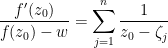
\displaystyle  \frac{f'(z_0)}{f(z_0)-w} = \sum_{j=1}^n \frac{1}{z_0-\zeta_j}

where {\zeta_1,\dots,\zeta_n} are the roots of the polynomial {f(z)-w} (counting multiplicity). By the pigeonhole principle, there must therefore exist a root {\zeta_j} of {f(z) - w} such that

\displaystyle  \frac{1}{|z_0-\zeta_j|} > \frac{1}{r}

and hence {\zeta_j \in D(z_0,r)}. Thus {f(D(z_0,r))} contains {w}, and the claim follows. \Box

The constant {\frac{1}{n}} in (iv) is completely sharp: if {f(z) = z^n} and {z_0} is non-zero then {f(D(z_0,|z_0|))} contains the disk

\displaystyle D(f(z_0), \frac{1}{n} |f'(z_0)| r) = D( z_0^n, |z_0|^n)

but avoids the origin, thus does not contain any disk of the form {D( z_0^n, |z_0|^n+\varepsilon)}. This example also shows that despite parts (ii), (iii) of the theorem, one cannot hope for a general inclusion of the form

\displaystyle  f(D(z_0,r)) \supset D(f(z_0), c |f'(z_0)| r )

for an absolute constant {c>0}.

Part (v) is implicit in the standard proof of Bloch’s theorem (part (ii)), and is easy to establish:

Proof: (Proof of (v)) From the Cauchy inequalities one has {f''(z) = O(\frac{A}{r} |f'(z_0)|)} for {z \in D(z_0,r/2)}, hence by Taylor’s theorem with remainder {f(z) = f(z_0) + f'(z_0) (z-z_0) (1 + O( A \frac{|z-z_0|}{r} ) )} for {z \in D(z_0, r/2)}. By Rouche’s theorem, this implies that the function {f(z)-w} has a unique zero in {D(z_0, 2cr/A)} for any {w \in D(f(z_0), cr|f'(z_0)|/A)}, if {c>0} is a sufficiently small absolute constant. The claim follows. \Box

Note that part (v) implies part (i). A standard point picking argument also lets one deduce part (ii) from part (v):

Proof: (Proof of (ii)) By shrinking {r} slightly if necessary we may assume that {f} extends analytically to the closure of the disk {D(z_0,r)}. Let {c} be the constant in (v) with {A=2}; we will prove (iii) with {c} replaced by {c/2}. If we have {|f'(z)| \leq 2 |f'(z_0)|} for all {z \in D(z_0,r/2)} then we are done by (v), so we may assume without loss of generality that there is {z_1 \in D(z_0,r/2)} such that {|f'(z_1)| > 2 |f'(z_0)|}. If {|f'(z)| \leq 2 |f'(z_1)|} for all {z \in D(z_1,r/4)} then by (v) we have

\displaystyle  f( D(z_0, r) ) \supset f( D(z_1,r/2) ) \supset D( f(z_1), \frac{c}{2} |f'(z_1)| \frac{r}{2} ) \supset D( f(z_1), \frac{c}{2} |f'(z_0)| r )

and we are again done. Hence we may assume without loss of generality that there is {z_2 \in D(z_1,r/4)} such that {|f'(z_2)| > 2 |f'(z_1)|}. Iterating this procedure in the obvious fashion we either are done, or obtain a Cauchy sequence {z_0, z_1, \dots} in {D(z_0,r)} such that {f'(z_j)} goes to infinity as {j \rightarrow \infty}, which contradicts the analytic nature of {f} (and hence continuous nature of {f'}) on the closure of {D(z_0,r)}. This gives the claim. \Box






