246B, Notes 2: Some connections with the Fourier transform
What's new 2021-01-24
In Exercise 5 (and Lemma 1) of 246A Notes 4 we already observed some links between complex analysis on the disk (or annulus) and Fourier series on the unit circle:
- (i) Functions
that are holomorphic on an annulus
are expressed by a convergent Fourier series (and also Laurent series)
, where
conversely, every doubly infinite sequenceof coefficients obeying (1) arises from such a function
- (ii) Functions
are expressed by a convergent Fourier series (and also Taylor series)
(so in particular
), where
conversely, every infinite sequenceof coefficients obeying (2) arises from such a function
- (iii) In the situation of (i), there is a unique decomposition
where
extends holomorphically to
, and
extends holomorphically to
and goes to zero at infinity, and are given by the formulae
whereis any anticlockwise contour in
, and and
wherebut not


This connection lets us interpret various facts about Fourier series through the lens of complex analysis, at least for some special classes of Fourier series. For instance, the Fourier inversion formula 


It turns out that there are similar links between complex analysis on a half-plane (or strip) and Fourier integrals on the real line, which we will explore in these notes.
We first fix a normalisation for the Fourier transform. If 


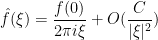
 will be a bounded continuous function; from the Riemann-Lebesgue lemma it also decays to zero as
  . My choice to place the
  in the exponent is a personal preference (it is slightly more convenient for some harmonic analysis formulae such as the identities (4), (5), (6) below), though in the complex analysis and PDE literature there are also some slight advantages in omitting this factor. In any event it is not difficult to adapt the discussion in this notes for other choices of normalisation. It is of interest to extend the Fourier transform beyond the
  class into other function spaces, such as
  or the space of tempered distributions, but we will not pursue this direction here; see for instance these lecture notes of mine for a treatment.
Exercise 1 (Fourier transform of Gaussian) Ifand
, show that the Fourier transform
.
The Fourier transform has many remarkable properties. On the one hand, as long as the function


 with “dual” qualitative properties of its Fourier transform ; in particular, “decay” properties of tend to be associated with “regularity” properties of , and vice versa. For instance, the Fourier transform of rapidly decreasing functions tend to be smooth. There are complex analysis counterparts of this Fourier dictionary, in which “decay” properties are described in terms of exponentially decaying pointwise bounds, and “regularity” properties are expressed using holomorphicity on various strips, half-planes, or the entire complex plane. The following exercise gives some examples of this:
Exercise 2 (Decay ofHint: to establish holomorphicity in each of these cases, use Morera’s theorem and the Fubini-Tonelli theorem. For uniqueness, use analytic continuation, or (for part (iv)) the Cauchy integral formula.
- (i) If
for all
and
(that is to say one has
for some finite quantity
depending only on
), then
. Furthermore, this function continues to be defined by (3).
- (ii) If
then the entire function
for
. In particular, if
then
.
- (iii) If
for all
, and obeys the bound
in this strip. Furthermore, this function continues to be defined by (3).
- (iv) If
(resp.
), then there is a unique continuous extension of
(resp. the lower half-plane
which is holomorphic in the interior of this half-plane, and such that
uniformly as
(resp.
). Furthermore, this function continues to be defined by (3).
Proof:
Later in these notes we will give a partial converse to part (ii) of this exercise, known as the Paley-Wiener theorem; there are also partial converses to the other parts of this exercise.
From (3) we observe the following intertwining property between multiplication by an exponential and complex translation: if 



 is a complex number such that at least one of the two sides of the equation in (7) is well defined. Thus, multiplication of a function by an exponential weight corresponds (formally, at least) to translation of its Fourier transform. By using contour shifting, we will also obtain a dual relationship: under suitable holomorphicity and decay conditions on , translation by a complex shift will correspond to multiplication of the Fourier transform by an exponential weight. It turns out to be possible to exploit this property to derive many Fourier-analytic identities, such as the inversion formula (4) and the Poisson summation formula (6), which we do later in these notes. (The Plancherel theorem can also be established by complex analytic methods, but this requires a little more effort; see Exercise 7.
…
The material in these notes is loosely adapted from Chapter 4 of Stein-Shakarchi’s “Complex Analysis”.
— 1. The inversion and Poisson summation formulae —
We now explore how the Fourier transform
Proposition 3 (Fourier transform of functions holomorphic in a strip) Let, and suppose that
which obeys a decay bound of the form
for all
,
, and some
(or in asymptotic notation, one has
whenever
).
- (i) (Translation intertwines with modulation) For any
in the strip
, the Fourier transform of the function
is
.
- (ii) (Exponential decay of Fourier transform) For any
such that
for all
(or in asymptotic notation, one has
for
- (iii) (Partial Fourier inversion) For any
and
and
- (iv) (Full Fourier inversion) For any
- (v) (Poisson summation formula) The identity (6) holds for this function



Proof: We begin with (i), which is a standard application of contour shifting. Applying the definition (3) of the Fourier transform, our task is to show that

 and . Clearly
 is the line segment contour from
  to
to  , and similarly after a change of variables

 . So it suffices to show that
 . But the left hand side can be rewritten as
For (ii), we apply (i) with 



 and all , giving the claim.
For the first part of (iii), we write 


 as
as  ) the left-hand side can be written as

To prove (iv), it suffices in light of (iii) to show that
 . The left-hand side can be written after a change of variables as


Now we prove (v). Let


 . If we sum the first identity for
  we see from the geometric series formula and Fubini’s theorem that
 we have


 , which are at the integers. Hence we shall restrict
  to be a half-integer
  . In this case, a routine application of the residue theorem shows that
 stays bounded for in
  or
or  when is a half-integer, we also see from dominated convergence as before that

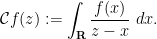
Exercise 4 (Hilbert transform and Plemelj formula) Letbe as in Proposition 3. Define the Cauchy-Stieltjes transform
by the formula
- (i) Show that
is holomorphic on
and has the Fourier representation
in the upper half-plane
and
in the lower half-plane
.
- (ii) Establish the Plemelj formulae
and
for any
of
- (iii) Show that
and solves the (very simple special case of the) Riemann-Hilbert problem
uniformly in
- (iv) Establish the identity
where the signum function
is defined to equal
for
,
for
, and
.
- (v) Show that
), with the identity
holding for
.
- (vi) Establish the identities
and
(Hint: for the latter inequality, square both sides of (9).)









Exercise 5
- (i) By applying the Poisson summation formula to the function
, establish the identity
for any positive real number
. Explain why this is consistent with Exercise 24 from Notes 1.
- (ii) By carefully taking limits of (i) as
, establish yet another alternate proof of Euler’s identity


Exercise 6 Forin the upper half-plane
, define the theta function
. Use Exercise 1 and the Poisson summation formula to establish the modular identity
for such

Exercise 7 (Fourier proof of Plancherel identity) Let, define the quantity
Remarkably, this proof of the Plancherel identity generalises to a nonlinear version involving a trace formula for the scattering transform for either Schrodinger or Dirac operators. For Schrodinger operators this was first obtained (implicitly) by Buslaev and Faddeev, and later more explicitly by by Deift and Killip. The version for Dirac operators more closely resembles the linear Plancherel identity; see for instance the appendix to this paper of Muscalu, Thiele, and myself. The quantity
- (i) When
. (Hint: find a way to rearrange the expression
.)
- (ii) For
, where the implied constant in the
- (iii) Establish the Plancherel identity (5).
is a component of a nonlinear quantity known as the transmission coefficient
of a Dirac operator with potential
, depending on normalisations).

The Fourier inversion formula was only established in Proposition 3 for functions that had a suitable holomorphic extension to a strip, but one can relax the hypotheses by a limiting argument. Here is one such example of this:
Exercise 8 (More general Fourier inversion formula) Letfor all

 , with
  for any
 Exercise 9 (Laplace inversion formula) Letbe a continuously twice differentiable function, obeying the bounds
for all
and some
The Laplace-Mellin inversion formula in fact holds under more relaxed decay and regularity hypotheses than the ones given in this exercise, but we will not pursue these generalisations here. The limiting integral in (10) is also known as the Bromwich integral, and often written (with a slight abuse of notation) as
- (i) Show that the Fourier transform
for any non-zero
- (ii) Establish the principal value inversion formula
for any positive real
. (Hint: modify the proof of Exercise 8(ii).) What happens when
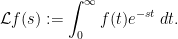
- (iii) Define the Laplace transform
of
by the formula
Show that
is continuous on the half-plane
, holomorphic on the interior of this half-plane, and obeys the Laplace-Mellin inversion formula
for any
and
, where
is the line segment contour from
to
. Conclude in particular that the Laplace transform
is injective on this class of functions
. The Laplace transform is a close cousin of the Fourier transform that has many uses; for instance, it is a popular tool for analysing ordinary differential equations on half-lines such as


Exercise 10 (Mellin inversion formula) Letbe a continuous function that is compactly supported in
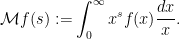
. Define the Mellin transform
by the formula
Show that
is entire and one has the Mellin inversion formula
for any
. The regularity and support hypotheses on

Exercise 11 (Perron’s formula) Letbe a function which is of subpolynomial growth in the sense that
for all
and
, where
depends on
(and
in the half-plane
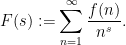
, form the Dirichlet series
For any non-integer
and any
, establish Perron’s formula
What happens when

Exercise 12 (Solution to Schrödinger equation) Letbe as in Proposition 3. Define the function
by the formula \{ u(t,x) := \int_R \hat f(\xi) e^{2\pi i x \xi – 4 \pi^2 i \xi^2 t} d\xi.\}
- (i) Show that
that obeys the Schrödinger equation
with initial condition
for
- (ii) Establish the formula
for
, where we use the standard branch of the square root.

— 2. Phragmen-Lindelof and Paley-Wiener —
The maximum modulus principle (Exercise 26 from 246A Notes 1) for holomorphic functions asserts that if a function continuous on a compact subset 


Theorem 13 (Lindelöf’s theorem) Letfor some
, which is holomorphic in the interior of the strip and obeys the bound
for all
and some constants
. Suppose also that
and
for all
and some
for all
and

Remark 14 The hypothesis (12) is a qualitative hypothesis rather than a quantitative one, since the exact values ofdo not show up in the conclusion. It is quite a mild condition; any function of exponential growth in
, or even with such super-exponential growth as
or
, will obey (12). The principle however fails without this hypothesis, as discussed previously.
Proof: By shifting and dilating (adjusting 


Suppose we temporarily assume that 


To remove the assumption that 


Corollary 15 (Phragmén-Lindelöf principle in a sector) Letfor some
, which is holomorphic on the interior of the sector and obeys the bound
for some
and
. Suppose also that
on the boundary of the sector
. Then one also has

Proof: Apply Theorem 13 to the function 

Exercise 16 With the notation and hypotheses of Theorem 13, show that the functionis log-convex on
Exercise 17 (Hadamard three-circles theorem) Let. Show that the function
is log-convex on
.
Exercise 18 (Phragmén-Lindelöf principle) Let, but suppose that we have the bounds
and
for all
and a constant
for all
(which is allowed to depend on the constants
in (12)). (Hint: it is convenient to work first in a half-strip such as
for some large
. Then multiply
for some suitable branch of the logarithm and apply a variant of Theorem 13 for the half-strip. A more refined estimate in this regard is due to Rademacher.) This particular version of the principle gives the convexity bound for Dirichlet series such as the Riemann zeta function. Bounds which exploit the deeper properties of these functions to improve upon the convexity bound are known as subconvexity bounds and are of major importance in analytic number theory, which is of course well outside the scope of this course.
Now we can establish a remarkable converse of sorts to Exercise 2(ii) known as the Paley-Wiener theorem, that links the exponential growth of (the analytic continuation) of a function with the support of its Fourier transform:
Theorem 19 (Paley-Wiener theorem) Letfor all
. Then the following are equivalent:
- (i) The Fourier transform
- (ii)
for some
.
- (iii)
for some

The continuity and decay hypotheses on
Proof: If (i) holds, then by Exercise 8, we have the inversion formula (4), and the claim (iii) then holds by a slight modification of Exercise 2(ii). Also, the claim (iii) clearly implies (ii).
Now we see why (iii) implies (i). We first assume that we have the stronger bound

 . Then we can apply Proposition 3 for any , and conclude in particular that
  and
and  . Applying (14) and the triangle inequality, we see that
 , we can then send
  and conclude that
  ; similarly for
  we can send
  and again conclude
  . This establishes (i) in this case.
Now suppose we only have the weaker bound on 


Finally, we show that (ii) implies (iii). The function 


— 3. The Hardy uncertainty principle —
Informally speaking, the uncertainty principle for the Fourier transform asserts that a function
 and all
  , which we will not prove here (see for instance Exercise 47 of this previous set of lecture notes).
Another manifestation of the uncertainty principle is the following simple fact:
Lemma 20
- (i) If
for all
, then the Fourier transform
is discrete.
- (ii) If
Proof: For (i), we observe from Exercise 2(iii) that
Lemma 20(ii) rules out the existence of a bump function whose Fourier transform is also a bump function, which would have been a rather useful tool to have in harmonic analysis over the reals. (Such functions do exist however in some non-archimedean domains, such as the 
Theorem 21 (Hardy uncertainty principle) Letfor all
for all
. Then
is a scalar multiple of the gaussian
, that is to say one has
for some
.
Proof: By replacing 



From Exercise 2(i),

 . Completing the square
  and using
  , we conclude the bound


 is bounded by on the imaginary axis. On the other hand, from hypothesis
  is also bounded by on the real axis. We can now almost invoke the Phragmén-Lindeöf principle (Corollary 15) to conclude that is bounded on all four quadrants, but the growth bound we have (15) is just barely too weak. To get around this we use the epsilon of room trick. For any , the function
  is still entire, and is still bounded by in magnitude on the real line. From (15) we have
  on the slightly tilted imaginary axis
  . We can now apply Corollary 15 in the two acute-angle sectors between
  and
and  to conclude that
  in those two sectors; letting , we conclude that
  in the first and third quadrants. A similar argument (using negative values of ) shows that in the second and fourth quadrants. By Liouville’s theorem, we conclude that is constant, thus we have
  for some complex number
  . The claim now follows from the Fourier inversion formula (Proposition 3(iv)) and Exercise 1.
 One corollary of this theorem is that if 


Exercise 22 Iffor some
and
for some
for some polynomial
of degree at most
Remark 23 There are many further variants of the Hardy uncertainty principle. For instance we have the following uncertainty principle of Beurling, which we state in a strengthened form due to Bonami, Demange, and Jaming: if, then