246B, Notes 3: Elliptic functions and modular forms
What's new 2021-02-03
On the real line, the quintessential examples of a periodic function are the (normalised) sine and cosine functions 


 and we obtain more general trigonometric polynomials that are -periodic; and the theory of Fourier series tells us that all other -periodic functions (with reasonable integrability conditions) can be approximated in various senses by such polynomial combinations. Using Euler’s identity, one can use
  and
and  in place of and as the basic generating functions here, provided of course one is willing to use complex coefficients instead of real ones. Of course, by rescaling one can also make similar statements for other periods than . -periodic functions
  can also be identified (by abuse of notation) with functions
  on the quotient space
  (known as the additive -torus or additive unit circle), or with functions
 ![{f: [0,1] \rightarrow {\bf C}}](https://s0.wp.com/latex.php?latex=%7Bf%3A+%5B0%2C1%5D+%5Crightarrow+%7B%5Cbf+C%7D%7D&bg=ffffff&fg=000000&s=0&c=20201002 "{f: [0,1] \rightarrow {\bf C}}") on the fundamental domain (up to boundary)
on the fundamental domain (up to boundary) ![{[0,1]}](https://s0.wp.com/latex.php?latex=%7B%5B0%2C1%5D%7D&bg=ffffff&fg=000000&s=0&c=20201002 "{[0,1]}") of that quotient space with the periodic boundary condition
of that quotient space with the periodic boundary condition  . The map
  also identifies the additive unit circle with the geometric unit circle
  , thanks in large part to the fundamental trigonometric identity
  ; this can also be identified with the multiplicative unit circle
  . (Usually by abuse of notation we refer to all of these three sets simultaneously as the “unit circle”.) Trigonometric polynomials on the additive unit circle then correspond to ordinary polynomials of the real coefficients
  of the geometric unit circle, or Laurent polynomials of the complex variable
  .
.What about periodic functions on the complex plane? We can start with singly periodic functions 



Proposition 1 (Description of singly holomorphic functions)In both cases, the coefficients
- (i) Every
where
is the nome
, and the
are complex coefficients such that
Conversely, every doubly infinite sequence
of coefficients obeying (2) gives rise to a
- (ii) Every bounded
on the upper half-plane
has an expansion
where the
Conversely, every infinite sequence
for every
).
by the Fourier inversion formula
for any
in
(in case (i)) or
(in case (ii)).





Proof: If 




For part (ii), we observe that the map 


Now let us turn attention to doubly periodic functions of a complex variable

 and some periods
  , which to avoid degeneracies we will assume to be linearly independent over the reals (thus
  are non-zero and the ratio
  is not real). One can rescale by a common scaling factor
  to normalise either
  or
or  , but one of course cannot simultaneously normalise both parameters in this fashion. As in the singly periodic case, such functions can also be identified with functions on the additive
  -torus
  , where
  is the lattice
  , or with functions on the solid parallelogram bounded by the contour
  (a fundamental domain up to boundary for that torus), obeying the boundary periodicity conditions
  in the edge
  , and
, and  in the edge
  .
.Within the world of holomorphic functions, the collection of doubly periodic functions is boring:
Proposition 2 Let
In the language of Riemann surfaces, this proposition asserts that the torus
Proof: The fundamental domain (up to boundary) enclosed by 
To obtain more interesting examples of doubly periodic functions, one must therefore turn to the world of meromorphic functions – or equivalently, holomorphic functions into the Riemann sphere 

 for -periodic real functions. This function will have a double pole at the origin
  , and more generally at all other points on the lattice , but no other poles. The derivative
  , and plays a role analogous to
  . Remarkably, all the other doubly periodic meromorphic functions with these periods will turn out to be rational combinations of
  and
and  ; furthermore, in analogy with the identity
  , one has an identity of the form
  (avoiding poles) and some complex numbers
  that depend on the lattice . Indeed, much as the map
  creates a diffeomorphism between the additive unit circle to the geometric unit circle
  , the map
  turns out to be a complex diffeomorphism between the torus and the elliptic curve
 maps the origin
  of the torus to the point
  at infinity. This fundamental identification with elliptic curves and tori motivates many of the further remarkable properties of elliptic curves; for instance, the fact that tori are obviously an abelian group gives rise to an abelian group law on elliptic curves (and this law can be interpreted as an analogue of the trigonometric sum identities for
  ). The description of the various meromorphic functions on the torus also helps motivate the more general Riemann-Roch theorem that is a fundamental law governing meromorphic functions on other compact Riemann surfaces (and is discussed further in these 246C notes). So far we have focused on studying a single torus . However, another important mathematical object of study is the space of all such tori, modulo isomorphism; this is a basic example of a moduli space, known as the (classical, level one) modular curve
  . This curve can be described in a number of ways. On the one hand, it can be viewed as the upper half-plane
  quotiented out by the discrete group
  ; on the other hand, by using the
  -invariant, it can be identified with the complex plane ; alternatively, one can compactify the modular curve and identify this compactification with the Riemann sphere . (This identification, by the way, produces a very short proof of the little and great Picard theorems, which we proved in 246A Notes 4.) Functions on the modular curve (such as the -invariant) can be viewed as -invariant functions on , and include the important class of modular functions; they naturally generalise to the larger class of (weakly) modular forms, which are functions on which transform in a very specific way under -action, and which are ubiquitous throughout mathematics, and particularly in number theory. Basic examples of modular forms include the Eisenstein series, which are also the Laurent coefficients of the Weierstrass elliptic functions . More number theoretic examples of modular forms include (suitable powers of) theta functions
  , and the modular discriminant
  . Modular forms are -periodic functions on the half-plane, and hence by Proposition 1 come with Fourier coefficients ; these coefficients often turn out to encode a surprising amount of number-theoretic information; a dramatic example of this is the famous modularity theorem, (a special case of which was) used amongst other things to establish Fermat’s last theorem. Modular forms can be generalised to other groups than and to other domains than the half-plane , leading to the important larger class of automorphic forms, which are of major importance in number theory and representation theory, but which are well outside the scope of this course to discuss.
— 1. Doubly periodic functions —
Throughout this section we fix two complex numbers 

We now study the doubly periodic meromorphic functions with respect to these periods that are not identically zero. We first observe some constraints on the poles of these functions. Of course, by periodicity, the poles will themselves be periodic, and thus the set of poles forms a finite union of disjoint cosets 

Lemma 3 (Consequences of residue theorem) Letbe a doubly periodic meromorphic function (not identically zero) with periods
- (i) The sum of residues at each
(i.e., we sum one residue per coset) is equal to zero.
- (ii) The number of poles
(again counting multiplicity, and once per coset).
- (iii) The sum of the poles
Proof: For (i), we first apply a translation so that none of the pole cosets

 , which is also doubly periodic.
For part (iii), we again translate so that none of the pole or zero cosets intersects
 . But one can rewrite this using the double periodicity as
 is an integer for
  . But (a slight modification of) the argument principle shows that this number is precisely the winding number around the origin of the image of
  under the map
  , and the claim follows.
This lemma severely limits the possible number of behaviors for the zeroes and poles of a meromorphic function. To formalise this, we introduce some general notation:
Definition 4 (Divisors)
- (i) A divisor on the torus
is a formal integer linear combination
, where
ranges over a finite collection of points in the torus
), and
are integers, with the obvious additive group structure; equivalently, the space
of divisors is the free abelian group with generators
for
(with the convention
).
- (ii) The number
is the degree
of a divisor
is the sum
of
, and each
of the divisor at
for all
if
is non-negative (i.e., the order of
is greater than or equal to that of
at every point
if
.
- (iii) Given a meromorphic function
(or equivalently, a doubly periodic function
is the divisor
, where
is the order of the zero (if
- (iv) Given a divisor
to be the space of all meromorphic functions
. That is to say,
if
A divisor can be viewed as an abstraction of the concept of a set of zeroes and poles (counting multiplicity). Observe that principal divisors obey the laws 



Remark 5 One can define divisors on other Riemann surfaces, such as the complex plane, then
if and only if
as a polynomial. This may give some hint as to the origin of the terminology “divisor”. The machinery of divisors turns out to have a rich algebraic and topological structure when applied to more general Riemann surfaces than tori, for instance enabling one to associate an abelian variety (the Jacobian variety) to every algebraic curve; see these 246C notes for further discussion.
It is easy to see that 

Liouville’s theorem (in the form of Proposition 2) tells us that all elements of 

Now we gradually work our way up to higher degree divisors
Lemma 6 For any divisor,
of codimension at least one. In particular,
Proof: It is clear that 


Now consider the space 
Now let us study the space 
 defined by the formula (6). Let us first verify that the series in (6) is absolutely convergent for
  . There are only finitely many
  with
with  , and all the summands are finite for
  , so we only need to establish convergence of the tail

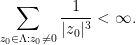
 of the fundamental domain ) shows that the number of lattice points in any disk
  ,
,  is
is  , and so by dyadic decomposition as in Notes 1, the series is absolutely convergent. Further repetition of the arguments from Notes 1 shows that the series in (6) converges locally uniformly in
  , and thus is holomorphic on this set. Furthermore, for any , the same arguments show that
  stays bounded in a punctured neighbourhood of , thus by the Riemann singularity removal theorem
  is equal to
  plus a bounded holomorphic function in the neighbourhood of . Thus is meromorphic with double poles (and vanishing residue) at every lattice point , and no other poles.
Now we show that 



 it telescopes to zero. The claim then follows by Fubini’s theorem.
By construction, 
From (6) it is also clear that the function 





 lies in the half-lattice
  but not in (thus, it lies in one of the half-periods
  ,
,  , or
, or  ) then from the even and doubly periodic nature of we see that
  for all
  , so
, so  in fact must have at least a double zero at , and again from Lemma 3(ii) these are the only zeroes of this function. So the identity (9) also holds in this case.
Exercise 7 (Classification of principal divisors)
- (i) Let
be four points
. Show that the divisor
is a principal divisor. (Hint: if
are all distinct, use the function
If some of the
- (ii) Show that every divisor of degree zero and sum zero is a principal divisor.
- (iii) Two divisors are said to be equivalent if their difference is a principal divisor. Show that two divisors are equivalent if and only if they have the same degree and same sum.
- (iv) Show that the quotient group
(known as the divisor class group or Picard group) is isomorphic (as a group) to
, and that the subgroup
arising from degree zero divisors (also known as the Jacobian variety of


Now let us study the space 


 in from one point
  to another
  , and the claim (7) now follows from another appeal to the fundamental theorem of calculus. Of course, will then also be three-dimensional for any other point on the torus. From (7) we also see that is odd; this also follows from the even nature of . From the oddness and periodicity has to have zeroes at the half-periods
  ; in particular, from Lemma 3(ii) there are no other zeroes, and the principal divisor is given by
Turning now to 


Something interesting happens though at 






 , so that the function
  , which extends holomorphically to the origin, has
  derivative equal to
  , where the Eisenstein series
  is defined by the formula
 case with convention
  . Note from the symmetric nature of that vanishes for odd
  ; this is consistent with the even nature of . We thus have the Laurent expansion
 near zero. This then gives the further Laurent expansions



 into a linear combination of
  does not actually involve (as this function is the only one that has a
  term in its Laurent expansion), and on comparing
  coefficients we see that the coefficient of must be
  . Thus we have a linear relationship of the form (8) for some coefficients
  , which on inspection of the
  and constant terms leads to the formulae
Exercise 8 (Classification of doubly periodic meromorphic functions)
- (i) For any
, show that
has dimension
- (ii) Show that every doubly periodic meromorphic function is a rational function of
We have an alternate form of (8):
Exercise 9 Define the roots,
,
.
- (i) Show that
are distinct, and that
for all
,
, and
.
- (ii) Show that the modular discriminant
is equal to
, and is in particular non-zero.


If we now define the elliptic curve


 together with the point at infinity (where the notions of “curve” and “plane” are relative to the underlying complex field rather than the more familiar real field ), then we have a map
  to
to  , with the convention that the origin is mapped to the point at infinity . For instance, the half-periods , , are mapped to the points
  of respectively.
Lemma 10 The mapdefined by (11) is a bijection between
Among other things, this lemma implies that the elliptic curve 
Proof: Clearly 




Analogously to the Riemann sphere 
- (i) When
is a point in
of the square root of
near
- (ii) In the neighbourhood of
for some
, the function
has a simple zero at
and so has a local inverse
that maps a neighbourhood of
. One can then use
as a coordinate function in a neighbourhood of
- (iii) A neighbourhood of
sufficiently large; then
, so in particular
and
should both go to zero as
of the curve in terms of
. The function
has a simple zero at zero and thus has a holomorphic local inverse
that maps
in a neighbourhood of infinity. We can then use
It is then a tedious but routine matter to check that 

 , so in particular the coordinate takes the form
  where the error term
  is holomorphic, with mapping to . In particular the map is a local complex diffeomorphism here and again we have holomorphicity. We thus conclude that the elliptic curve is complex diffeomorphic to the torus using the map . From Exercise 8, the meromorphic functions on may be identified with the rational functions on .
While we have shown that all tori are complex diffeomorphic to elliptic curves, the converse statement that all elliptic curves are diffeomorphic to tori will have to wait until the next section for a proof, once we have set up the machinery of modular forms.
Exercise 11 (Group law on elliptic curves)
- (i) Let
be three distinct elements of the torus
if and only if the three points
,
,
are collinear in
for some complex numbers
with
not both zero.
- (ii) What happens in (i) if (say)
?
- (iii) Using (i), (ii), give a purely geometric definition of a group addition law on the elliptic curve
Exercise 12 (Addition law) Show that for anylying in distinct cosets of

Exercise 13 (Special case of Riemann-Roch)
- (i) Show that if two divisors
are equivalent (in the sense of Exercise 7(iii)), then the vector spaces
are isomorphic (in particular, they have the same dimension).
- (ii) If
, show that the dimension of the space
, equal to
, equal to
and
- (iii) Verify the identity
for any divisor

Exercise 14 (Elliptic integrals)
- (i) Show that
to the thrice-punctured plane
.
- (ii) Let
to another complex number
, and suppose that there is a holomorphic branch
of the square root of
with
,
such that

Remark 15 The integralis an example of an elliptic integral; many other elliptic integrals (such as the integral arising when computing the perimeter of an ellipse) can be transformed into this form (or into a closely related integral) by various elementary substitutions. Thus the Weierstrass elliptic function
, where
are the standard coordinates on the elliptic curve
, but this identity in fact reveals that the form extends holomorphically to all of
Remark 16 The elliptic curve
— 2. Modular functions and modular forms —
In Exercise 32 of 246A Notes 5, it was shown that two tori 

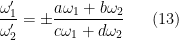
 with
with  . From this it is not difficult to see that if
  are two lattices in , then and
  are diffeomorphic if and only if
  for some , i.e., the lattices are complex dilations of each other.
Let us write 


 with . Recall that the Möbius transformation
  preserves (see Exercise 20 of 246A Notes 5), so the
  sign here must actually be positive. We can interpret this in terms of the action of the matrix group
  by Möbius transformation
 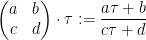 are equivalent if and only if the period ratios
  lie in the same orbit of . Thus we can identify the modular curve (as a set, at least) with the quotient space
  . Actually if one wished one could replace here with the projective subgroup
  , since the negative identity matrix
  acts trivially on .
If we use the relation

 approaches the real line as
  , which amongst other things makes the action of on proper (for any compact set
  , one has
  intersecting
  for at most finitely many
  . If acted freely on (i.e., any element of other than the identity and negative identity has no fixed points in ), then the quotient would be a Riemann surface by the discussion in Section 2 of 246A Notes 5. Unfortunately, this is not quite true. For instance, the point
  is fixed by the Möbius transformation
  coming from the rotation matrix
  of , and the point
  is similarly fixed by the transformation
  coming from the matrix
  of . Geometrically, these fixed points come from the fact that the Gaussian integgers
  are invariant with respect to rotation by
  , while the Eisenstein integers
  are invariant with respect to rotation by
  . On the other hand, these are basically the only two places where the action is not free:
Exercise 17 Suppose that.
- (i) Show that
for some complex number
- (ii) Show that the dilation
- (iii) Show that there is no rotation invariance
with
. (Hint: again, work with a non-zero element of
- (iv) Show that
or
.
Remark 18 The conformal mapon the complex numbers preserves the Gaussian integers
to itself; similarly the conformal map
preserves the Eisenstein integers and thus descends to a conformal map from the Eisenstein torus
to itself. These rare examples of complex tori equipped with additional conformal automorphisms are examples of tori (or elliptic curves) endowed with complex multiplication. There are additional examples of elliptic curves endowed with conformal endomorphisms that are still considered to have complex multiplication, and have a particularly nice algebraic number theory structure, but we will not pursue this topic further here.
If we let 


A function 


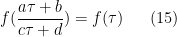 and are integers with
  . Similarly if takes values in the Riemann sphere rather than . If is holomorphic (resp. meromorphic) on , this will in particular define a holomorphic (resp. meromorphic) function on , and morally to all of as well (although we have not yet defined a Riemann structure on all of ).
 We define a modular function to be a meromorphic function
 with sufficiently large imaginary part, and some constants
  (this bound is needed for technical reasons to ensure “meromorphic” behaviour at the cusp , as opposed to an essential singularity). Specialising to the matrices
  -periodicity
 . Conversely, these two special cases of (15) imply the general case:
Exercise 19
- (i) Let
be two elements of
with
to the quadruplet
after a finite number of applications of the moves
and
({Hint: use the principle of infinite descent, applying the moves in a suitable order to decrease the lengths of
and
when the dot product
is not too small, taking advantage of the Lagrange identity
to determine when this procedure terminates. It may help to think geometrically and draw plenty of pictures.) Conclude that the two matrices (17) generate all of
- (ii) Show that a function


Exercise 20 (Standard fundamental domain) Define the standard fundamental domainfor
- (i) Show that every lattice
with
, with
for some
, or from the pair
for some
. (Hint: arrange
- (ii) Show that
with
for
with
for
from

We will give some examples of modular functions (beyond the trivial example of constant functions) shortly, but let us first observe that when one differentiates a modular function one gets a more general class of function, known as a modular form. In more detail, observe from (14) that the derivative of the Möbius transformation 

 for any natural number to be a meromorphic function
  which obeys the modularity relation
  and all integers with (with the convention that
  for any non-zero complex
  ), and which is meromorphic at the cusp in the sense of (16). Thus for instance modular functions are weakly modular forms of weight . A modular form of weight is a weakly modular form of weight which is holomorphic (not just meromorphic) on , and also “holomorphic at ” in the sense that
  is bounded for
  large enough. Note that as viewed a function
  of the nome
  , a modular form can be thought of as a certain type of holomorphic function
  on the disk (using the Riemann singularity removal theorem to remove the singularity at the origin
  ), while weakly modular forms (and in particular modular functions) are certain types of meromorphic functions on this disk. A modular form that vanishes at infinity is known as a cusp form.
Exercise 21 Letfor all

Exercise 22 (Lattice interpretation of modular forms) Letfor all
for any lattice


Observe that the product of a modular form of weight 

Somewhat analogously to how we used Lemma \reef{dude} to investigate the spaces
Theorem 23 (Valence formula) Letwhere
is the order of vanishing of
,
is the order of vanishing of
(i.e.,
, with just one zero counted per equivalence class. (This will be a finite sum.)

Informally, this formula asserts that the point 


Proof: Firstly, from Exercise 20, we can place all the zeroes
As in the proof of Lemma 3(ii), we use the residue theorem. For simplicity, let us first suppose that there are no zeroes on the boundary of the fundamental domain 
 is the closed contour consisting of the polygonal path
  concatenated with the circular arc
  . From the -periodicity, the contribution of the two vertical edges
  and
and  cancel each other out. The contribution of the horizontal edge
  can be written using the change of variables as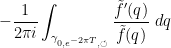
 . Finally, using the modularity (21), one calculates that the contribution of the left arc
  is equal to
  minus the contribution of the right arc
  . This gives the proof of the valence theorem in the case that there are no zeroes on the boundary of .
Suppose now that there is a zero on the right edge 



Exercise 24 (Quick applications of the valence formula)
- (i) Let
- (ii) (Liouville theorem for
of
- (iii) For
, show that the vector space of modular forms of weight
with
- (iv) Show that there are no cusp forms of weight
or
, and for
the space of cusp forms of weight
- (v) Show that for any
A basic example of modular forms are provided by the Eisenstein series
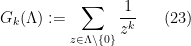
 greater than two (we ignore the odd Eisenstein series as they vanish). We can view this as a function on by the formula
  are integers with , then
  . Inserting this into (23), (24) we conclude that
 , so
, so  is holomorphic. Also, using the bounds
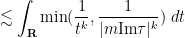
 , while
 is the famous Riemann zeta function
 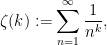 and using the hypothesis
  that
that  is bounded at infinity. Summarising, we have established that the Eisenstein series is a modular form of weight , which is not identically zero (since it approaches the non-zero value
  at the cusp ). Combining this with Exercise 24(iii), we see that we have completely classified the modular forms of weight for , namely they are the scalar multiples of . For instance, the coefficients
 and weight
  respectively, and the modular discriminant
 . From that exercise, this modular form never vanishes on , hence by the valence formula it must have a simple zero at , and in particular is a cusp form. From Exercise 24 it is the unique cusp form of weight , up to constants.
Exercise 25 Give an alternate proof thatand
.
We can now create our first non-trivial modular function, the
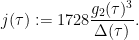
 is traditional, as it gives a nice normalisation at , as we shall see later. One can take advantage of complex multiplication to compute two special values immediately:
Lemma 26 We haveand
.
Proof: Using the rotation symmetry 



Being modular, we can think of
Proposition 27 The mapis a bijection.
Proof: Note that for any 



-
-
-
Note that this proof also shows that 


We can now give the entire modular curve 

Proposition 28 Every modular function is a rational function of the
Conversely, it is clear that every rational function of
Exercise 29 Show that every modular function is the ratio of two modular forms of equal weight (with the denominator not identically zero).
Exercise 30 (All elliptic curves are tori) Letbe two complex numbers with
. Show that there is a lattice
and
, so in particular the elliptic curve
is complex diffeomorphic to a torus

Remark 31 By applying some elementary algebraic geometry transformations one can show that any (smooth, irreducible) cubic plane curvegenerated by a polynomial
of degree
can also be placed in this form. However we will not detail the required transformations here.

A famous application of the theory of the
Theorem 32 (Little Picard theorem) Letomits at most one point of
Proof: Suppose for contradiction that 

Theorem 33 (Great Picard theorem) Letbe holomorphic on a disk
outside of a singularity at
omits at most one point of
Proof: Again, suppose for sake of contradiction that 


All modular forms are
Exercise 34 Letbe the nome. Establish the identity
in two different ways:
- (i) By applying the Poisson summation formula (Proposition 3(v) of Notes 2).
- (ii) By first establishing the identity
by applying Proposition 1 to the difference of the two sides, and differentiating in


From (25), (26) (and symmetry) one has


 it is not difficult to show that the double sum here is absolutey convergent and can be rearranged as we please. If we group the terms based on the product
  we thus have the Fourier expansion
 divisor function
  is defined by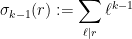
 that divide
  . Thus for instance
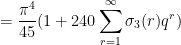
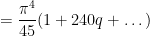





 in the definition of the -invariant normalises the “residue” of at infinity to equal .
 Remark 35 If one expands out a few more terms in the above expansions, one can calculateThe various coefficients in here have several remarkable algebraic properties. For instance, applying this expansion at
for a natural number
, one obtains the approximation
Now for certain values of
, the torus
admits a complex multiplication that allows for computation of the
admit unique factorisation, see these previous notes for some related discussion). For instance, one can eventually establish that
which eventually leads to the famous approximation
(first observed by Hermite, but also attributed to Ramanujan via an April Fools’ joke of Martin Gardner) which is accurate to twelve decimal places. The remaining coefficients have a remarkable interpretation as dimensions of components of a certain representation of the monster group known as the moonshine module, a phenomenon known as monstrous moonshine. For instance, the smallest irreducible representation of the monster group has dimension
, precisely one less than the
of the (normalised) modular discriminant,
form a sequence known as the Ramanujan
whenever
are coprime; see Exercise 40.



Exercise 36 (Dimension of space of modular forms)
- (i) If
except when
. (Hint: for
this follows from Exercise 24; to cover the larger ranges of
is isomorphic to the space of modular forms of weight
- (ii) If
where
range over natural numbers (including zero) with
.
Thus far we have constructed modular forms and modular functions starting from Eisenstein series
 that goes to zero as
  . It is not quite a modular form, but is -periodic (instead of -periodic) in the sense that
  , and from Poisson summation (see Exercise 7 of Notes 2) we have the variant
Exercise 37 Define the Dedekind eta functionby the formula
or in terms of the nome
where
is one of the
roots of
- (i) Establish the modified
and the modified modularity
using the standard branch of the square root. (Hint: a direct application of Poisson summation applied to
gives a sum that looks somewhat like
but with different numerical constants (in particular, one sees terms like
instead of
arising). Split the index of summation
into three components
,
,
based on the residue classes modulo
- (ii) Establish the identity
(Hint: show that both sides are cusp forms of weight
near the cusp.)





Remark 38 The relationship betweenbetween the modular descriminant
of a certain highly symmetric
-dimensional lattice
known as the Leech lattice, but we will not pursue this connection further here.
The 


Theorem 39 (Jacobi triple product identity) For any, one has


Observe that by replacing 


 modulo . One can obtain many further identities of this type by other substitutions; for instance, by setting
  in the triple product identity, one obtains
Proof: Let us denote the left-hand side and right-hand side of (31) by 



 -periodicity


 also obeys the same modified -periodicity
 is meromorphic and doubly periodic. Furthermore, one checks that only vanishes when is equal to
  modulo
  with a simple zero at those locations, so the ratio has at most a single simple pole on the torus
  and thus constant by the discussion after Lemma 6 (alternatively, one can show that also vanishes at this point and apply Proposition 2). Thus there is some quantity
  depending only on for which we have the identity
 . To exploit this, we first set
  and replace by
  to conclude that


 and not modify , we have
  and
and  on the left-hand sides cancel when is odd, so that on making the substitution
  we obtain



 as
as  . If we then iterate (34) we conclude that
Theta functions can be used to encode various number-theoretic quantities involving quadratic forms, such as sums of squares. For instance, from (29) and collecting terms one obtains the formula
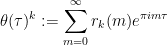 , where
  denotes the number of ways to express a natural number as the sum
  of squares of integers. From Fourier inversion (Proposition 1 and a rescaling) one then has a representation
  , which allows one to obtain asymptotics for
  when is large through estimation of the theta function (this is an example of the circle method); moreover, explicit identities relating the theta function to other near-modular forms (such as the Eisenstein series and their relatives) can be used to obtain exact formulae for for small values of that can be used for instance to establish the famous Lagrange four-square theorem that all natural numbers are the sum of four squares. We refer the reader to the Stein-Shakarchi text for an exposition of this connection.
Exercise 40 (Hecke operators) LetSimultaneous eigenfunctions of the Hecke operators are known as Hecke eigenfunctions and are of major importance in number theory.
- (i) If
of weight
on lattices is related to
where the sum ranges over all sublattices
of
is equal to
is a linear operator on the space of weight
- (ii) Give the more explicit formula
- (iii) Show that the Hecke operators all commute with each other, thus
whenever
if
- (iv) If
, show that for any coprime positive integers
coefficient of
.
- (v) Establish the multiplicativity
![\displaystyle G(\Lambda) := m^{k-1} \sum_{\Lambda' \subset \Lambda: [\Lambda:\Lambda'] = m} F(\Lambda')](https://s0.wp.com/latex.php?latex=%5Cdisplaystyle++G%28%5CLambda%29+%3A%3D+m%5E%7Bk-1%7D+%5Csum_%7B%5CLambda%27+%5Csubset+%5CLambda%3A+%5B%5CLambda%3A%5CLambda%27%5D+%3D+m%7D+F%28%5CLambda%27%29&bg=ffffff&fg=000000&s=0&c=20201002 "\displaystyle G(\Lambda) := m^{k-1} \sum_{\Lambda' \subset \Lambda: [\Lambda:\Lambda'] = m} F(\Lambda')")
