246B, Notes 4: The Riemann zeta function and the prime number theorem
What's new 2021-02-12
One of the great classical triumphs of complex analysis was in providing the first proof (by Hadamard and de Vallée Poussin in 1896) of arguably the most important theorem in analytic number theory, the prime number theorem:
Theorem 1 (Prime number theorem) Letdenote the number of primes less than a given real number
. Then
(or in asymptotic notation,
as
).
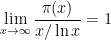
(Actually, it turns out to be slightly more natural to replace the approximation 

The complex-analytic proof of this theorem hinges on the study of a key meromorphic function related to the prime numbers, the Riemann zeta function 

Definition 2 (Riemann zeta function, preliminary definition) Letbe such that
. Then we define
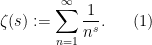
Note that the series is locally uniformly convergent in the half-plane

The Riemann zeta function has several remarkable properties, some of which we summarise here:
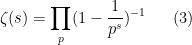
Theorem 3 (Basic properties of the Riemann zeta function)
- (i) (Euler product formula) For any
where the product is absolutely convergent and is over the prime numbers
.
- (ii) (Trivial zero-free region)
has no zeroes in the region
.
- (iii) (Meromorphic continuation)
and no other poles. Furthermore, the Riemann xi function
is an entire function of order
(after removing all singularities). The function
is an entire function of order one after removing the singularity at
- (iv) (Functional equation) After applying the meromorphic continuation from (iii), we have
for all
for all



Proof: We just prove (i) and (ii) for now, leaving (iii) and (iv) for later sections.
The claim (i) is an encoding of the fundamental theorem of arithmetic, which asserts that every natural number 


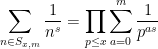
 ,
,  , and
, and  consists of all the natural numbers of the form
  for some
  . Sending
  and to infinity, we conclude from monotone convergence and the geometric series formula that
 is real, and then from dominated convergence we see that the same formula holds for complex
  with as well.
The claim (ii) is immediate from (i) since the Euler product 

We remark that by sending
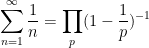
 . This can be viewed as a weak version of the prime number theorem, and already illustrates the potential applicability of the Riemann zeta function to control the distribution of the prime numbers.
The meromorphic continuation (iii) of the zeta function is initially surprising, but can be interpreted either as a manifestation of the extremely regular spacing of the natural numbers 
Henceforth we work with the meromorphic continuation of 
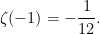
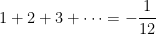
From Theorem 3 and the non-vanishing nature of 




 by (1), hence for all (except the pole at ) by meromorphic continuation. Thus if is a non-trivial zero then so is
  . We conclude that the set of non-trivial zeroes is symmetric by reflection by both the real axis and the critical line
  . We have the following infamous conjecture:
Conjecture 4 (Riemann hypothesis) All the non-trivial zeroes of
This conjecture would have many implications in analytic number theory, particularly with regard to the distribution of the primes. Of course, it is far from proven at present, but the partial results we have towards this conjecture are still sufficient to establish results such as the prime number theorem.
Return now to the original region where
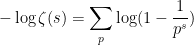
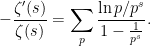
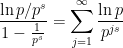
 , where the von Mangoldt function
  is defined to equal
  whenever
  is a power
  of a prime
  for some
  , and
, and  otherwise. The contribution of the higher prime powers
  is negligible in practice, and as a first approximation one can think of the von Mangoldt function as the indicator function of the primes, weighted by the logarithm function.
The series 

Exercise 5 (Standard Dirichlet series) Let
- (i) Show that
.
- (ii) Show that
, where
is the divisor function of
- (iii) Show that
, where
is the Möbius function, defined to equal
when
distinct primes for some
, and
otherwise.
- (iv) Show that
, where
is the Liouville function, defined to equal
- (v) Show that
, where
is the holomorphic branch of the logarithm that is real for
vanishes for
.
- (vi) Use the fundamental theorem of arithmetic to show that the von Mangoldt function is the unique function
such that
for every positive integer
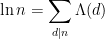
Given the appearance of the von Mangoldt function 
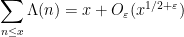
Theorem 6 (Prime number theorem, von Mangoldt form) One has(or in asymptotic notation,
as
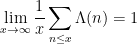
Let us see how Theorem 6 implies Theorem 1. Firstly, for any 
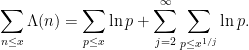
 is non-zero for only
  values of
  , and is of size
  , thus
 , we conclude from Theorem 6 that
 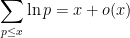 . Next, observe from the fundamental theorem of calculus that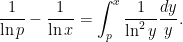
 and summing over all primes
  , we conclude that
 , thus
 and
and  we see that the right-hand side is
  , and Theorem 1 follows.
Exercise 7 Show that Theorem 1 conversely implies Theorem 6.
The alternate form (8) of the Euler product identity connects the primes (represented here via proxy by the von Mangoldt function) with the logarithmic derivative of the zeta function, and can be used as a starting point for describing further relationships between
Theorem 8 (Riemann-von Mangoldt explicit formula) For any non-integer, we have
where
. Furthermore, the convergence of the limit is locally uniform in

Actually, it turns out that this formula is in some sense too precise; in applications it is often more convenient to work with smoothed variants of this formula in which the sum on the left-hand side is smoothed out, but the contribution of zeroes with large imaginary part is damped; see Exercise 22. Nevertheless, this formula clearly illustrates how the non-trivial zeroes

 )
) 
 induces an oscillation in the von Mangoldt function, with
  controlling the frequency of the oscillation and
  the rate to which the oscillation dies out as
  . This relationship is sometimes known informally as “the music of the primes”.
Comparing Theorem 8 with Theorem 6, it is natural to suspect that the key step in the proof of the latter is to establish the following slight but important extension of Theorem 3(ii), which can be viewed as a very small step towards the Riemann hypothesis:
Theorem 9 (Slight enlargement of zero-free region) There are no zeroes of.
It is not quite immediate to see how Theorem 6 follows from Theorem 8 and Theorem 9, but we will demonstrate it below the fold.
Although Theorem 9 only seems like a slight improvement of Theorem 3(ii), proving it is surprisingly non-trivial. The basic idea is the following: if there was a zero at 


 can be negative for large regions of the variable , whereas is always non-negative. This conflict eventually leads to a contradiction, but it is not immediately obvious how to make this argument rigorous. We will present here the classical approach to doing so using a trigonometric identity of Mertens.
In fact, Theorem 9 is basically equivalent to the prime number theorem:
Exercise 10 For the purposes of this exercise, assume Theorem 6, but do not assume Theorem 9. For any non-zero realas
, where
denotes a quantity that goes to zero as
. Use this to derive Theorem 9.
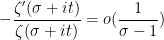
This equivalence can help explain why the prime number theorem is remarkably non-trivial to prove, and why the Riemann zeta function has to be either explicitly or implicitly involved in the proof.
This post is only intended as the briefest of introduction to complex-analytic methods in analytic number theory; also, we have not chosen the shortest route to the prime number theorem, electing instead to travel in directions that particularly showcase the complex-analytic results introduced in this course. For some further discussion see this previous set of lecture notes, particularly Notes 2 and Supplement 3 (with much of the material in this post drawn from the latter).
— 1. Meromorphic continuation and functional equation —
We now focus on understanding the meromorphic continuation of 

One way to motivate the meromorphic continuation



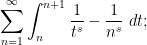
 , it is a routine application of the Fubini and Morera theorems to establish analytic continuation of the residual to the half-plane
  , thus giving a meromorphic extension
  to the region
  . Among other things, this shows that (the meromorphic continuation of) has a simple pole at with residue .
Exercise 11 Using the trapezoid rule, show that for anywith
, there exists a unique complex number
for any natural number
, where
. Use this to extend the Riemann zeta function meromorphically to the region
and
.

Exercise 12 Obtain the refinement
to the trapezoid rule when
are integers and
is continuously three times differentiable. Then show that for any
with
, there exists a unique complex number
for any natural number
.



One can keep going in this fashion using the Euler-Maclaurin formula (see this previous blog post) to extend the range of meromorphic continuation to the rest of the complex plane. However, we will now proceed in a different fashion, using the theta function

 of the argument in the upper half-plane (so
  ); from Exercise 7 of Notes 2 we have the modularity relation
 decays exponentially to as , blows up like
  as
as  .
.We will attempt to apply the Mellin transform (Exercise 11 from Notes 2) to this function; formally, we have
 := \int_0^\infty x^s \theta(ix) \frac{dx}{x}.](https://s0.wp.com/latex.php?latex=%5Cdisplaystyle++%7B%5Cmathcal+M%7D%5B%5Ctheta%28i%5Ccdot%29%5D%28s%29+%3A%3D+%5Cint_0%5E%5Cinfty+x%5Es+%5Ctheta%28ix%29+%5Cfrac%7Bdx%7D%7Bx%7D.&bg=ffffff&fg=000000&s=0&c=20201002 "\displaystyle {\mathcal M}[\theta(i\cdot)](s) := \int_0^\infty x^s \theta(ix) \frac{dx}{x}.") goes to infinity, converges to one, and the integral here is unlikely to be convergent. So we will compute the Mellin transform of
goes to infinity, converges to one, and the integral here is unlikely to be convergent. So we will compute the Mellin transform of  :
: 
 decays exponentially as , and blows up like
  as , so this integral will be absolutely integrable when
  . Since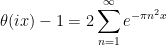


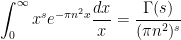

 . Replacing by
  , we can rearrange this as a formula for the
  function (4), namely
  .
.Now we exploit the modular identity (12) to improve the convergence of this formula. The convergence of 


 to obtain


 . However, the integrand here is holomorphic in and exponentially decaying in , so from the Fubini and Morera theorems we easily see that the right-hand side is an entire function of ; also from inspection we see that it is symmetric with respect to the symmetry
  . Thus we can define as an entire function, and hence as a meromorphic function, and one verifies the functional equation (6).
It remains to establish that 



 (say), and hence is of order at most as required. (One can show that has order exactly one by inspecting what happens to
  as
as  , using that
  in this regime.) This completes the proof of Theorem 3.
Exercise 13 (Alternate derivation of meromorphic continuation and functional equation)
- (i) Establish the identity
whenever
- (ii) Establish the identity
whenever
,
where
is the branch of the logarithm with real part in
, and
is the contour consisting of the line segment
, the semicircle
, and the line segment
.
- (iii) Use (ii) to meromorphically continue
.
- (iv) By shifting the contour
for a large natural number
again using the branch
.
- (v) Establish the functional equation (5).
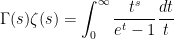


Exercise 14 Use the formulafrom Exercise 12, together with the functional equation, to give yet another proof of the identity
.
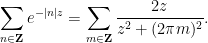
Exercise 15 (Relation between zeta function and Bernoulli numbers)
- (i) For any complex number
with
, use the Poisson summation formula (Proposition 3(v) from Notes 2) to establish the identity
- (ii) For
Conclude that
for any natural number
are defined through the Taylor expansion
Thus for instance
,
, and so forth.
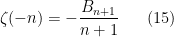
- (iii) Show that
for any odd natural number
- (iv) Use (14) and the residue theorem (now working inside the contour
, rather than outside) to give an alternate proof of (15).



Exercise 16 (Convexity bounds)It is possible to improve the bounds (iii) in the region
- (i) Establish the bounds
for any
and
with
.
- (ii) Establish the bounds
for any
and
- (iii) Establish the bounds
for any
and
; such improvements are known as subconvexity estimates. For instance, it is currently known that
for any
and
, although this remains unproven (it is however a consequence of the Riemann hypothesis).
Exercise 17 (Riemann-von Mangoldt formula) Show that for any, the number of zeroes of
is equal to
. (Hint: apply the argument principle to
for some
that is chosen so that the horizontal edges of the rectangle do not come too close to any of the zeroes (cf. the selection of the radii
in the proof of the Hadamard factorisation theorem in Notes 1), and use the functional equation and Stirling’s formula to control the asymptotics for the horizontal edges.)
We remark that the error term
, due to von Mangoldt in 1905, has not been significantly improved despite over a century of effort. Even assuming the Riemann hypothesis, the error has only been reduced very slightly to
(a result of Littlewood from 1924).
Remark 18 Thanks to the functional equation and Rouche’s theorem, it is possible to numerically verify the Riemann hypothesis in any finite portionof the critical strip, so long as the zeroes in that strip are all simple. Indeed, if there was a zero
off of the critical line
, then an application of the argument principle (and Rouche’s theorem) in some small contour around
on the critical line, applying the argument principle for some small contour around that zero and symmetric around the critical line would numerically verify that there was exactly one zero within that contour, which by the functional equation would then have to lie exactly on that line. (In practice, more efficient methods are used to numerically verify the Riemann hypothesis over large finite portions of the strip, but we will not detail them here.)
— 2. The explicit formula —
We now prove Riemann-von Mangoldt explicit formula. Since
 , where ranges over the non-trivial zeroes of (note from Exercise 11 that there is no zero at the origin), and
  is some constant. From (4) we can calculate



One can compute the values of 
Exercise 19 By inspecting both sides of (16) as, show that
, and hence
.
Jensen’s formula tells us that the number of non-trivial zeroes of 


Exercise 20 (Local bound on zeroes)
- (i) Establish the upper bound
whenever
and
. (Hint: use (10). More precise bounds are available with more effort, but will not be needed here.)
- (ii) Establish the bounds
uniformly in
- (iii) Show that for any
is
- (iv) For
, and
, with
(Hint: use Exercise 9 of Notes 1.)
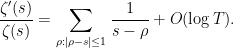
Meanwhile, from Perron’s formula (Exercise 12 of Notes 2) and (8) we see that for any non-integer 

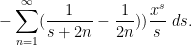
Exercise 21 (Riemann-von Mangoldt explicit formula) Let(Hint: for (i)-(iii), shift the contour
- (i)
.
- (ii)
.
- (iii) For any positive integer
- (iv) For any non-trivial zero
- (v) We have
.
- (vi) We have
.
to
for an
that gets sent to infinity, and using the residue theorem. The same argument works for (iv) except when
, in which case a detour to the contour may be called for. For (vi), use Exercise 20 and partition the zeroes depending on what unit interval
falls into.)
- (viii) Using the above estimates, conclude Theorem 8.

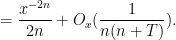


The explicit formula in Theorem 8 is completely exact, but turns out to be a little bit inconvenient for applications because it involves all the zeroes
Exercise 22 (Smoothed explicit formula)
- (i) Let
be a smooth function compactly supported on
. Show that
is entire and obeys the bound
(say) for some
, all
, and all
- (ii) With
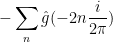
as in (i), establish the identity
with the summations being absolutely convergent by applying the Fourier inversion formula to
for some
, applying (8), and then shifting the contour again (using Exercise 20 and (i) to justify the contour shifting).
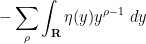
- (iii) Show that
whenever
is a smooth function, compactly supported in
, with the summation being absolutely convergent.
- (iv) Explain why (iii) is formally consistent with Theorem 8 when applied to the non-smooth function
.



— 3. Extending the zero free region, and the prime number theorem —
We now show how Theorem 9 implies Theorem 6. Let 

![{[2,x]}](https://s0.wp.com/latex.php?latex=%7B%5B2%2Cx%5D%7D&bg=ffffff&fg=000000&s=0&c=20201002 "{[2,x]}")
![{[1.5, x + x/T]}](https://s0.wp.com/latex.php?latex=%7B%5B1.5%2C+x+%2B+x%2FT%5D%7D&bg=ffffff&fg=000000&s=0&c=20201002 "{[1.5, x + x/T]}")

![{y \in [1.5,2]}](https://s0.wp.com/latex.php?latex=%7By+%5Cin+%5B1.5%2C2%5D%7D&bg=ffffff&fg=000000&s=0&c=20201002 "{y \in [1.5,2]}") and
and  , and
, and 
![{y \in [x,x+T]}](https://s0.wp.com/latex.php?latex=%7By+%5Cin+%5Bx%2Cx%2BT%5D%7D&bg=ffffff&fg=000000&s=0&c=20201002 "{y \in [x,x+T]}") and . Such a function can be constructed by gluing together various rescaled versions of (antiderivatives of) standard bump functions. For such a function, we have
and . Such a function can be constructed by gluing together various rescaled versions of (antiderivatives of) standard bump functions. For such a function, we have 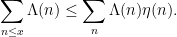

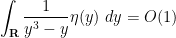

 and
and  , where
  is a parameter to be chosen later. For , there are only
  zeros, and all of them have real part strictly less than by Theorem 9. Hence there exists
  such that
  for all such zeroes. For each such zero, we have from the triangle inequality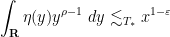
 . For each zero with
  , we integrate parts twice to get some decay in :

 we conclude
 is convergent (this follows from Exercise 20 we conclude (for
  large enough depending on
  ) that the total contribution here is
  . Thus, after choosing suitably, we obtain the bound
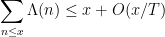 is sufficiently large depending on (since
  depends only on , which depends only on ). A similar argument (replacing
  by
by  in the construction of
  ) gives the matching lower bound
 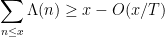 is sufficiently large depending on . Sending
  , we obtain Theorem 6.
Exercise 23 Assuming the Riemann hypothesis, show thatfor any
for any
to the region
was first holomorphically continued to the region
).

It remains to prove Theorem 9. The claim is clear for 

 sufficiently close to . Taking logarithms, we see in particular that
 that gives
  sufficiently close to one, and on taking logarithms as before we get
 close to
  for most numbers that are weighted by
  . To get the contradiction, we use the analytic continuation of to
  to conclude that


 is close to then
  has to be close to
  ) as well as the non-negative nature of to conclude that
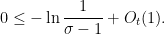 , and proves the prime number theorem.
Exercise 24 Establish the inequalityfor any

Remark 25 There are a number of ways to improve Theorem 9 that move a little closer in the direction of the Riemann hypothesis. Firstly, there are a number of zero-free regions for the Riemann zeta function known that give lower bounds for(and in particular preclude the existence of zeros) a small amount inside the critical strip, and can be used to improve the error term in the prime number theorem; for instance, the classical zero-free region shows that there are no zeroes in the region
for some sufficiently small absolute constant
, and lets one improve the
error term in Theorem 6 to
(with a corresponding improvement in Theorem 1, provided that one replaces
with the logarithmic integral