Sumsets and entropy revisited
What's new 2023-06-28
Ben Green, Freddie Manners and I have just uploaded to the arXiv our preprint “Sumsets and entropy revisited“. This paper uses entropy methods to attack the Polynomial Freiman-Ruzsa (PFR) conjecture, which we study in the following two forms:
Conjecture 1 (Weak PFR over) Let
be a finite non-empty set whose doubling constant
is at most
. Then there is a subset
of
of density
that has affine dimension
(i.e., it is contained in an affine space of dimension
Conjecture 2 (PFR over) Let
be a non-empty set whose doubling constant
is at most
cosets of a subspace of cardinality at most
.
Our main results are then as follows.
Theorem 3 If, then
- (i) There is a subset
- (ii) There is a subset
of affine dimension
goes to zero as
).
- (iii) If Conjecture 2 holds, then There is a subset
The skew-dimension of a set is a quantity smaller than the affine dimension which is defined recursively; the precise definition is given in the paper, but suffice to say that singleton sets have dimension 



Part (i) of this theorem was implicitly proven by Pálvölgi and Zhelezov by a different method. Part (ii) with 

Our proof strategy is to establish these combinatorial additive combinatorics results by using entropic additive combinatorics, in which we replace sets 
For instance, the analogue of the combinatorial doubling constant 
![\displaystyle \sigma_{\mathrm{ent}}[X] := {\exp( \bf H}(X_1+X_2) - {\bf H}(X) )](https://s0.wp.com/latex.php?latex=%5Cdisplaystyle++%5Csigma_%7B%5Cmathrm%7Bent%7D%7D%5BX%5D+%3A%3D+%7B%5Cexp%28+%5Cbf+H%7D%28X_1%2BX_2%29+-+%7B%5Cbf+H%7D%28X%29+%29&bg=ffffff&fg=000000&s=0&c=20201002) in , where
in , where  are independent copies of and
  denotes Shannon entropy. There is also an analogue of the Ruzsa distance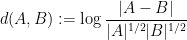
 of , namely the entropic Ruzsa distance
 are independent copies of
  respectively. (Actually, one thing we show in our paper is that the independence hypothesis can be dropped, and this only affects the entropic Ruzsa distance by a factor of three at worst.) Many of the results about sumsets and Ruzsa distance have entropic analogues, but the entropic versions are slightly better behaved; for instance, we have a contraction property
 is a homomorphism. In fact we have a refinement of this inequality in which the gap between these two quantities can be used to control the entropic distance between “fibers” of (in which one conditions
  and
and  to be fixed). On the other hand, there are direct connections between the combinatorial and entropic sumset quantities. For instance, if
  is a random variable drawn uniformly from , then
 ![\displaystyle \sigma_{\mathrm{ent}}[U_A] \leq \sigma[A].](https://s0.wp.com/latex.php?latex=%5Cdisplaystyle++%5Csigma_%7B%5Cmathrm%7Bent%7D%7D%5BU_A%5D+%5Cleq+%5Csigma%5BA%5D.&bg=ffffff&fg=000000&s=0&c=20201002) has small doubling, then has small entropic doubling. In the converse direction, if has small entropic doubling, then is close (in entropic Ruzsa distance) to a uniform random variable
has small doubling, then has small entropic doubling. In the converse direction, if has small entropic doubling, then is close (in entropic Ruzsa distance) to a uniform random variable  drawn from a set
  of small doubling; a version of this statement was proven in an old paper of myself, but we establish here a quantitatively efficient version, established by rewriting the entropic Ruzsa distance in terms of certain Kullback-Liebler divergences.
Our first main result is a “99% inverse theorem” for entropic Ruzsa distance: if 

 to a set of small doubling, which can then be related to a subgroup by standard inverse theorems; this gives a weak version of (1) (roughly speaking losing a square root in the bound), and some additional analysis is needed to bootstrap this initial estimate back to (1).
We now sketch how these tools are used to prove our main theorem. For (i), we reduce matters to establishing the following bilinear entropic analogue: given two non-empty finite subsets 



 have skew-dimension at most
  , for some absolute constant
  . This can be shown by an induction on
  (say). One applies a non-trivial coordinate projection
  to . If
  and
and  are very close in entropic Ruzsa distance, then the 99% inverse theorem shows that these random variables must each concentrate at a point (because
  has no non-trivial finite subgroups), and can pass to a fiber of these points and use the induction hypothesis. If instead and are far apart, then by the behavior of entropy under projections one can show that the fibers of and
  under
under  are closer on average in entropic Ruzsa distance of and themselves, and one can again proceed using the induction hypothesis.
For parts (ii) and (iii), we first use an entropic version of an observation of Manners that sets of small doubling in
 take values in a torsion-free abelian group such as ; this turns out to follow from two applications of the entropy submodularity inequality. One corollary of this (and the behavior of entropy under projections) is that
  and
and  worlds that is used to prove (ii), (iii): while (iii) relies on the still unproven PFR conjecture over , (ii) uses the unconditional progress on PFR by Konyagin, as detailed in this survey of Sanders. The argument has a similar inductive structure to that used to establish (i) (and if one is willing to replace by then the argument is in fact relatively straightforward and does not need any deep partial results on the PFR).
As one byproduct of our analysis we also obtain an appealing entropic reformulation of Conjecture 2, namely that if
![\displaystyle d_{\mathrm{ent}}(X, U_H) \ll \sigma_{\mathrm{ent}}[X].](https://s0.wp.com/latex.php?latex=%5Cdisplaystyle++d_%7B%5Cmathrm%7Bent%7D%7D%28X%2C+U_H%29+%5Cll+%5Csigma_%7B%5Cmathrm%7Bent%7D%7D%5BX%5D.&bg=ffffff&fg=000000&s=0&c=20201002)
![\displaystyle d_{\mathrm{ent}}(X, U_H) \ll_\varepsilon \sigma_{\mathrm{ent}}[X] + \sigma_{\mathrm{ent}}^{3+\varepsilon}[X]](https://s0.wp.com/latex.php?latex=%5Cdisplaystyle++d_%7B%5Cmathrm%7Bent%7D%7D%28X%2C+U_H%29+%5Cll_%5Cvarepsilon+%5Csigma_%7B%5Cmathrm%7Bent%7D%7D%5BX%5D+%2B+%5Csigma_%7B%5Cmathrm%7Bent%7D%7D%5E%7B3%2B%5Cvarepsilon%7D%5BX%5D&bg=ffffff&fg=000000&s=0&c=20201002)
 , by using Konyagin’s partial result towards the PFR.