Adjoint Brascamp-Lieb inequalities
What's new 2023-06-30
Jon Bennett and I have just uploaded to the arXiv our paper “Adjoint Brascamp-Lieb inequalities“. In this paper, we observe that the family of multilinear inequalities known as the Brascamp-Lieb inequalities (or Holder-Brascamp-Lieb inequalities) admit an adjoint formulation, and explore the theory of these adjoint inequalities and some of their consequences.
To motivate matters let us review the classical theory of adjoints for linear operators. If one has a bounded linear operator 





 on
on  respectively. Using the dual characterization
 (and similarly for
  ), one can show that
  has the same operator norm as
  .
.There is a slightly different way to proceed using Hölder’s inequality. For sake of exposition let us make the simplifying assumption that 




 we obtain
  , and a similar argument also recovers the reverse inequality.
The first argument also extends to some extent to multilinear operators. For instance if one has a bounded bilinear operator 




 . It is also possible, formally at least, to adapt the Hölder inequality argument to reach the same conclusion.
In this paper we observe that the Hölder inequality argument can be modified in the case of Brascamp-Lieb inequalities to obtain a different type of adjoint inequality. (Continuous) Brascamp-Lieb inequalities take the form

 and surjective linear maps
  , where
  are arbitrary non-negative measurable functions and
  is the best constant for which this inequality holds for all such
  . [There is also another inequality involving variances with respect to log-concave distributions that is also due to Brascamp and Lieb, but it is not related to the inequalities discussed here.] Well known examples of such inequalities include Hölder’s inequality and the sharp Young convolution inequality; another is the Loomis-Whitney inequality, the first non-trivial example of which is

 . There are also discrete analogues of these inequalities, in which the Euclidean spaces
  are replaced by discrete abelian groups, and the surjective linear maps
  are replaced by discrete homomorphisms.
The operation 



 and various exponents
  , where
  is the optimal constant for which the above inequality holds for all such
  ; informally, such inequalities control the
  norm of a non-negative function in terms of its marginals. It turns out that every Brascamp-Lieb inequality generates a family of adjoint Brascamp-Lieb inequalities (with the exponent
  being less than or equal to
  ). For instance, the adjoints of the Loomis-Whitney inequality (2) are the inequalities
 , all
, all  summing to , and all
  , where the
  exponents are defined by the formula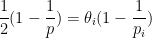
 are the marginals of :


One can derive these adjoint Brascamp-Lieb inequalities from their forward counterparts by a version of the Hölder inequality argument mentioned previously, in conjunction with the observation that the pushforward maps 
We have located a modest number of applications of the adjoint Brascamp-Lieb inequality (but hope that there will be more in the future):
- The inequalities become equalities at
; taking a derivative at this value (in the spirit of the replica trick in physics) we recover the entropic Brascamp-Lieb inequalities of Carlen and Cordero-Erasquin. For instance, the derivative of the adjoint Loomis-Whitney inequalities at
- The adjoint Loomis-Whitney inequalities, together with a few more applications of Hölder’s inequality, implies the log-concavity of the Gowers uniformity norms on non-negative functions, which was previously observed by Shkredov and by Manners.
- Averaging the adjoint Loomis-Whitney inequalities over coordinate systems gives reverse
norms or entropies of the
-plane transform in
are chosen in a dimensionally consistent fashion).
We also record a number of various of the adjoint Brascamp-Lieb inequalities, including discrete variants, and a reverse inequality involving 
