Monotone non-decreasing sequences of the Euler totient function
What's new 2023-09-06
I have just uploaded to the arXiv my paper “Monotone non-decreasing sequences of the Euler totient function“. This paper concerns the quantity 



 because the totient function is non-decreasing on the set
  or
or  , but not on the set
  .
.Since 



 ; this conjecture is verified up to
  . The previous best known upper bound was basically of the form
 for an explicit constant
  , from combining results from the above paper with that of Ford or of Maier-Pomerance. In this paper we obtain the asymptotic
 . This answers a question of Erdős, as well as a closely related question of Pollack, Pomerance, and Treviño.
 The methods of proof turn out to be mostly elementary (the most advanced result from analytic number theory we need is the prime number theorem with classical error term). The basic idea is to isolate one key prime factor 


 is a medium sized prime,
  is a significantly larger prime, and
  is a number with all prime factors less than . This leads to an approximation
 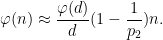 fixed, and also localize to a relatively short interval, then can only be non-decreasing in if is also non-decreasing at the same time. This turns out to significantly cut down on the possible length of a non-decreasing sequence in this regime, particularly if is large; this can be formalized by partitioning the range of into various subintervals and inspecting how this (and the monotonicity hypothesis on ) constrains the values of associated to each subinterval. When is small, we instead use a factorization
  is very smooth (i.e., has no large prime factors), and is a large prime. Now we have the approximation
 will have to basically be piecewise constant in order for to be non-decreasing. Pursuing this analysis more carefully (in particular controlling the size of various exceptional sets in which the above analysis breaks down), we end up achieving the main theorem so long as we can prove the preliminary inequality
 . This is in fact also a necessary condition; any failure of this inequality can be easily converted to a counterexample to the bound (2), by considering numbers of the form (3) with equal to a fixed constant (and omitting a few rare values of where the approximation (4) is bad enough that is temporarily decreasing). Fortunately, there is a minor miracle, relating to the fact that the largest prime factor of denominator of in lowest terms necessarily equals the largest prime factor of , that allows one to evaluate the left-hand side of (5) almost exactly (this expression either vanishes, or is the product of
  for some primes ranging up to the largest prime factor of ) that allows one to easily establish (5). If one were to try to prove an analogue of our main result for the sum-of-divisors function
  , one would need the analogue
In the final section of the paper we discuss some near counterexamples to the strong conjecture (1) that indicate that it is likely going to be difficult to get close to proving this conjecture without assuming some rather strong hypotheses. Firstly, we show that failure of Legendre’s conjecture on the existence of a prime between any two consecutive squares can lead to a counterexample to (1). Secondly, we show that failure of the Dickson-Hardy-Littlewood conjecture can lead to a separate (and more dramatic) failure of (1), in which the primes are no longer the dominant sequence on which the totient function is non-decreasing, but rather the numbers which are a power of two times a prime become the dominant sequence. This suggests that any significant improvement to (2) would require assuming something comparable to the prime tuples conjecture, and perhaps also some unproven hypotheses on prime gaps.