Fisher’s Fundamental Theorem (Part 3)
Persiflage 2020-10-08
Last time we stated and proved a simple version of Fisher’s fundamental theorem of natural selection, which says that under some conditions, the rate of increase of the mean fitness equals the variance of the fitness. But the conditions we gave were very restrictive: namely, that the fitness of each species of replicator is constant, not depending on how many of these replicators there are, or any other replicators.
To broaden the scope of Fisher’s fundamental theorem we need to do one of two things:
1) change the left side of the equation: talk about some other quantity other than rate of change of mean fitness.
2) change the right side of the question: talk about some other quantity than the variance in fitness.
Or we could do both!  People have spent a lot of time generalizing Fisher’s fundamental theorem. I don’t think there are, or should be, any hard rules on what counts as a generalization.
But today we’ll take alternative 1). We’ll show the square of something called the ‘Fisher speed’ always equals the variance in fitness. One nice thing about this result is that we can drop the restrictive condition I mentioned. Another nice thing is that the Fisher speed is a concept from information theory! It’s defined using the Fisher metric on the space of probability distributions.
And yes—that metric is named after the same guy who proved Fisher’s fundamental theorem! So, arguably, Fisher should have proved this generalization of Fisher’s fundamental theorem. But in fact it seems that I was the first to prove it, around February 1st, 2017. Some similar results were already known, and I will discuss those someday. But they’re a bit different.
A good way to think about the Fisher speed is that it’s ‘the rate at which information is being updated’. A population of replicators of different species gives a probability distribution. Like any probability distribution, this has information in it. As the populations of our replicators change, the Fisher speed says the rate at which this information is being updated. So, in simple terms, we’ll show
The square of the rate at which information is updated is equal to the variance in fitness.
This is quite a change from Fisher’s original idea, namely:
The rate of increase of mean fitness is equal to the variance in fitness.
But it has the advantage of always being true… as long the population dynamics are described by the general framework we introduced last time. So let me remind you of the general setup, and then prove the result!
The setup
We start out with population functions 


for some differentiable functions 
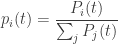
Using the Lotka–Volterra equation we showed last time that these probabilities obey the replicator equation

Here 

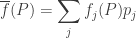
is the mean fitness.
The Fisher metric
The space of probability distributions on the set 

It’s called 


The Fisher metric is a Riemannian metric on the interior of the (n-1)-simplex. That is, given a point 

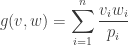
Here we are describing the tangent vectors 


If we have a probability distribution 

if the derivative 
Now we’ve got all the formulas we’ll need to prove the result we want. But for those who don’t already know and love it, it’s worthwhile saying a bit more about the Fisher metric.
The factor of 

But the reason the Fisher metric is important, I think, is its connection to relative information. Given two probability distributions 

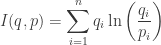
You can show this is the expected amount of information gained if 
Suppose
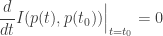
That is, in some sense ‘to first order’ no information is being gained at any moment 

So, the square of the Fisher speed has a nice interpretation in terms of relative entropy!
For a derivation of these last two equations, see Part 7 of my posts on information geometry. For more on the meaning of relative entropy, see Part 6.
The result
It’s now extremely easy to show what we want, but let me state it formally so all the assumptions are crystal clear.
Theorem. Suppose the functions 

for some differentiable functions 

Then if none of the populations 


Proof. The proof is near-instantaneous. We take the square of the Fisher speed:
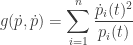
and plug in the replicator equation:

We obtain:

as desired. █
It’s hard to imagine anything simpler than this. We see that given the Lotka–Volterra equation, what causes information to be updated is nothing more and nothing less than variance in fitness! But there are other variants of Fisher’s fundamental theorem worth discussing, so I’ll talk about those in future posts.