The Kepler Problem (Part 12)
Azimuth 2025-10-15
It’s been a while. Let me finally wrap up this this series. I’ll show you how we can the periodic table of elements from a quantum field theory of massless spin-1/2 particles.
We’ve been studying the hydrogen atom using Schrödinger’s equation, but still taking the electron’s spin into account. This is more realistic than the basic Schrödinger equation that ignores spin, but less realistic than a full-fledged relativistic treatment using the Dirac equation. It’s a pretty good approximation. We saw that bound states of this hydrogen atom can be reinterpreted as states of a massless left-handed spin-1/2 particle in the Einstein universe—a universe where space is the 3-sphere

Then I ‘second quantized’ both theories. If we do this to the massless spin-1/2 particle, we get a free quantum field theory on the Einstein universe! This describes arbitrary collections of noninteracting massless spin-1/2 particles. If we second quantize the hydrogen atom, we get a theory of multi-electron atoms—but a naive theory where the electrons don’t interact. In this naive theory we don’t get the periodic table of elements. But today I want to tweak the Hamiltonian so we do get the observed periodic table, at least roughly.
Let’s do it!
In Part 7 we saw how the Hilbert space of bound states of the hydrogen atom, taking the electron’s spin into account, is

In atomic physics, the eigenspaces of the Hamiltonian 


and the subshells as

The shells are direct sums of subshells as follows:

and the direct sum of all the shells is the whole Hilbert space of bound states of the hydrogen atom:

The dimension of the subshell 


In Part 11 we second quantized the hydrogen atom and got the fermionic Fock space 
The Aufbau principle is a famous approximate way to describe the ground state of an 


and then we let

Thus,


then we have

Thus, we can minimize

in a way that minimizes the total energy

If we follow this recipe taking 

that depend only on the shell, not the subshell. Thus, this choice makes no prediction about the order in which subshells are filled! That’s no good.
For the recipe to give results that more closely match the periodic table, we need to choose the energies
• subshells are filled in order of increasing value of 
• for subshells with the same value of 


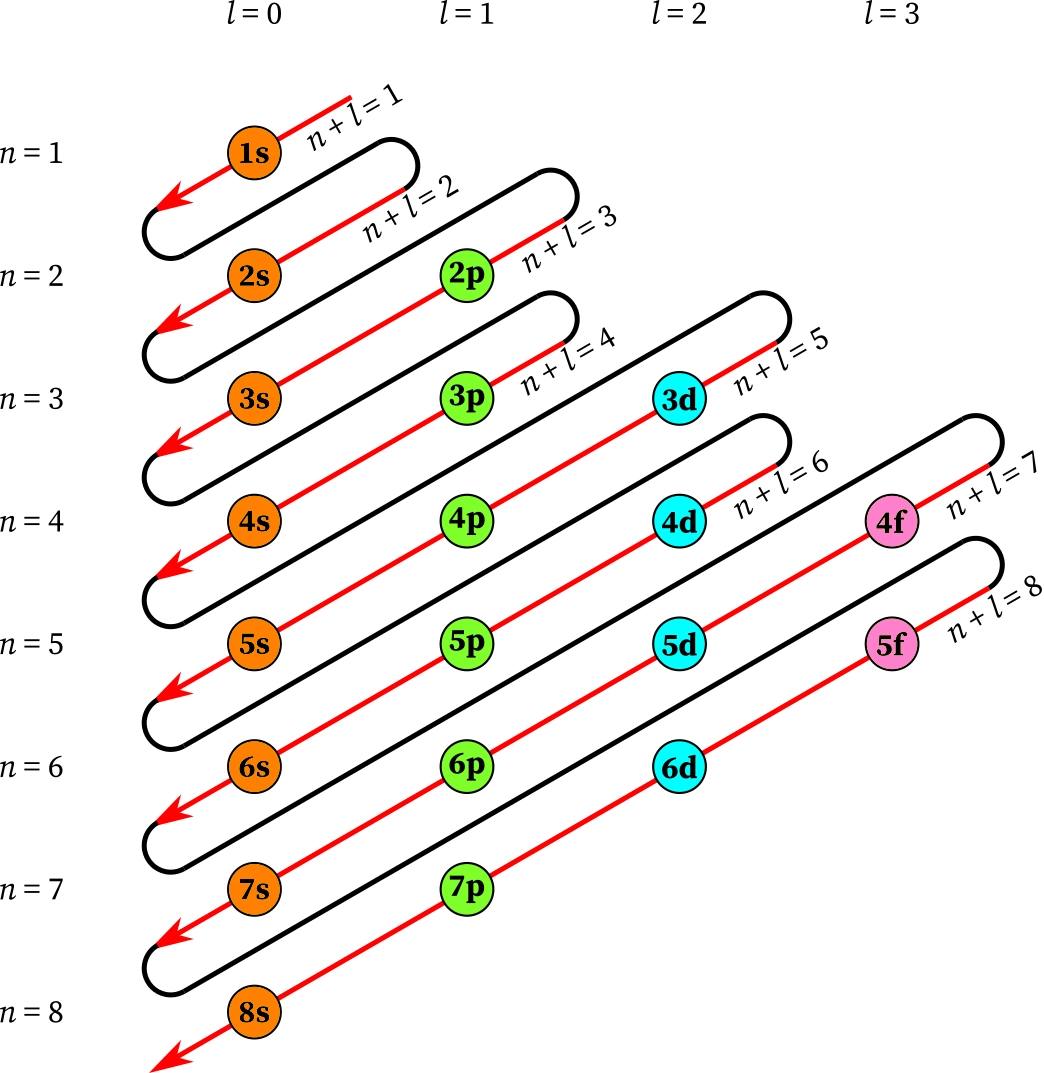
In reality this nice pattern is broken by quite a few elements, but here we only consider a simple model in which the Madelung rules hold. The pattern of subshell filling then looks like this:

The above chart uses some old but still popular notation from spectroscopy:
• 


For example, the subshell 


In 1945, a chemist named Wiswesser noted that the Madelung rules follow from the recipe we outlined if we choose

There are many other functions of

and this formula is more convenient for us.
The Madelung rules do not always hold! The first exception is element 24, chromium. The Madelung rules predict that chromium has 2 electrons in the 

Thus it is of some interest, if only as a curiosity, to define a Hamiltonian on the Hilbert space 
Recall from Part 7:
![\begin{array}{cclll} A^2 |n , \ell, m \rangle &=& \frac{1}{4}(n^2 - 1) |n , \ell, m, s \rangle \\ [3pt] L^2 |n , \ell, m \rangle &=& \ell(\ell + 1) |n , \ell, m, s \rangle \end{array}](https://s0.wp.com/latex.php?latex=%5Cbegin%7Barray%7D%7Bcclll%7D++++++A%5E2+%7Cn+%2C+%5Cell%2C+m+%5Crangle++%26%3D%26+%5Cfrac%7B1%7D%7B4%7D%28n%5E2+-+1%29+%7Cn+%2C+%5Cell%2C+m%2C+s+%5Crangle+%5C%5C+%5B3pt%5D+++++++L%5E2+%7Cn+%2C+%5Cell%2C+m+%5Crangle+%26%3D%26+%5Cell%28%5Cell+%2B+1%29+%7Cn+%2C+%5Cell%2C+m%2C+s+%5Crangle++++%5Cend%7Barray%7D+&bg=ffffff&fg=333333&s=0&c=20201002)
The Duflo isomorphism, as discussed in Part 6, makes it natural to define operators

If we then define 

![\begin{array}{cclcl} \tilde{A} |n , \ell, m \rangle &=& \frac{1}{2} n |n , \ell, m \rangle \\ [3pt] \tilde{L} |n , \ell, m \rangle &=& (\ell + \frac{1}{2}) |n , \ell, m \rangle \end{array}](https://s0.wp.com/latex.php?latex=%5Cbegin%7Barray%7D%7Bcclcl%7D++++++%5Ctilde%7BA%7D+%7Cn+%2C+%5Cell%2C+m+%5Crangle++%26%3D%26+%5Cfrac%7B1%7D%7B2%7D+n+%7Cn+%2C+%5Cell%2C+m+%5Crangle++++%5C%5C+%5B3pt%5D+++++++%5Ctilde%7BL%7D+%7Cn+%2C+%5Cell%2C+m+%5Crangle+%26%3D%26+%28%5Cell+%2B+%5Cfrac%7B1%7D%7B2%7D%29+%7Cn+%2C+%5Cell%2C+m+%5Crangle+++%5Cend%7Barray%7D+&bg=ffffff&fg=333333&s=0&c=20201002)
and thus

This suggests taking our single-particle Hamiltonian to be

If we then define a Hamiltonian on the Fock space
and create an orthonormal basis 


and so on.
Here the assignments of magnetic quantum numbers 
• every
• all of the electrons in singly occupied orbitals have the same spin.
We could go further and attempt to choose a simple Hamiltonian for which the principle of energy mimization also gives Hund’s rules. However, we prefer to stop here, leaving you with the challenge of finding a better-behaved quantum field theory on the Einstein universe whose Hamiltonian gives the Madelung rules, or perhaps better understanding the Hamiltonian we have given here.
Here is the periodic table we get from our approach:
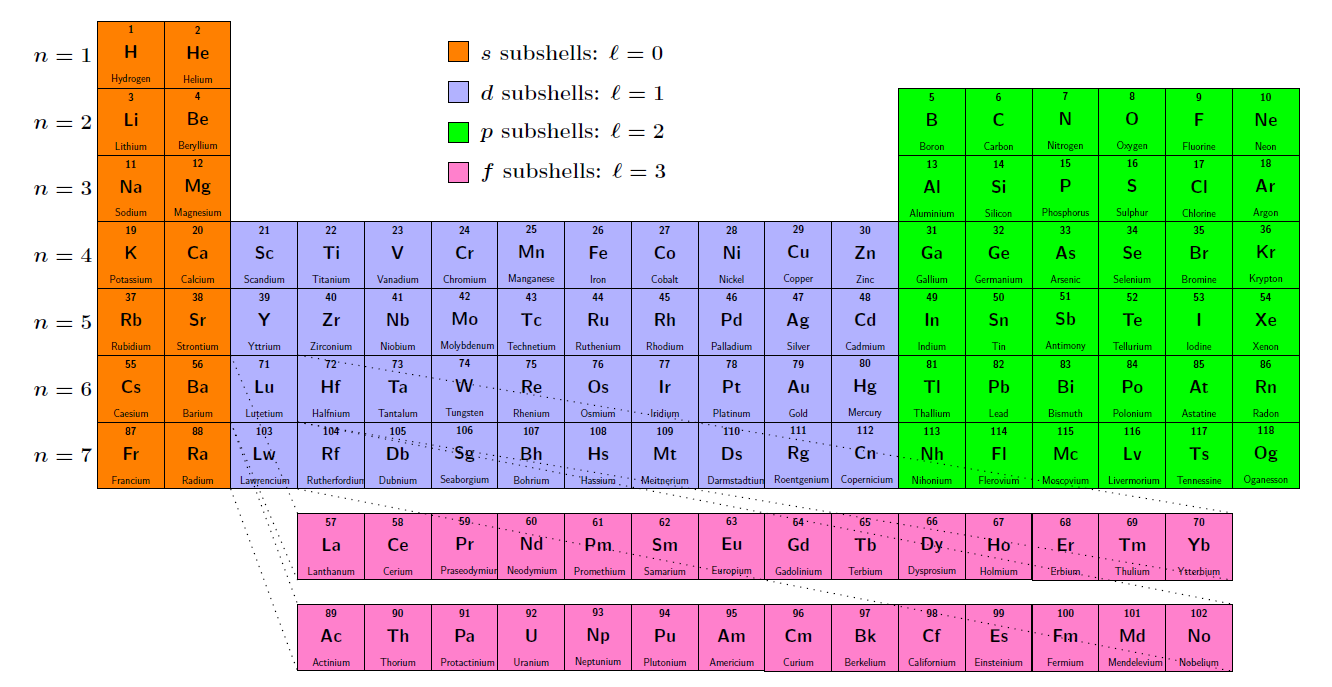
and here are the energies for subshells
that we’re using in our approach:
For more, read my paper:
• Second quantization for the Kepler problem.
or these blog articles, which are more expository and fun:
• Part 1: a quick overview of Kepler’s work on atoms and the solar system, and more modern developments.
• Part 2: why the eccentricity vector is conserved for a particle in an inverse square force, and what it means.
• Part 3: why the momentum of a particle in an inverse square force moves around in a circle.
• Part 4: why the 4d rotation group 
• Part 5: quantizing the bound states of a particle in an attractive inverse square force, and getting the Hilbert space 
• Part 6: how the Duflo isomorphism explains quantum corrections to the hydrogen atom Hamiltonian.
• Part 7: why the Hilbert space of bound states for a hydrogen atom including the electron’s spin is

• Part 8: why 
• Part 9: a quaternionic description of the hydrogen atom’s bound states (a digression not needed for later parts).
• Part 10: changing the complex structure on
• Part 11: second quantizing the massless spin-1/2 particle and getting a quantum field theory on the Einstein universe, or alternatively a theory of collections of electrons orbiting a nucleus.
• Part 12: obtaining the periodic table of elements from a quantum field theory on the Einstein universe.