The Tonnetz
Azimuth 2026-01-01
Harmony in music is the dance of rational and irrational numbers, coming close enough to kiss but never touching.
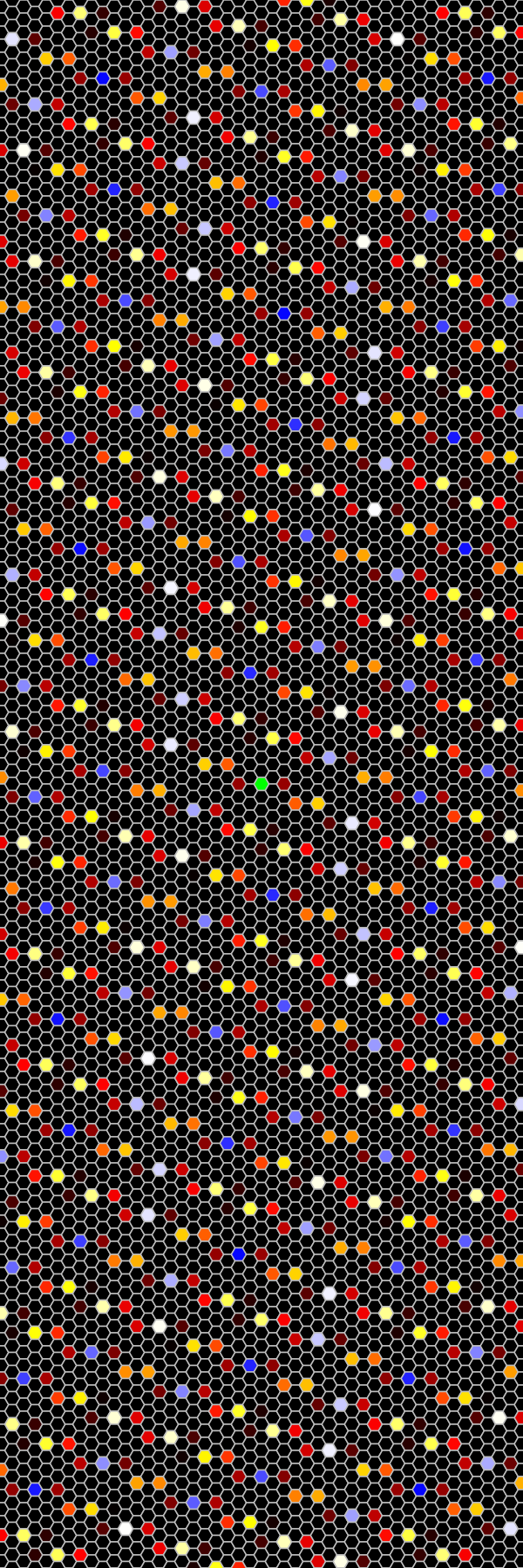
This image by my friend Gro-Tsen illustrates what I mean. Check out how pairs of brightly colored hexagons seem to repeat over and over… but not exactly. Look carefully. The more you look, the more patterns you’ll find! And most of them have musical significance. I’ll give his explanation at the end.

Gro-Tsen writes:
Let me explain what I drew here, and what it has to do with music, but also with diophantine approximations of log(2), log(3) and log(5).
So, each hexagon in my diagram represents a musical note, or frequency, relative to a reference note which is the bright green hexagon in the exact center. Actually, more precisely, each hexagon represents a note modulo octaves… in the sense that two notes separated by an integer number of octaves are considered the same note. And when two hexagons are separated in the same way in the diagram, the notes are separated by the same interval (modulo octaves).
More precisely: for each given hexagon, the one to its north (i.e., above) is the note precisely one just fifth above, i.e. with 3/2 the same frequency; equivalently, it is the note one just fourth below (i.e., with 3/4 the frequency) since we are talking modulo octaves. And of course, symmetrically, the hexagon to the south (i.e., below) is precisely one just fourth above, i.e., 4/3 the frequency, or equivalently, one just fifth below (2/3 the frequency).
The hexagon to the northwest of any given hexagon is one major third above (frequency ×5/4) or equivalently, one minor sixth below (frequency ×5/8). Symmetrically, the hexagon to the southeast is one minor sixth above (×8/5) or one major third below (×4/5). And the hexagon to the northeast of any given hexagon is one minor third above (frequency ×6/5) or equivalently, one major sixth below (×3/5); and the one to the southwest is one major sixth above (×5/3) or one minor third below.
The entire grid is known as a “Tonnetz”, as explained in
• Wikipedia, Tonnetz
— except that unfortunately my convention (and JCB’s) is up-down-symmetric wrt the one used in the Wikipedia illustration.

[On top of that, I’ve rotated Gro-Tsen’s image 90 degrees counterclockwise to make it fit better in this blog. I’ve changed his wording to reflect this, and I hope I did it right. – JCB]
Mathematically, if we talk about the log base 2 of frequencies, modulo 1, we can say that one step to the north adds log₂(3), and one step to the northwest adds log₂(5) (all values being taken modulo 1).
Since log(2), log(3) and log(5) are linearly independent over the rationals (an easy consequence of uniqueness of prime factorization!), NO two notes in the diagram are exactly equal. But they can come very close! And this is what my colors show.
Black hexagons are those which distant from the reference note by more than 1 halftone (where here, “halftone” refers to exactly 1/12 of an octave in log scale), or 100 cents. Intervals between 100 and 50 cents are colored red (bright red for 50 cents), intervals between 50 and 25 cents are colored red-to-yellow (with bright yellow for 25 cents), intervals between 25 and 12.5 cents are colored yellow-to-white (with pure white for 12.5 cents), and below 12.5 cents we move to blue.
(Yes, this is a purely arbitrary color gradient, I didn’t give it much thought. It’s somewhat reminiscent of star colors.) Anyway, red-to-white are good matches, and white-to-blue are pretty much inaudible differences, with pure blue representing an exact match, … except that the center hexagon has been made green instead so we can easily tell where it is (but in principle it should be pure blue).
The thing about the diagram is that it LOOKS periodic, and it is APPROXIMATELY so, but not exactly!
Because when you have an approximate match (i.e., some combination of fifths and thirds that is nearly an integer number of octaves), by adding it again and again, the errors accumulate, and the quality of the match decreases.
For example, 12 hexagons to the north of the central one, we have a yellow hexagon (quality: 23.5 cents), because 12 perfect fifths gives almost 7 octaves. But 12 hexagons north of that is only reddish (quality: 46.9 cents) because 24 fifths isn’t so close to 14 octaves.
For the same reason that log(2), log(3) and log(5) are linearly independent over the rationals, the diagram is never exactly periodic, but there are arbitrarily good approximations, so arbitrarily good “almost periods”.
An important one in music is that 3 just fifths plus 1 minor third, so, 3 steps north and 1 step northeast in my diagram gives (2 octaves plus) a small interval with frequency ratio of 81/80 (that’s 21.5 cents) that often gets smeared away when constructing musical scales.
Anyway, for better explanations about this, I refer to JCB’s blog post here:
Can you spot how his basic parallelogram appears as an approximate period in my diagram?”
Musicians call the change in pitch caused by going 12 hexagons to the north the Pythagorean comma:

They call the change in pitch cause by going 3 hexagons north and 1 hexagon northeast the syntonic comma:

You can also see a lot of bright hexagons in pairs, one just a bit east of the other! This is again a famous phenomenon: the change in pitch caused by going one hexagon northwest and then one hexagon northeast is called the lesser chromatic semitone in just intonation:

If you go one hexagon south and one southwest from a bright hexagon, you’ll also sometimes reach a bright hexagon. This pitch ratio is called the diatonic semitone

But this pattern is weaker, because this number is farther from 1.
With more work you should be able to find hexagons separated by the lesser diesis 128/125, the greater diesis 648/625, the diaschisma 2048/2025, and other musically important numbers close to 1, built from only the primes 2, 3, and 5.
Happy New Year!
For more on the mathematics of tuning systems, read these series: