Freiman’s Constant
Azimuth 2026-05-07
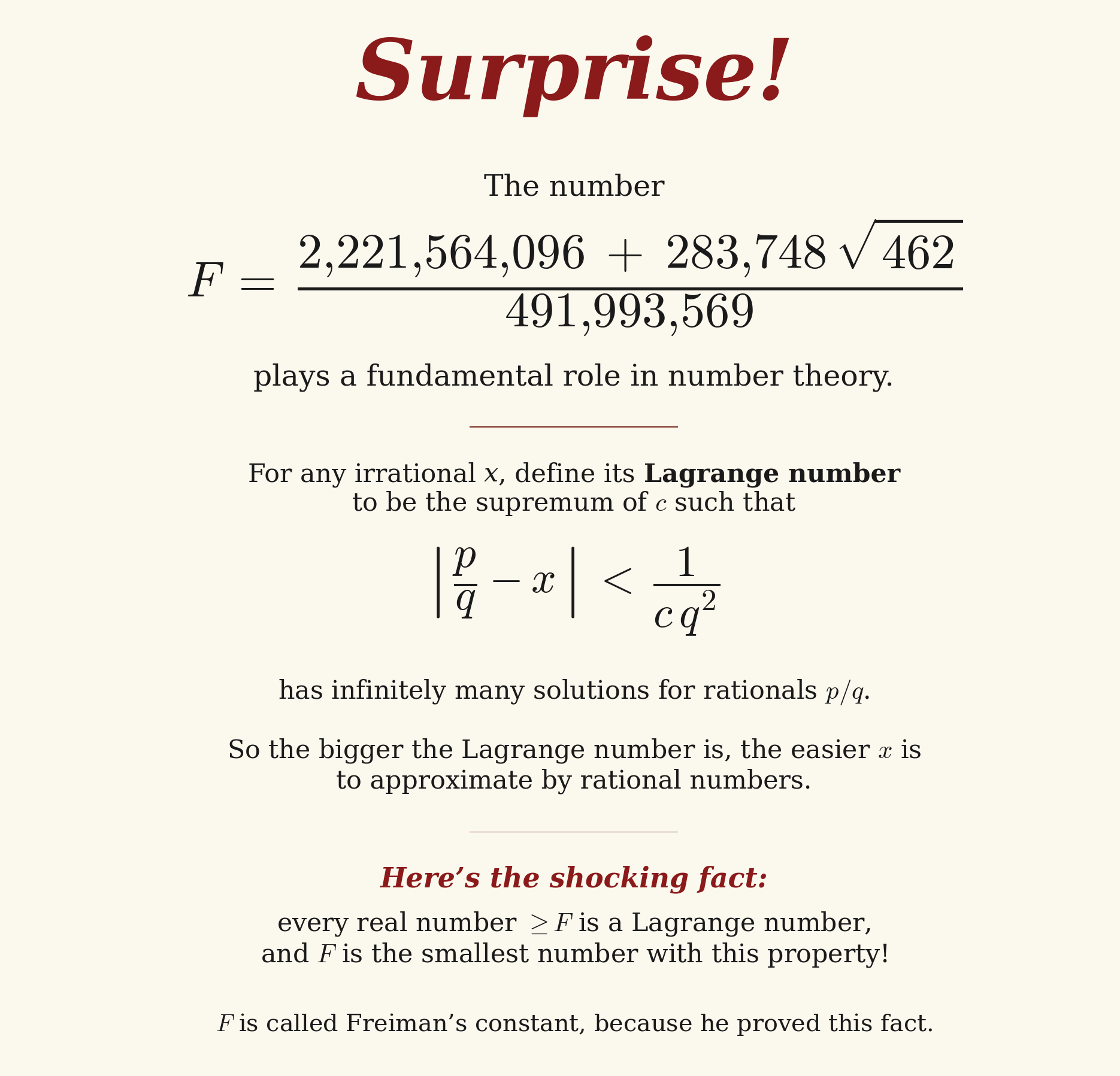
I recently asked people on Mastodon “What’s the most surprising fact you’ve learned in the last couple of weeks?” It was a nice way to learn a lot of interesting things. My own biggest recent surprise was this: the number

plays a fundamental role in number theory!
For any irrational 


has infinitely many solutions for rationals 

Quite famously, the golden ratio has the smallest possible Lagrange number, namely √5. The set of all Lagrange numbers is very complicated, and very interesting.
But here’s the shocking fact: if
then every real number 

• G. A. Freiman, Diophantine Approximations and the Geometry of Numbers (Markov’s Problem) [in Russian]. Kalinin State University Press, Kalinin, 1975.
The proof also appears here:
• Thomas W. Cusick and Mary E. Flahive, The Markov and Lagrange Spectra, AMS Mathematical Surveys and Monographs 30, AMS, Providence, Rhode Island, 1989.
There’s a lot more crazy stuff known about the set of all Lagrange numbers, which is called the Lagrange spectrum. As mentioned, the smallest number in the Lagrange spectrum is 


with 

Above 3 the Lagrange spectrum becomes much richer: it has infinitely many gaps, but positive Hausdorff dimension, increasing as we move up. Eventually the Hausdorff dimension hits 1. Later we hit Freiman’s constant,

and every number
The Markov spectrum is another set, containing the Lagrange spectrum, and their relationship is very interesting. Here’s a free online reference that reviews all the basics before doing more:
• Carlos Gustavo Moreira, Geometric properties of the Markov and Lagrange spectra, Annals of Mathematics 188, 145–170.
For a stripped-down account, go here:
• Wikipedia, Markov spectrum.