The Great Icosahedron
Azimuth 2026-05-27
I never knew what was so great about the ‘great icosahedron’. Now I do.
Take a regular icosahedron whose vertices have coordinates in the field ℚ[√5], which consists of numbers a + b√5 with a and b rational.

Apply the nontrivial element of the Galois group of this field: that is, simply replace √5 by -√5 in all your formulas. You get the great icosahedron:

What do I mean by this, exactly? For example, take the regular icosahedron whose 12 vertices are
where Φ = (1 + √5)/2 is the golden ratio. Form a bunch of
• points (all the vertices of the icosahedron), • lines (containing all the edges of the icosahedron), and • planes (containing all the faces of the icosahedron)
Now replace √5 by -√5 in all your formulas. You get the equations for a new bunch of points, lines and planes. And:
• the points are the vertices a great icosahedron; • the lines contain all the edges of this great icosahedron; • the planes contain all the faces of this great icosahedron.
So, replacing √5 by -√5 makes the icosahedron great!
On Mastodon, J. M. animated this using an interpolation process called ‘tweening’:
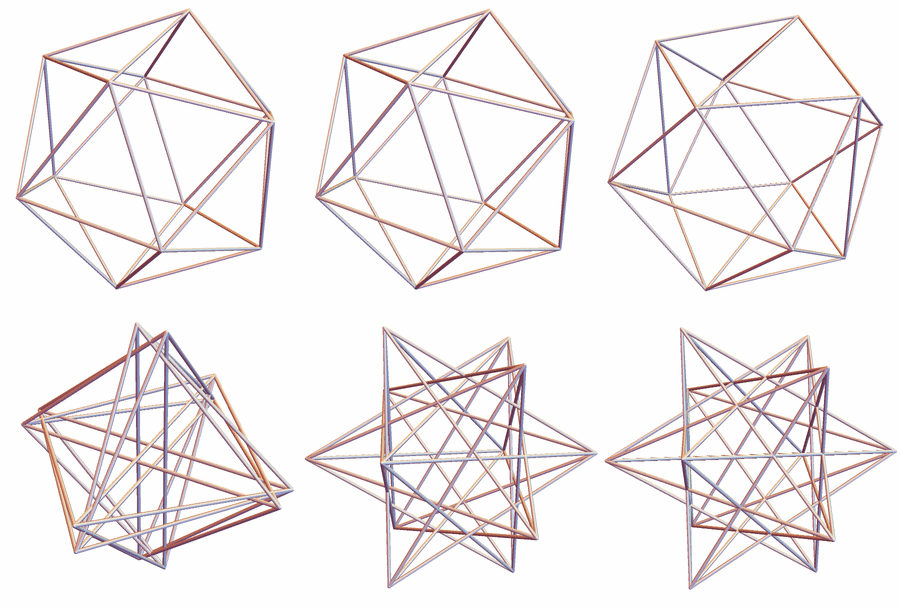
If you apply the Galois transformation again you get back the icosahedron. If you apply it yet again you make the icosahedron great again.
I thank and andeux for their help on this.
This fact is asserted without proof in the section on regular star-polytopes near the end of this book:
• John Horton Conway, Heidi Burgiel and Chaim Goodman-Strauss, The Symmetries of Things, A K Peters, Natick, Massachusetts, 2008.
Let me sketch an uninspired, purely computational proof. Take each of these twelve icosahedron vertices:
and find its five nearest neighbors. Then apply the Galois transformation, which amounts to replacing Φ with -1/Φ. You get twelve new points
which turn out to be vertices of a new, smaller icosahedron!
Then, for each vertex of the original icosahedron, see where it goes under this transformation, and see where its nearest neighbors go. You’ll see they become second nearest neighbors.
Thus the edges of the original icosahedron, which connect nearest neighbor vertices, go to edges connecting second nearest neighbors of a new smaller icosahedron.
What about the faces? The faces of the original icosahedron are equilateral triangles whose corners are triples of icosahedron vertices that are all nearest neighbors of each other. So, they get sent to triangles whose corners are triples of vertices that are all second nearest neighbors.
And these facts characterize the great icosahedron: it has the vertices of a regular icosahedron, edges connecting all pairs of second nearest neighbor vertices:
and faces formed by all triples of second nearest neighbor vertices. You can’t see any of these triangular faces in its entirety in this picture—but if you look hard you can see most of one.
These are all the possible squared distances between vertices in the original icosahedron and the new great icosahedron:
To get the new squared distances from the old ones we simply replace Φ by -1/Φ, as we must, since Galois transformations preserve the field operations and squared distances are computed using field operations.
The nearest neighbors had distance squared 4, and these must be mapped to new points that still have distance squared 4—but now these are second nearest neighbors.
Of course it would be nice to have a deeper, more general understanding of what the Galois transformation sending 
