From Pentagons to Pentagrams
Azimuth 2026-05-29
I recently showed you that if you take the regular icosahedron:
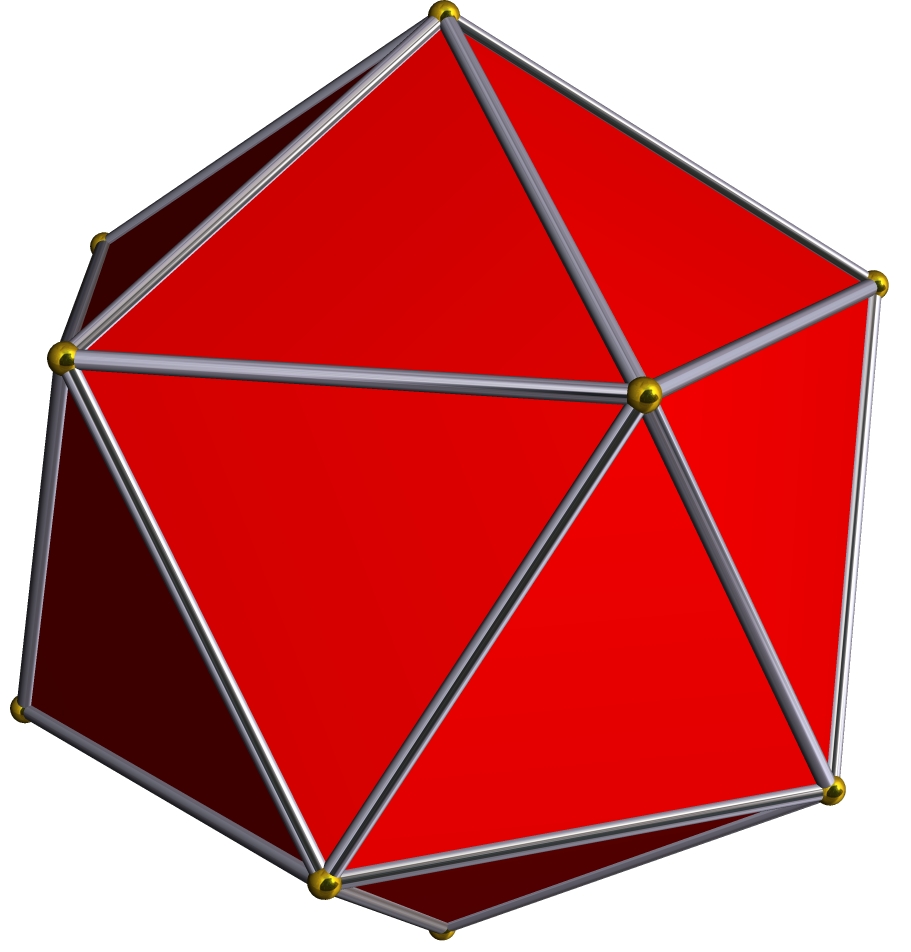
considered in a coordinate system based on the golden ratio, and then replace √5 by -√5 in all your formulas, you get the great icosahedron:
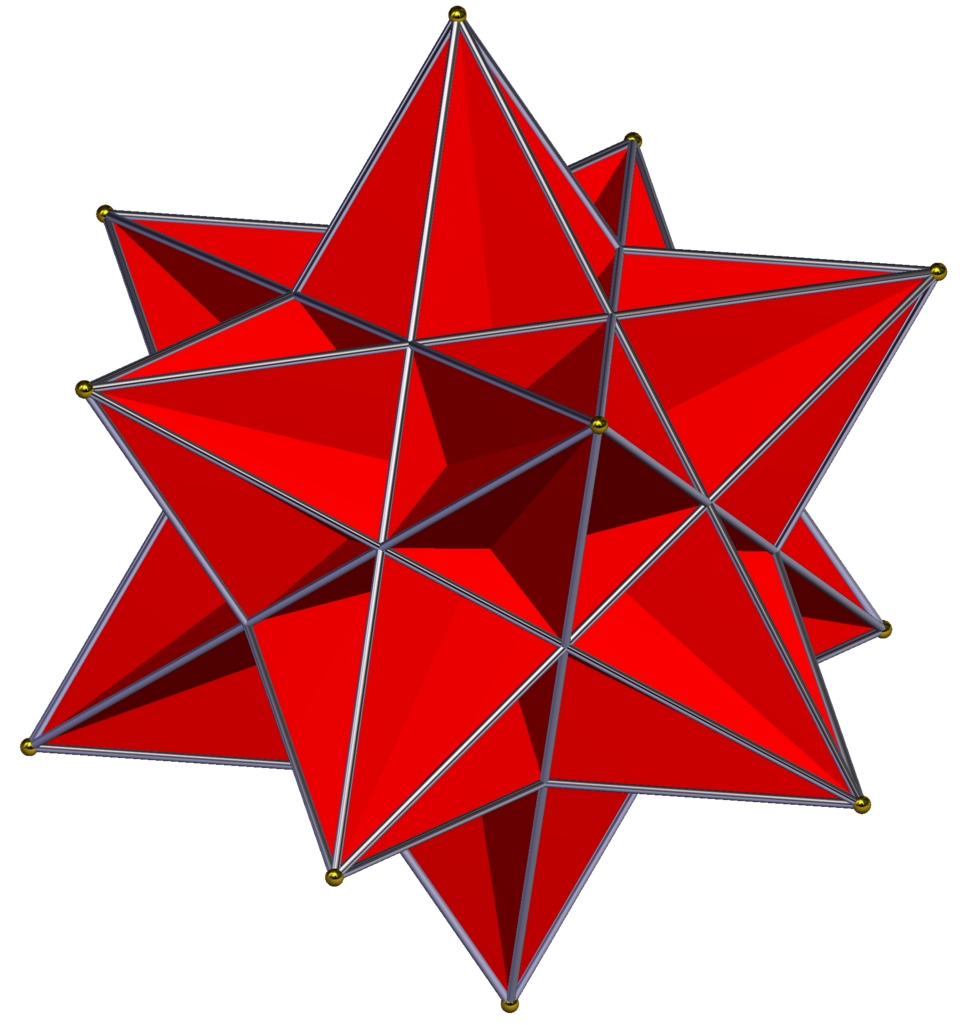
But this fact isn’t an isolated one-off! If we do the same for the regular dodecahedron:
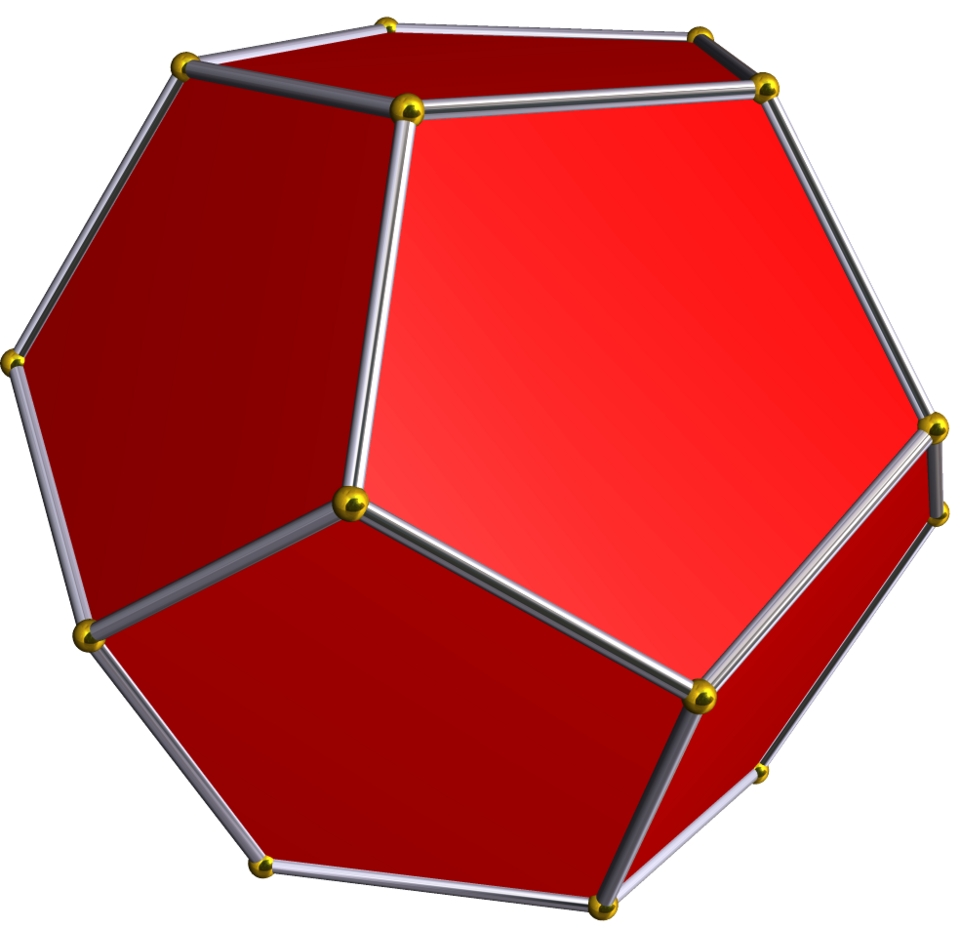
we get the great stellated dodecahedron:
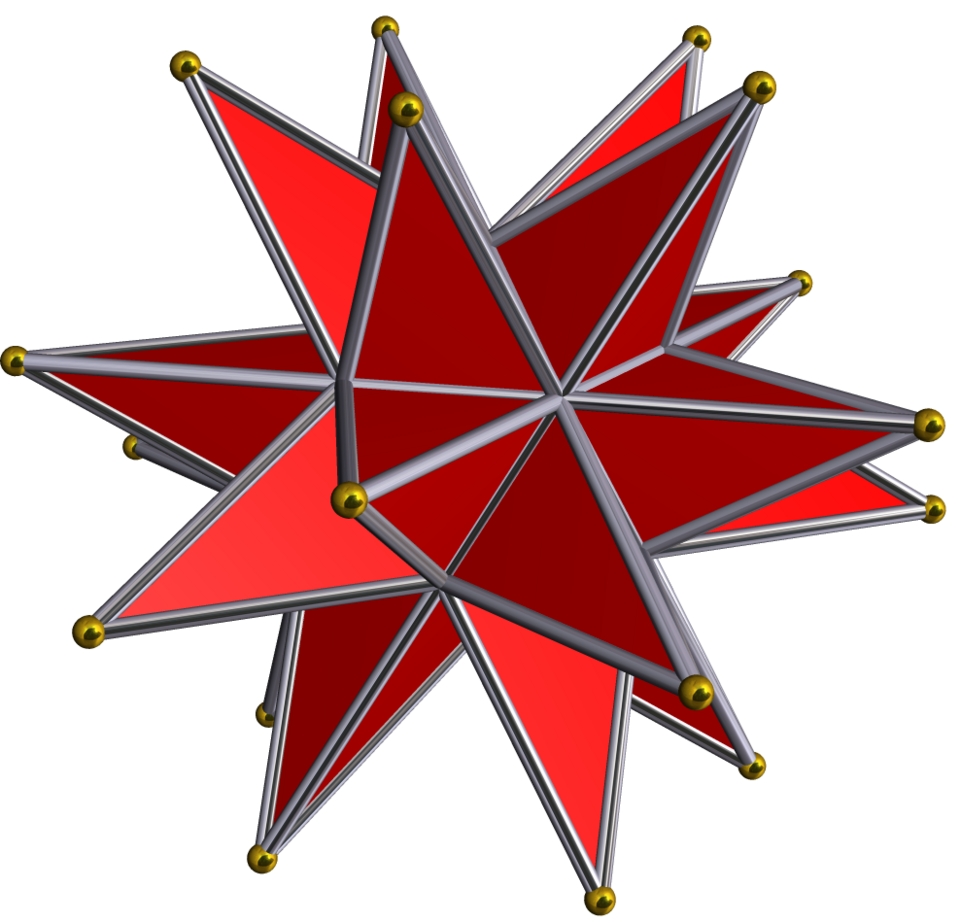
There’s also a star polyhedron called the great dodecahedron:

and if we play the same game, replacing 

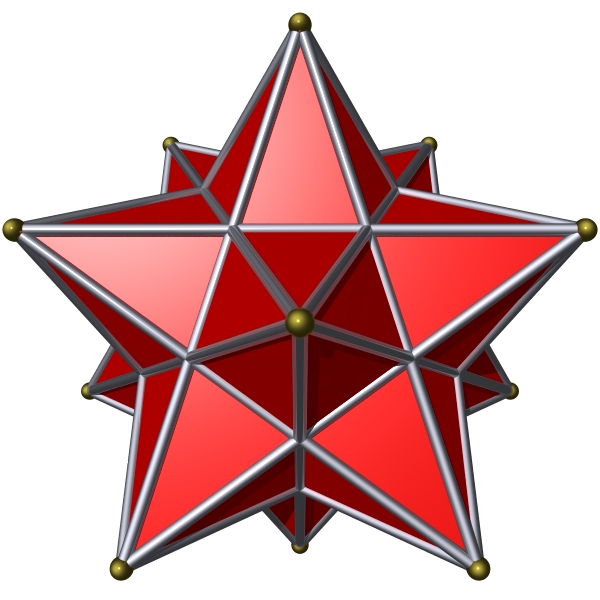
These six polyhedra form a family; the four nonconvex ones are called the Kepler–Poinsot polyhedra. I never understood what was so great about them, though of course they look ravishingly attractive. So it was nice to learn that if we include the convex ones, they come in three pairs related by the operation of replacing 
• John Horton Conway, Heidi Burgiel and Chaim Goodman-Strauss, The Symmetries of Things, A K Peters, Natick, Massachusetts, 2008.
These authors spend more energy describing three other relations among this family of polyhedra:
.png)
But I’m more interested in Galois conjugation, which carries each polyhedron in this picture to the one at the opposite corner of the hexagon. I got interested in Galois conjugation because it interchanges two kinds of quasiparticles that propagate in icosahedral quasicrystals, called phonons and phasons:
But there’s some simple geometry behind it, which I’d like to discuss here.
You’ll notice that in all the examples I gave, Galois conjugation takes regular pentagons to regular pentagrams. And that turns out to be a general fact!
Let 

with 

by

This map preserves all the field operations, and if you apply it twice you get back where you started. Thus, it’s like complex conjugation in many respects.
The golden field gets its name because it contains the golden ratio

If we apply Galois conjugation to the golden ratio, we get its negative reciprocal:

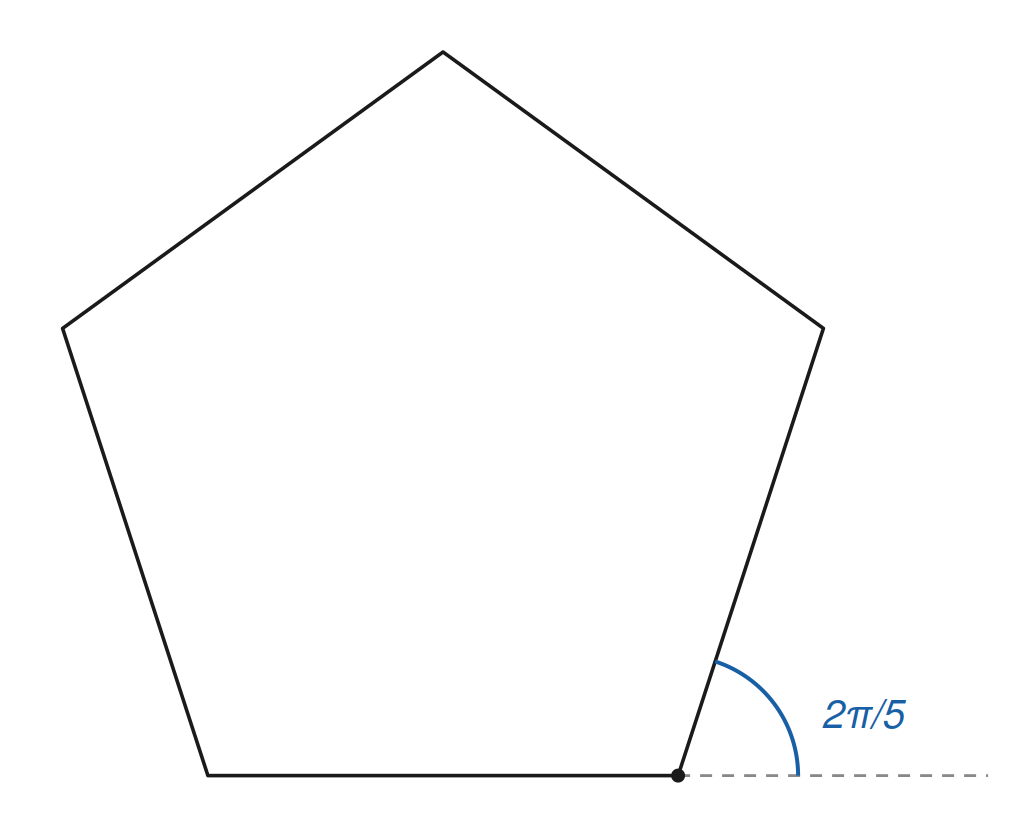
This suggests that Galois conjugation should somehow map regular pentagons to regular pentagrams! Why? Well, in a regular pentagon, each exterior turning angle is 
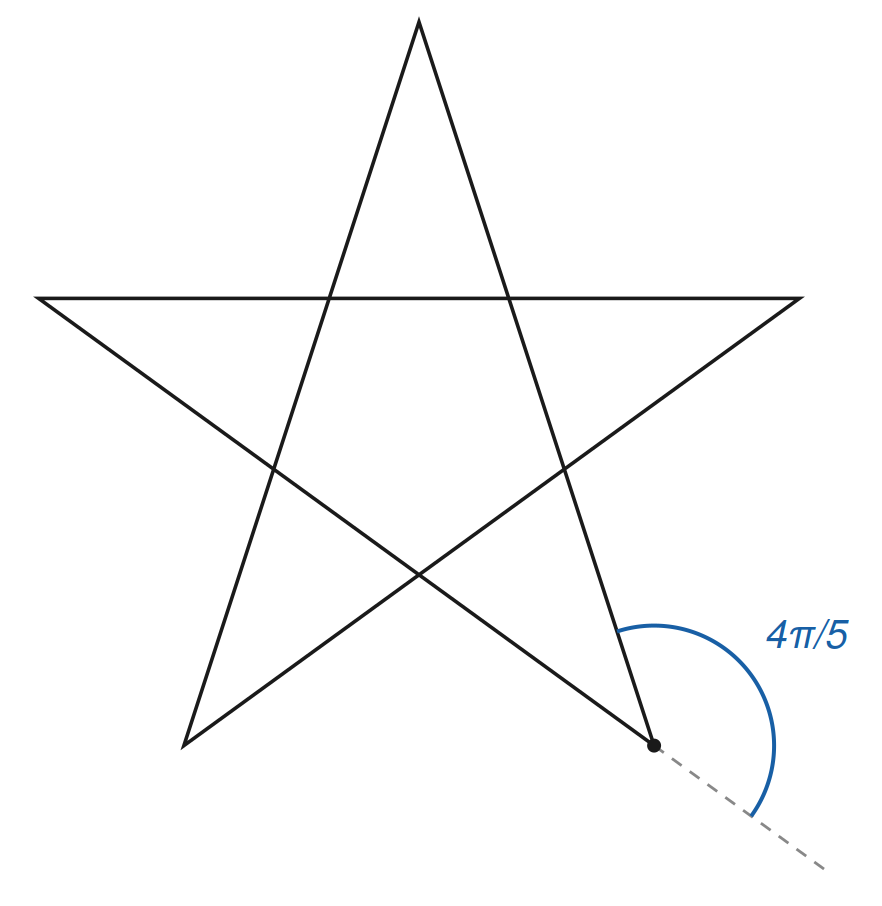
while in a regular pentagram, each exterior turning angle is

The cosine of the exterior turning angle for the pentagon is

and we apply Galois conjugation to this, we get the cosine of the exterior turning angle for the pentagram!

This is not quite a proof that Galois conjugation turns regular pentagons into regular pentagrams—indeed, we have to clarify what we even mean by that claim. But it’s a key ingredient of the proof.
To be more precise, let’s consider a regular pentagon in 

Puzzle. Show this.
But it’s possible in 3 or more dimensions. For example:

taken in cyclic order, are the vertices of a regular pentagon in 3 dimensions. And once you can get one, you can get plenty, by translations and rotations. It may take a bit of thought to dream up rotation matrices with entries in the golden field, but there are lots: even rotation matrices with rational entries are dense among all rotations.
Now, Galois conjugation acts on 

If we take a regular pentagon and apply this map to its vertices and edges, what do we get? A regular pentagram, I claim!
We can simplify the proof by noticing that only the cyclic ordering on the vertices is needed to distinguish a regular pentagon and a regular pentagram.
Theorem. Let 

Proof. Define the edge vectors

All these have the same squared length

The exterior turning angle at each vertex of the pentagon is 


we have

Now let 


so

and

Therefore the cosine of the angle between consecutive edge vectors 

Since

it follows that the angle between consecutive edge vectors is

But wait! The above calculation secretly assumed 


with 

and thus

This is a sum of squares of real numbers, hence nonnegative. It is strictly positive because 

The five points 


The same style of argument shows that applying Galois conjugation to a regular pentagram with vertices in 

We can also play similar games with heptagons and the like, using different fields.
Acknowledgments and addenda
The red pictures of polyhedra were made using were created using Robert Webb’s Stella software and placed on Wikicommons. The diagram of Kepler–Poinsot polyhedra was created by Tilman Piesk and placed on Wikicommons.
.png)
For a description of the small stellated dodecahedron and great dodecahedron as Riemann surfaces—branched coverings of the sphere—try this:
• John Baez, Small stellated dodecahedron, Visual Insight, 15 June 2016.
I do not know how these branched coverings are related to the Galois theory perspective given here!
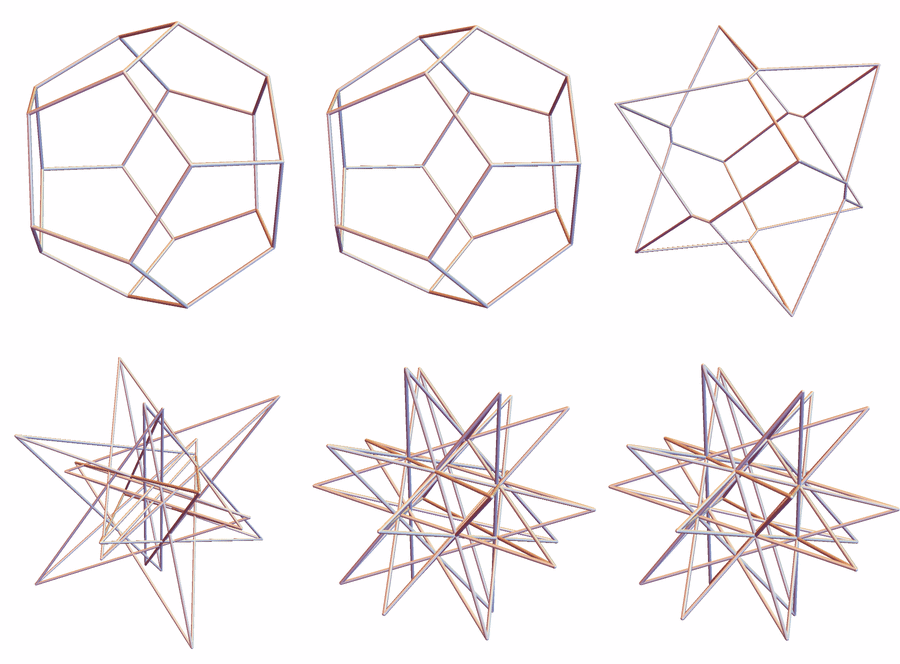
On Mastodon, J. M. animated an icosahedron morphing into a great icosahedron:
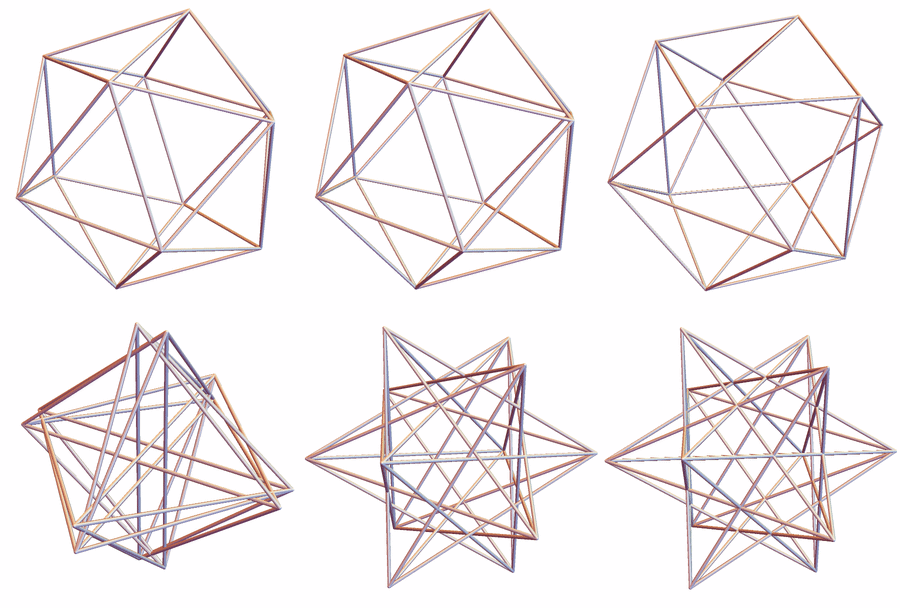
and a dodecahedron morphing to a great stellated dodecahedron:
Here’s another fun example. If you take a rhombicosidodecahedron with vertex coordinates all in the golden field:
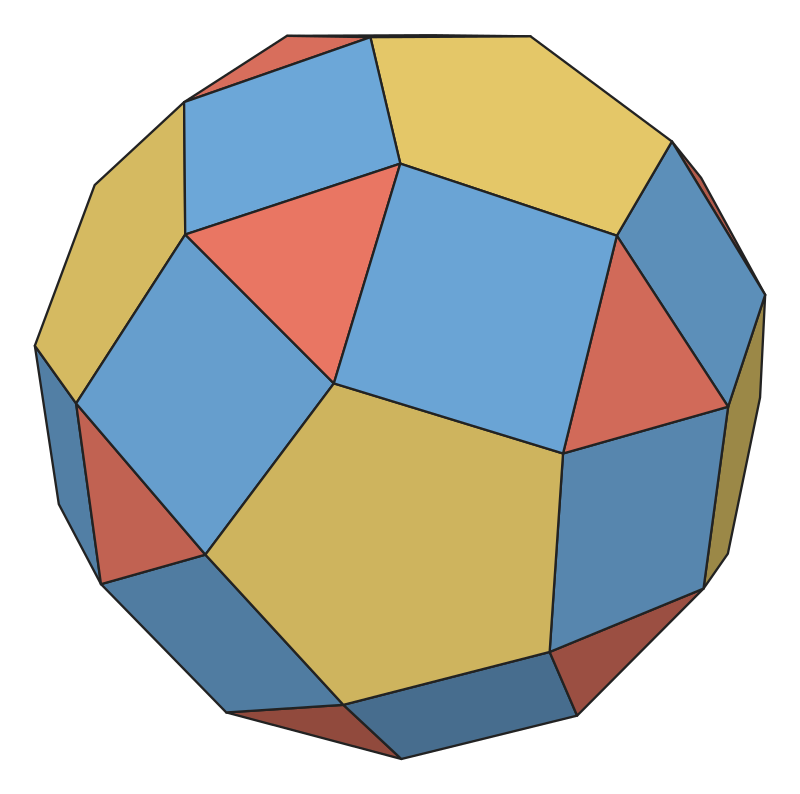
and apply the Galois transformation 
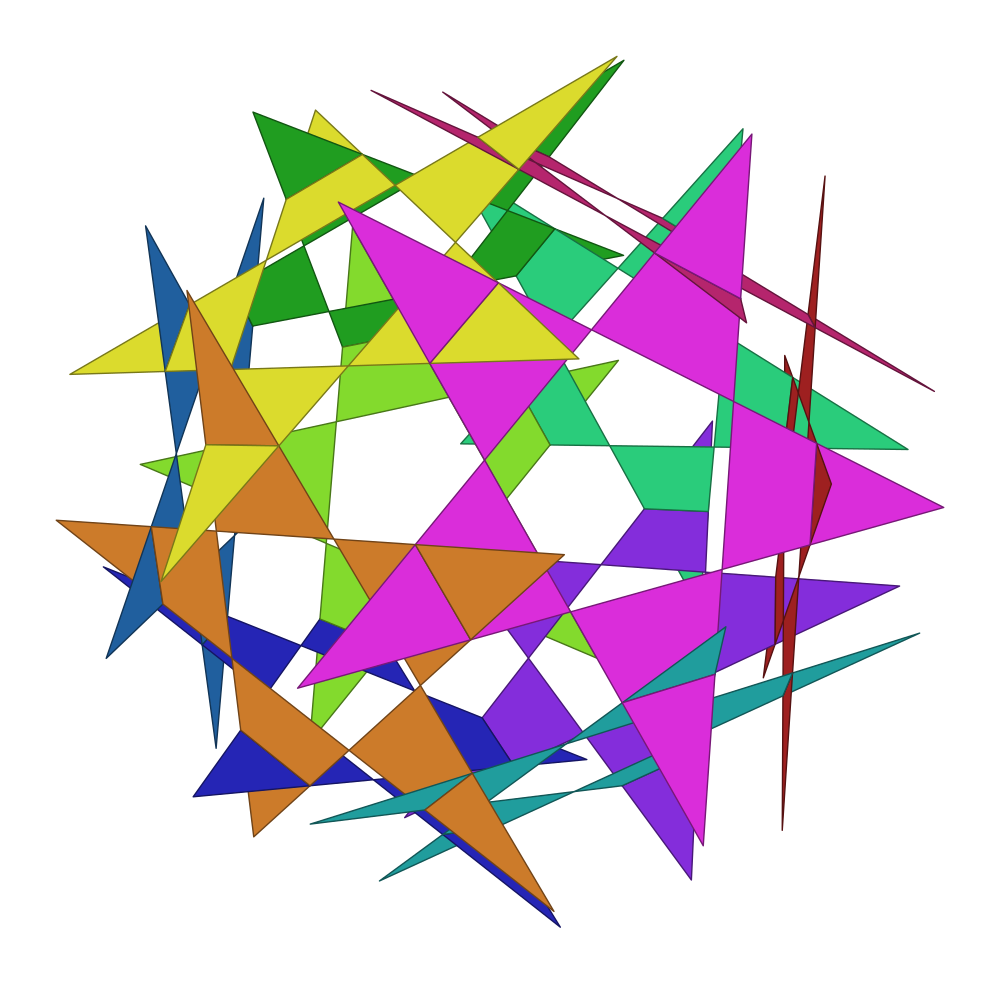
Interestingly the squares and triangles, not drawn, stay the same size—because the squared lengths of their edges are rational! But the squared lengths of the pentagon edges involve 