The Mantle
Azimuth 2026-08-23
As we descend from the base of Earth’s crust through the mantle, the rock does not remain unchanged. Pressure and temperature rise inexorably, and the minerals that thrive at the surface are forced, step by step, into new and denser crystallographic arrangements. This is the story of those transformations.
In this tale, I’ll act like I know a bit about minerals. I actually don’t: there are a bewildering variety, and I can never remember them. So don’t worry: when you come across a jargon-filled patch of prose, just power through it. You might learn a little… or you can just ignore it. The overall point here is that the Earth is made of beautiful crystalline structures that change character in complex ways as we descend.
The Mohorovičić discontinuity
Our story begins at the boundary where Earth’s crust, rich in feldspar and quartz, gives way to the denser mantle beneath. We see this boundary through its effect on seismic waves, and it’s called the Mohorovičić discontinuity or “Moho”. The Moho does not lie at one fixed depth: it’s 5–10 kilometers below the seafloor, but 30–50 kilometers below most continents, and as much as 70–80 below young mountain belts like the Himalayas.
The mantle just below the Moho mainly consists of a rock called peridotite, which is made mostly of olivine and pyroxene, with smaller amounts of garnet (or, at shallower depths, spinel). Peridotite has a delicious coarse green appearance:
_28_(cropped)).jpg)
More precisely, this is what peridotite looks like up here. When geochemists talk about the bulk composition of the upper mantle, however, they usually use an idealized model called pyrolite—not a rock you can pick up, but a hypothetical recipe Ted Ringwood proposed in the 1960s for the primitive upper mantle.
You see, since the Earth has had a convecting mantle, solid mantle rock wells up in places. As it does, the pressure drops, and a bit of it melts: the minerals with lower melting points. This melt flows upward. It’s called basalt. It builds the Earth’s crust. It leaves a residue behind, made of minerals with higher melting points.
In Ringwood’s theory, which for expository purposes I’ll assume is true, pyrolite is what mantle rock is like before any partial melting depletes it of basaltic ingredients. The name is a portmanteau of pyroxene and olivine, the two dominant minerals. Pyrolite is about 60% pyroxene; the remaining 40% is mostly pyroxenes plus garnet.
• A pyroxene is a mineral built from single, unbranched chains of corner-sharing SiO₄ tetrahedra, with metal cations—chiefly Mg, Fe, and Ca—linking the chains together. The general formula is XY(Si,Al)₂O₆, where X and Y are those cations.

• Olivine is a green silicate, (Mg,Fe)₂SiO₄:

Its crystal structure in the upper mantle is an orthorhombic arrangement of isolated SiO₄ tetrahedra knit together by magnesium and iron in octahedral sites. It’s called the α-phase because we’ll see some more compressed phases as we descend.
• A garnet is built from separate SiO₄ tetrahedra held together by cations, but assembled into a dense, hard, characteristically cubic-symmetry crystal. There are different kinds of garnet, but the general formula is X₃Y₂(SiO₄)₃: three divalent X cations, two trivalent Y cations, and three isolated silica tetrahedra. The mantle’s garnet is largely pyrope, Mg₃Al₂(SiO₄)₃.

As we descend, the pyroxenes and garnet gradually dissolve into each other, producing a new high-pressure mineral called majorite. Here’s a rare sample from a meteorite fall in Canada:

So even before the dramatic change 410 kilometers down, the rock is no longer the simple olivine-pyroxene-garnet assemblage we had further up.
The 410-kilometer discontinuity
Roughly 410 kilometers down, the pressure reaches about 13,000 atmospheres and the temperature hovers around 1,400°C. Olivine can no longer hold its familiar shape. It transforms to its β form: wadsleyite, a mineral with the same chemical formula but a fundamentally different atomic arrangement. Instead of isolated SiO₄ tetrahedra, wadsleyite contains paired Si₂O₇ groups, and the oxygens pack more densely. The density jump is sharp enough to be detected globally by seismologists as a reflector of earthquake waves.
Wadsleyite has a remarkable property: it can hold several weight percent of water locked within its crystal structure. The transition zone may thus contain more water than all the oceans combined! However, very little wadsleyite has been seen on the Earth’s surface. Here’s a bit from that same meteor fall in Canada:

The 520-kilometer discontinuity
Descend further, to around 520 kilometers, and the temperature goes up only a little, to roughly 1500–1600°C, since convection here is strong. The pressure goes up to about 175,000 atmospheres. At this point wadsleyite transforms into the γ form of olivine: ringwoodite. This is denser, still chemically Mg₂SiO₄, but now with cations packed into tetrahedral and octahedral holes in a close-packed oxygen framework—the most efficient packing geometry that nature offers for this composition:

Ringwoodite is named for the great Australian geochemist Ted Ringwood, who studied these transitions. Here’s an artificially manufactured sample:

For a long time the mineral’s existence in the mantle was purely hypothetical. But in 2014, a tiny grain was discovered as an inclusion inside a diamond brought up from the deep mantle by an eruption, providing the first direct proof of its existence in Earth’s interior.
The 660-kilometer discontinuity
At a depth of 660 kilometers and a pressure of roughly 230,000 atmospheres, the most dramatic phase transition of all occurs. Ringwoodite does not merely rearrange into a yet more dense form. Instead, it decomposes into two entirely new minerals: bridgmanite (MgSiO₃) and ferropericlase (MgO). The majorite garnet also decomposes, yielding davemaoite (CaSiO₃), which is stable through the rest of the lower mantle:

The 660-kilometer discontinuity is sharp, globally consistent, and marks the conventional boundary between the upper and lower mantle. One reason it’s important is that enormous slabs of colder, denser rock sink through the upper mantle until they hit this discontinuity. These slabs are 30–100 kilometers thick and hundreds to a thousand kilometers across!
When they hit the discontinuity they flatten out, sometimes lying there and piling up for tens of millions of years. You can see this in seismic images beneath Japan and the Marianas. However, some slabs punch straight through into the lower mantle and keep sinking toward the core–mantle boundary. It may also be that some slabs pile up at the 660 kilometer discontinuity until the accumulated cold dense material overwhelms the barrier and flushes down in a comparatively sudden avalanche—lasting mere millions of years.
The lower mantle
This is the realm of bridgmanite, probably the most abundant mineral in the Earth. Bridgmanite is a beautifully symmetric cage of corner-sharing SiO₆ octahedra, with Mg tucked into the large cavities between them. It accommodates enormous pressure because there is very little void space left to compress.
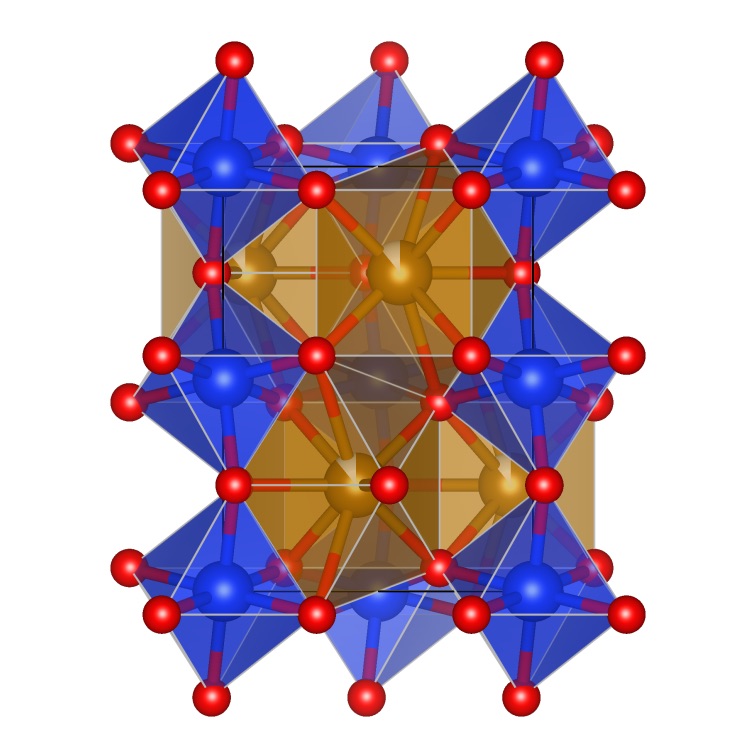
It is a striking fact that while bridgmanite is the most abundant mineral on the planet, it went unnamed until 2014, simply because no natural hand-sized specimen had ever been recovered. Everything we know about it comes either from high-pressure laboratory synthesis, from microscopic grains in shocked meteorites, or from the indirect testimony of earthquake waves that have traveled through 2,000 kilometers of it.
For over 2,000 kilometers of descent, from 660 to roughly 2,700 kilometers down, bridgmanite and its companion ferropericlase reign without significant further phase change. Seismic velocities increase steadily, but there are no dramatic discontinuities.
The D″ discontinuity
As we approach the core-mantle boundary—at depths around 2,700 kilometers, pressures of approximately 120,000–125,000 atmospheres, and temperatures of 2,200–3,7000°C—even bridgmanite yields. It transforms into the post-perovskite phase. Post-perovskite is a layered, sheet-like structure of SiO₆ octahedra, quite different from bridgmanite’s three-dimensional cage, making it potentially much weaker and more prone to flow.
This transition is believed to be responsible for the seismic D″ discontinuity observed at 2,900 kilometers depth. The D″ layer is a highly dynamic region, likely the site of storage of subducted materials and the source of deep mantle plumes.
A summary of the descent
The table below summarizes the major transitions:
Depth (km) Minerals0–410olivine (α) + pyroxenes + garnet410→ wadsleyite (β)520→ ringwoodite (γ)660→ bridgmanite + ferropericlase + davemaoite660–2700bridgmanite dominates~2700→ post-perovskite2900 → liquid iron coreThe interesting thing about this story is that it was told first by seismology—the sharp jumps in wave speeds at 410 and 660 kilometers were detected long before geologists could reproduce those pressures in the lab—and only later checked by diamond-anvil cell experiments squeezing tiny mineral samples to millions of atmospheres. The rocks never rise to the surface to tell their story directly, so much of the tale above is just theory.
Which minerals are there the most of?
We can estimate how much of the Earth is made of wadsleyite, ringwoodite, and bridgmanite using known shell volumes, estimated densities, and mineral proportions from the pyrolite model.
Step 1: Earth’s mass budget by layer
The Earth’s total mass is M⊕ ≈ 5.972 × 1024 kg. The mass budget by layer is approximately:
• Crust: ~0.4% of Earth’s mass • Upper mantle + transition zone (35–660 km): ~18% of Earth’s mass • Lower mantle (660–2,891 km): ~49% of Earth’s mass • Core (outer + inner): ~32.5% of Earth’s mass
Step 2: The transition zone (410–660 km)
Using PREM densities averaging ~3,760 kg/m3 across the transition zone, and the volume of each spherical shell:
Wadsleyite zone (410–520 km): Shell volume ≈ 4.8 × 10¹⁹ m3 Shell mass ≈ 1.76 × 10²³ kg Fraction of Earth’s mass ≈ 2.9%
Ringwoodite zone (520–660 km): Shell volume ≈ 5.9 × 10¹⁹ m3 Shell mass ≈ 2.24 × 10²³ kg Fraction of Earth’s mass ≈ 3.8%
In the pyrolite model of mantle composition, forms of olivine (wadsleyite and ringwoodite) make up roughly 60% of the transition zone by mass, with the remaining ~40% being majoritic garnet. Applying this correction:
Wadsleyite: 0.60 × 2.9% ≈ 1.8% of Earth’s mass Ringwoodite: 0.60 × 3.8% ≈ 2.3% of Earth’s mass
These estimates carry roughly 20–30% uncertainty, mainly from the assumed 60% olivine proportion in the transition zone, which varies with local temperature and bulk composition.
Step 3: Bridgmanite (660–2,700 km)
The lower mantle holds about 49% of Earth’s mass—it is an enormous shell! Bridgmanite constitutes approximately 80% of the lower mantle mineral assemblage (by mass) in the pyrolite model:
0.80 × 49% ≈ 39% of Earth’s mass
This is consistent with the well-cited literature figure that bridgmanite comprises approximately 38% of the planet’s mass—making it the single most abundant mineral in the Earth by a vast margin.
MineralDepth (km)Fraction of Earth’s MassWadsleyite410–520~1.8%Ringwoodite520–660~2.3%Bridgmanite660–2,700~38–39%All three combined410–2,700~42%Thus, these three minerals—all members of the same Mg₂SiO₄/MgSiO₃ chemical lineage—together constitute roughly 42% of Earth’s entire mass. All other named minerals on Earth, including quartz, feldspar, calcite, diamond, and the roughly 3,800 others known to mineralogists, divide up the remaining scraps.