From the Octahedron to E8
Azimuth 2020-03-21
Here’s a fun challenge for people confined due to coronavirus.
The E8 lattice is a thing of beauty, taking full advantage of the magic properties of the number 8. The octahedron has 8 sides. Wouldn’t it be cool if you could build the E8 lattice from the humble octahedron?

David Harden thinks he’s found a way! But I haven’t carefully checked that it works: it takes some calculations. Can you check it?
He wrote about it here:
• David L. Harden, What other lattices are obtainable from this noncommutative ring?, MathOverflow, 14 March 2020.
Let me dive in and explain it.
You start with the octahedron. You take the double cover of its group of rotational symmetries and think of this as a group of unit quaternions. You get 48 very special quaternions this way. You then take integer linear combination of these quaternions: call the set of these 


where 
Not every quaternion of this form is in ![\mathbb{Q}[\sqrt{2}]^4,](https://s0.wp.com/latex.php?latex=%5Cmathbb%7BQ%7D%5B%5Csqrt%7B2%7D%5D%5E4%2C&bg=ffffff&fg=333333&s=0 "\mathbb{Q}[\sqrt{2}]^4,")
To see this lattice as E8, we put this norm on
![\mathbb{Q}[\sqrt{2}]^4:](https://s0.wp.com/latex.php?latex=%5Cmathbb%7BQ%7D%5B%5Csqrt%7B2%7D%5D%5E4%3A&bg=ffffff&fg=333333&s=0 "\mathbb{Q}[\sqrt{2}]^4:")


This norm comes from an inner product in the usual way. So, we have a lattice in an 8-dimensional real vector space with an inner product… and David claims that it’s a copy of the E8 lattice!
To prove this, it’s enough to show that
1) the inner product of any two vectors in
and that either
2a) the inner product of any vector in
or
2b) the inner product of any vector in
or
2c) there are no vectors in
Either of these characterizes E8. David has actually checked 1) and both 2b) and 2c), but some of his calculations take work, so I hope some of you can check them again.
Let me help you out a bit.
If we start with the octahedron and take the double cover of its group of rotational symmetries, you get something called the binary octahedral group, which has 48 elements. I described it here:
• John Baez, The binary octahedral group, Azimuth, 29 August 2019.
I even described how to think of its elements as unit quaternions. We get 8 like this:

and 16 like this:

These 24 are the vertices of a wonderful shape called the 24-cell, drawn here by Greg Egan:
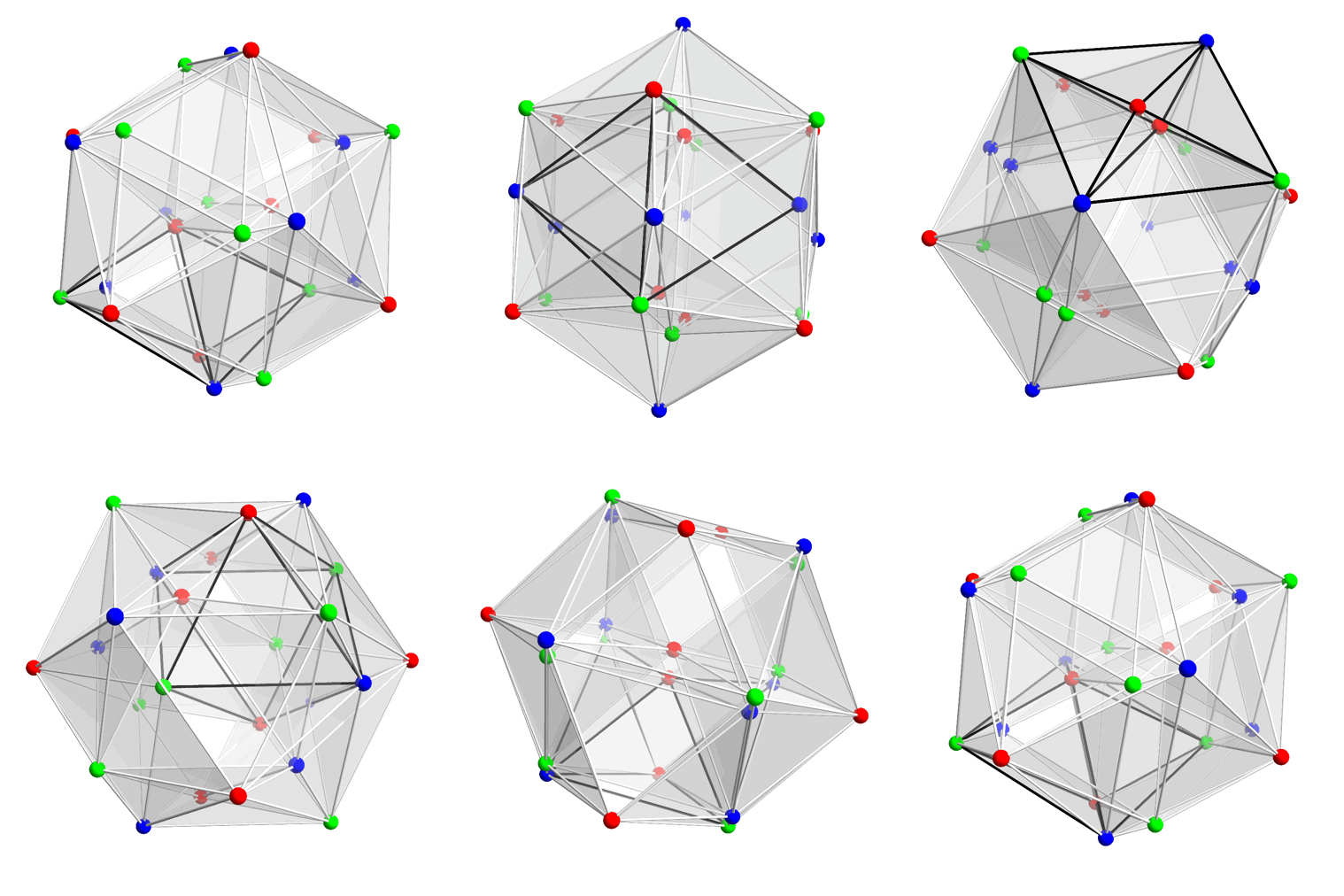
The remaining 24 elements of the binary octahedral group form the vertices of a second 24-cell! Here they are:


Starting from the 48 elements of the binary octahedral group, we can easily get ahold of 8 generators of the lattice

I think it’s pretty easy to see that these generate the lattice 
Concretely, this inner product works as follows. Given

and

then

So, for example,

(You might have been fooled into thinking it’s 

After doing a bunch of these, I’m convinced that all the inner products are integers. So the hard part is checking 2a) or 2b) or 2c).
Can you do it?
By the way, all this is extremely similar to the construction of the E8 lattice from the icosahedron, explained in Conway and Sloane’s book and later here:
• John Baez, From the icosahedron to E8.
There you start with the icosahedron. You take the double cover of its group of rotational symmetries, which is called the binary icosahedral group, and think of this as a group of unit quaternions. You then take integer linear combination of these quaternions: call the set of these 


where
Not every quaternion of this form is in ![\mathbb{Q}[\sqrt{5}]^4,](https://s0.wp.com/latex.php?latex=%5Cmathbb%7BQ%7D%5B%5Csqrt%7B5%7D%5D%5E4%2C&bg=ffffff&fg=333333&s=0 "\mathbb{Q}[\sqrt{5}]^4,")
To see this lattice as 
![\mathbb{Q}[\sqrt{5}]^4:](https://s0.wp.com/latex.php?latex=%5Cmathbb%7BQ%7D%5B%5Csqrt%7B5%7D%5D%5E4%3A&bg=ffffff&fg=333333&s=0 "\mathbb{Q}[\sqrt{5}]^4:")

And we get a copy of the E8 lattice this way, since 1) and 2a) hold, and for that matter also 2b).
The lattice
It’ll be cute to see an octahedron giving E8, since they are both connected to the number eight! But even if this construction really works, I have no idea what it ‘really means’.
Is this construction new? It seems like such a natural thing to consider… in retrospect.