Structured Cospans and Double Categories
Azimuth 2020-03-30

I’m giving the first talk at the ACT@UCR seminar. It’ll happen on Wednesday April 1st—I’m not kidding!—at 5 pm UTC, which is 10 am in California, 1 pm on the east coast of the United States, or 6 pm in England. It will be held online via Zoom, here:
https://ucr.zoom.us/j/607160601
We will have discussions online here—I suggest going here 20 minutes before the talk, so you can meet people and chat:
https://categorytheory.zulipchat.com/
I’ll also chat with people afterwards at that location. With luck I’ll also be able to put a video of my talk on YouTube… but you can look at the slides now:
• John Baez, Structured cospans and double categories.
Abstract. One goal of applied category theory is to better understand networks appearing throughout science and engineering. Here we introduce “structured cospans” as a way to study networks with inputs and outputs. Given a functor L: A → X, a structured cospan is a diagram in X of the form
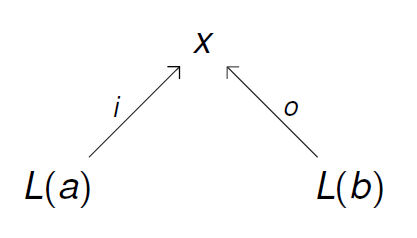
If A and X have finite colimits and L is a left adjoint, we obtain a symmetric monoidal category whose objects are those of A and whose morphisms are certain equivalence classes of structured cospans. However, this arises from a more fundamental structure: a symmetric monoidal double category where the horizontal 1-cells are structured cospans, not equivalence classes thereof. We explain the mathematics and illustrate it with an example from epidemiology.
This talk is based on work with Kenny Courser and Christina Vasilakopoulou, some of which appears here:
• John Baez and Kenny Courser, Structured cospans.
• Kenny Courser, Open Systems: a Double Categorical Perspective.
Yesterday Rongmin Lu told me something amazing: structured cospans were already invented in 2007 by José Luiz Fiadeiro and Vincent Schmit. It’s pretty common for simple ideas to be discovered several times. The amazing thing is that these other authors also called them ‘structured cospans’!
• José Luiz Fiadeiro and Vincent Schmitt, Structured co-spans: an algebra of interaction protocols, in International Conference on Algebra and Coalgebra in Computer Science, Springer, Berlin, 2007.
These earlier authors did not do everything we’ve done, so I’m not upset. Their work proves I chose the right name.