Viable Alternatives to Book Processing Charges (BPCs) | H-Net
flavoursofopenscience's bookmarks 2025-10-23
Summary:
A guest post from Feeding the Elephant: A Forum for Scholarly Communications.
Guest post by Tom Grady, Copim project co-Lead, Birkbeck, University of London.
This post is the second in a two-part series. The first installment, Bonfire of the Humanities: Publishing Challenges, Opportunities, and Open Access, was published on October 15, 2025.
In my previous post, I described the gloomy circumstances facing the Arts, Humanities, and Social Sciences and publishing in these disciplines. Though deferred in 2024, the UK OA mandate is coming in 2029, and anyone who publishes authors based at a UK HEI would be well-advised to start thinking about this now. Books take a long time to research and write; some scholars may even be working on manuscripts right now that could be in scope. And funders in Europe, Austria, Norway, the Netherlands, Ireland, Portugal, and the Wellcome Trust are all mandating OA books and chapters. More policies and mandates may be in the works elsewhere.
Publishing these books will cost money, and if the author, their department, or their library doesn’t have cash lying around for the dominant ‘pay to publish’ model, then the sector is going to need alternative ways to fund publication of OA books. This is where the work of my organization, Copim Open Book Futures project, comes in.
We have been developing (mandate-compliant) models that can enable OA book publishing requiring no author-facing fees, no embargoes, and no paywalls for readers. These models are based in part on the pioneering work of academic-led presses punctum books in the USA and Open Book Publishers in the UK who have been publishing OA for 10+ years through innovative collective membership revenue models. Both are now part of a growing number of publishers on the Copim-developed Open Book Collective (OBC), a platform where libraries can easily find OA presses (or presses moving towards being fully OA) and sign up to their membership schemes, supporting the presses financially without the need for per book fees. This model flips traditional publishing on its head: instead of buying books one-at-time after publication, libraries instead pay a small fee upfront and the Collective pools these fees to successfully fund the member presses’ publishing activity - all open access. OBC have several university presses on board and have applications from publishers wishing to join from Europe and the USA.
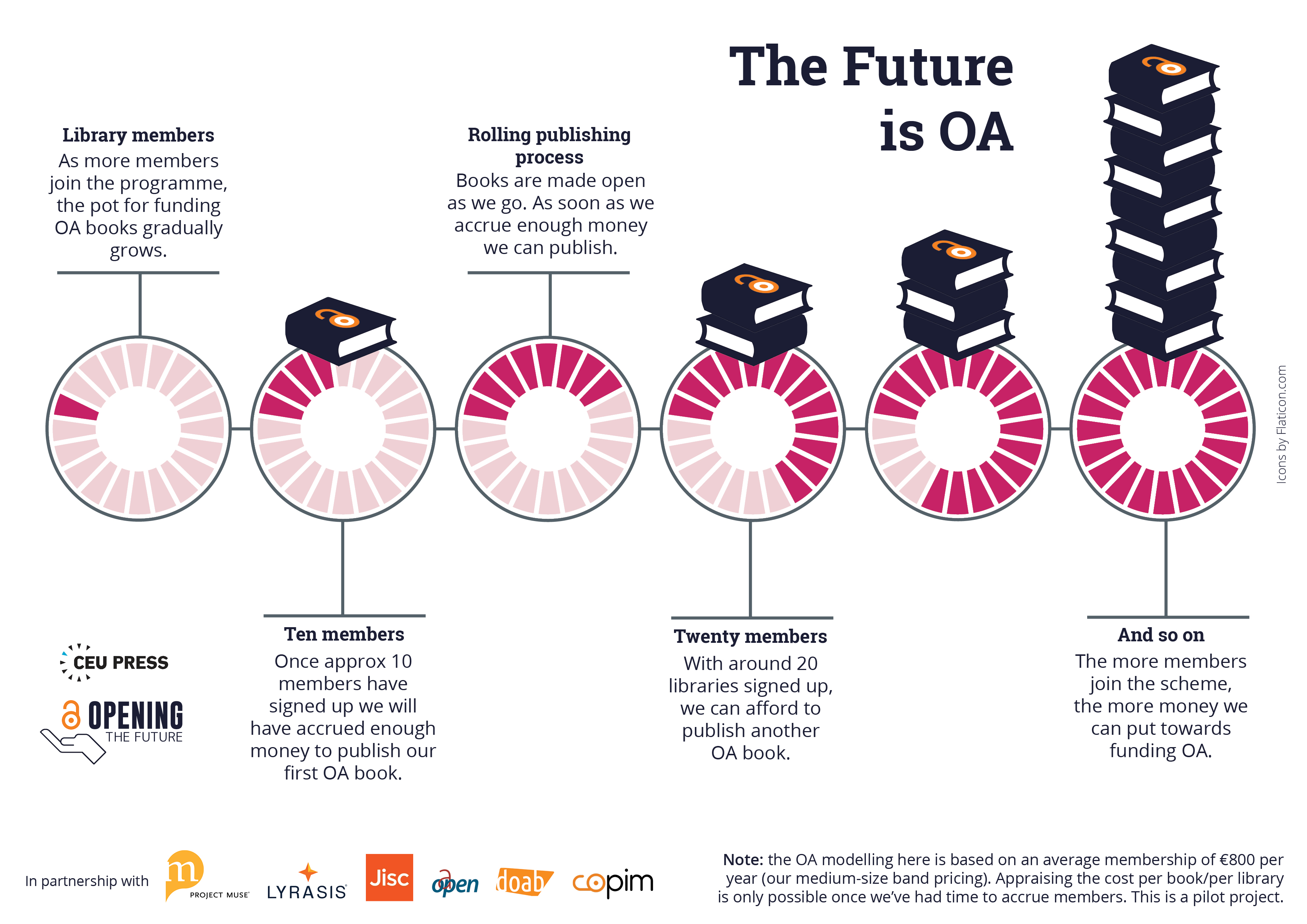
Another Copim output is Opening the Future (OtF), a mechanism tailored for ‘traditional’ publishers to shift toward OA while maintaining financial stability. It is based on low-cost library subscriptions to publishers’ closed backlist titles: those ‘backlist’ books are still relevant titles, still available for normal purchase, but are just not part of a publisher's new or forthcoming ‘frontlist’ books. Subscribing members pay for access to packages of (closed, non-OA) backlist e-books hosted by non-profit Project MUSE, which is a pretty standard arrangement for libraries acquiring bundles of content. But the innovation here is that their fees go towards only publishing new, frontlist books in open access e-format. So special access to closed content is used as a sort of lever, to fund new open access content. The more libraries Opening the Future has on board, the more books the publisher can flip to OA, and it’s low risk too: presses continue publishing as normal until the ‘pot’ has grown sufficiently to cover their costs for the next frontlist title in their pipeline, at which point it gets published OA. Then they wait for the pot to build again and so on. The program is freely available to implement by any publisher with a closed (or partially closed) backlist.