Social Karma in 2000 With Slashdot and BowieNet Version 2.0
Cybercultural: Internet History 2025-10-06
 Slashdot homepage, 20 June 2000; via Wayback Machine.
For the first several months of 2000, David Bowie’s website was a work in progress. BowieNet was undergoing a redesign, which had originally been scheduled to go-live at the end of January. But like many other software projects before and since, it got delayed. Finally, in May, the new version of BowieNet was launched.
“There are some exciting and great new features including new 'points' system accumulator, new message boards, Beatnik enhanced pages [an interactive audio technology], web based email for all members, 10 meg of free web space, your personal profile, [and] your own account section,” wrote Paul Kinder on his fan site BowieWonderworld.
 BowieNet version 2 design, by Polished Solid for Nettmedia.
“BowieNet Version 2.0,” as it was dubbed, had a fresh new look and feel. It was lighter, more spacious, and opted for a kind of pastel colour scheme on a white background — bright blue, royal yellow, pale orange, and minty green. It was somewhat reminiscent of the 1999 range of bright-coloured iMacs released by Apple — which had been given “flavour” names, like blueberry and tangerine.
Regardless of whether Apple had inspired the colour scheme for BowieNet v2, it was refreshingly different to the dark and muddy colours of the previous Outside theme.
 "BowieNet v2 requires the Flash 4 plugin."
Another notable feature of v2 was its extensive use of Flash, which unfortunately means that version of the site is almost entirely inaccessible via the Wayback Machine 25 years later. There was one Flash file I managed to recover, however. I've embedded the launch trailer below, via YouTube.

Social Software in BowieNet
Beyond the flashy new design, the main goal of BowieNet v2 was to enhance community.
“The number one focus of BowieNet is our community," BowieNet webmaster Howard Jackowitz said in an interview for Adobe’s Web Center publication. “With v2, we're completely overhauling the 'Discourse' section of the site, moving more to a publishing module and giving the user more control.”
That meant fans could essentially create blogs on BowieNet now — although this feature was promoted as “individual member profiles.” As for Bowie himself, the online journal he'd begun in August 1998 was only being updated sporadically. But he regularly popped into the forums of BowieNet and left comments as “Sailor.” He seemed genuinely interested in communicating with his fans via the Internet, albeit on his terms and often using one of his jokey personas.
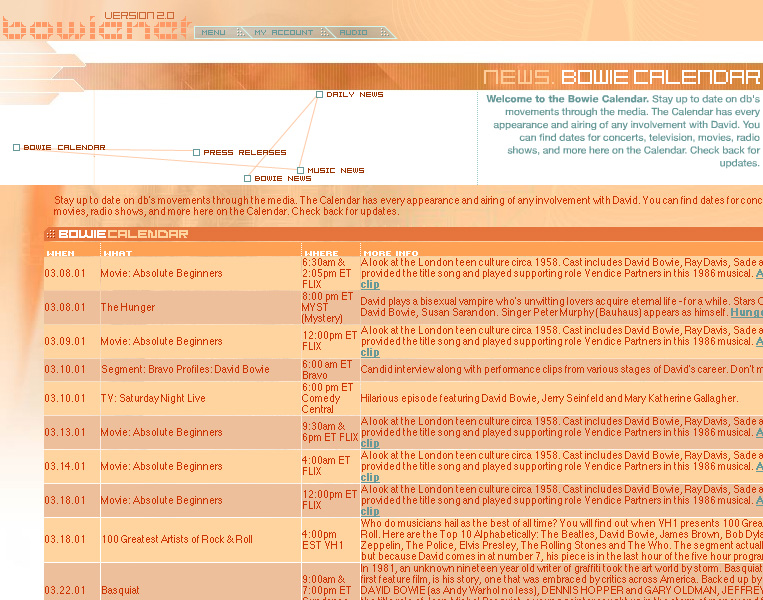 BowieNet calendar, circa 2000; via Polished Solid for Nettmedia.
“Of course, the whole idea of the relationship between artist-audience has always tweaked my curiosity, and online presence gives anyone the chance to both 'mystify' or 'demystify,'" Bowie told the Adobe magazine. "I'm trying out demystification at the moment — though that could change overnight."
BowieNet Karma System
By mid-2000, BowieNet had 10,000 members and attracted 190,000 unique users each month. It was a drop in the bucket compared to web portals like AOL and Yahoo, but the BowieNet user base was just large enough to encourage an active social network. Today, we can think of it as a kind of prototype Reddit group (for context, the David Bowie subreddit has 68,000 users as I write this in 2025).
After the launch of v2, Evan Torrie from fan site Teenage Wildlife commented that the new “karma” system was one of the more interesting additions.
“Various user contributed items (such as message board posts and fan sites) have a "karma" rating — calculated by members who can add or delete karma from each item based on whether they think it's good or bad. One option we might see is items with high karma being promulgated to the top of listings.”
In addition, there was a new points system, which awarded points for various types of contributions to the BowieNet web site — posting news items, starting discussions, chatting, etc. As Torrie noted, “at the end of each quarter, the points are tallied and prizes given out to the highest point-scoring members.”
 An indication of what BowieNet community features looked like in 2000; via INside book.
Initially, there was some confusion amongst BowieNet members about the difference between karma and points. Whereas points led to rewards, explained the BowieNet editors, “karma is a community tool.” The way they described it, karma was a content ratings system:
“Every member can be as active as they would like on V.2, and one way to do so is to 'rate' postings to the site. You can add or subtract Karma from any posting with a simple click, and by doing that, all other members of the site can see which postings were fan favorites, and which were not. Karma is a fun way for the community as a whole to interact in ways which weren't possible before.”
These days we associate a karma system with Reddit, which popularised the concept from its launch in 2005. For Reddit, karma is more about rating the user than the content. An FAQ on the present version of Reddit explains that karma is “a reputation system” and that “Reddit as a whole will trust you more if you have more of it.”
Slashdot's Karma System
Before there was Reddit, or even BowieNet, there was Slashdot — a tech news aggregator launched in 1997. It was one of the original “social news” websites, where stories are posted by users and then ranked by popularity. The highest ranking stories in sites like Slashdot and Reddit also tend to attract large comment threads; and those comments may also be ranked according to popularity.
The concept of karma appears to have been formulated on Slashdot sometime in 1999, as a response to the site’s increasing popularity.
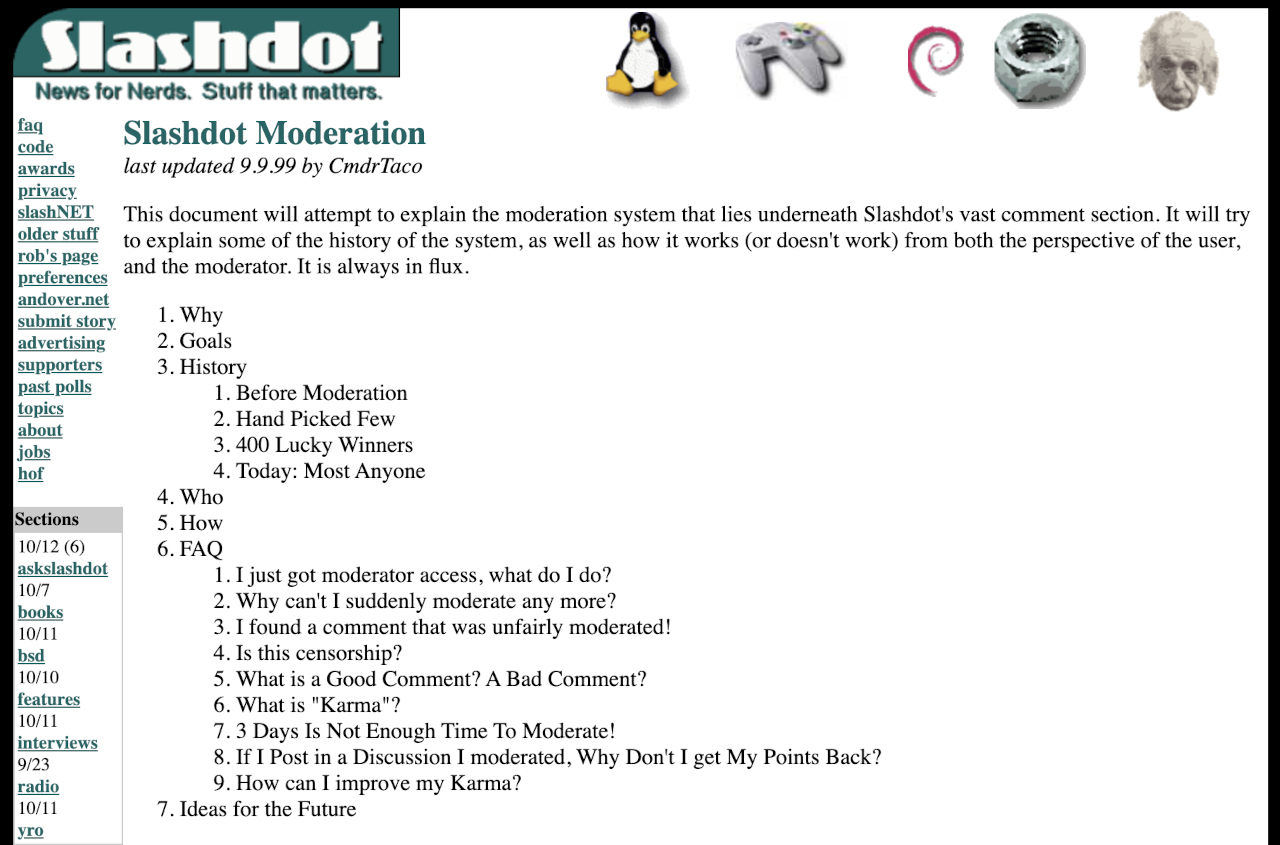 Slashdot moderation, 1999.
In the early days, Slashdot had a “hand picked” crew of 25 moderators, which then turned into 400 people. But it needed to scale even more, so co-founder Rob Malda implemented a “mass moderation” system to enable any user with good “karma” to be a moderator. As defined in a September 1999 version of its guidelines:
“Karma is the sum of all moderation activity done to a user. Karma is used to determine eligibility for moderator status. Every new user starts with a Karma of 0, and as long as your karma isn't negative you are eligible to become a moderator. This doesn't mean you ever will become a moderator, but it does make you eligible!”
So the criteria to be a moderator wasn’t onerous. As long as you had “non negative Karma,” indicating that “you have posted more good comments than bad,” then you were eligible to help moderate Slashdot.
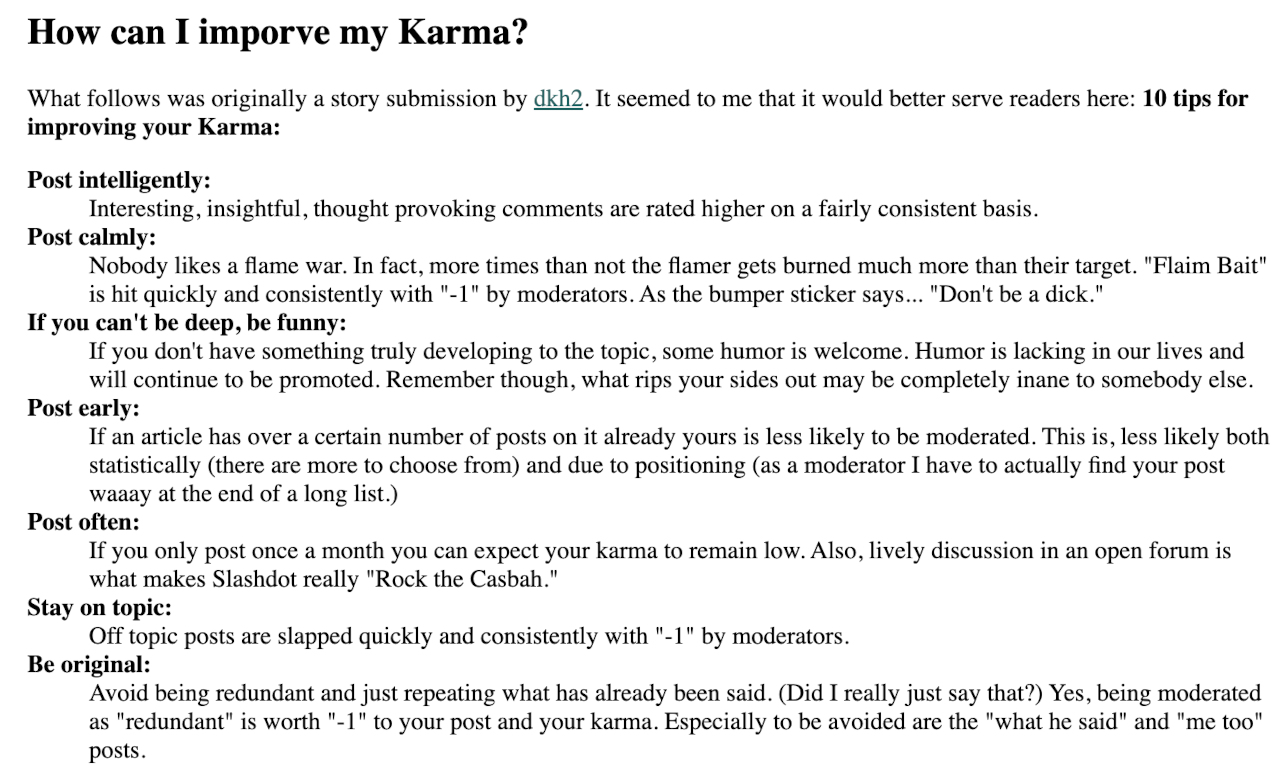 How to "imporve" karma; Slashdot FAQ.
By 2000, Slashdot had become popular enough to be recognised by The Webby Awards, then in its fourth year of operation. In May 2000, Slashdot was awarded two Webbys: the “Peoples Voice” awards for “Community” and “Print & Zines.” Curiously, it didn’t get the nod for those two awards from the organisation that ran the Webbys, the grandly-named International Academy of Digital Arts & Sciences — whose 350-person membership included one David Bowie. Instead, the academy gave Best Community to Café Utne and Best Print & Zine to Nerve (both sites are now long gone).
Karma for Google and Amazon
2000 was also the year that Google got its first Webby, receiving the award for “Technical Achievement” in both the official and ‘peoples voice’ categories.
There’s a curious YouTube video of Google founders Sergey Brin and Larry Page talking to a Webbys host at the red carpet event on May 11, 2000, at San Francisco's Masonic Center. For some reason, both Google founders wore tin foil capes. Asked how he felt about the Webby win, Brin replied, “Well, I think there's been a lot of focus these days on the economy and Wall Street's ups and downs, [so] it’s really good to see concern for the products still, and the services that are available on the web.”
 Sergey Brin and Larry Page at the Webbys ceremony in May 2000.
When the host asked what Google’s plans were, Brin’s reply was revealing. They wanted to become a stable business.
“Actually we are paying attention to our finances. Uh, we're working on profitability and we're working on becoming a really great business success. That's what we're focused on.”
“You too can be a billionaire,” quipped the rather clueless host.
“Uh, I hope so,” Page finally piped up, when the microphone was pointed his way.
As the Nasdaq stock market index continued a gradual decline from its March 2000 peak, the Internet economy was slowly transforming itself. It was becoming clear that to survive the downturn, you needed to find sources of reliable revenue and manage your expenses.
The smart startups were thinking ahead. After testing keyword advertising for much of 2000, Google launched a new product in October: AdWords, an online marketplace that enabled “any advertiser to purchase individualized and affordable keyword advertising that appears instantly on the google.com search results page.” AdWords was destined to become Google’s golden goose for revenue generation.
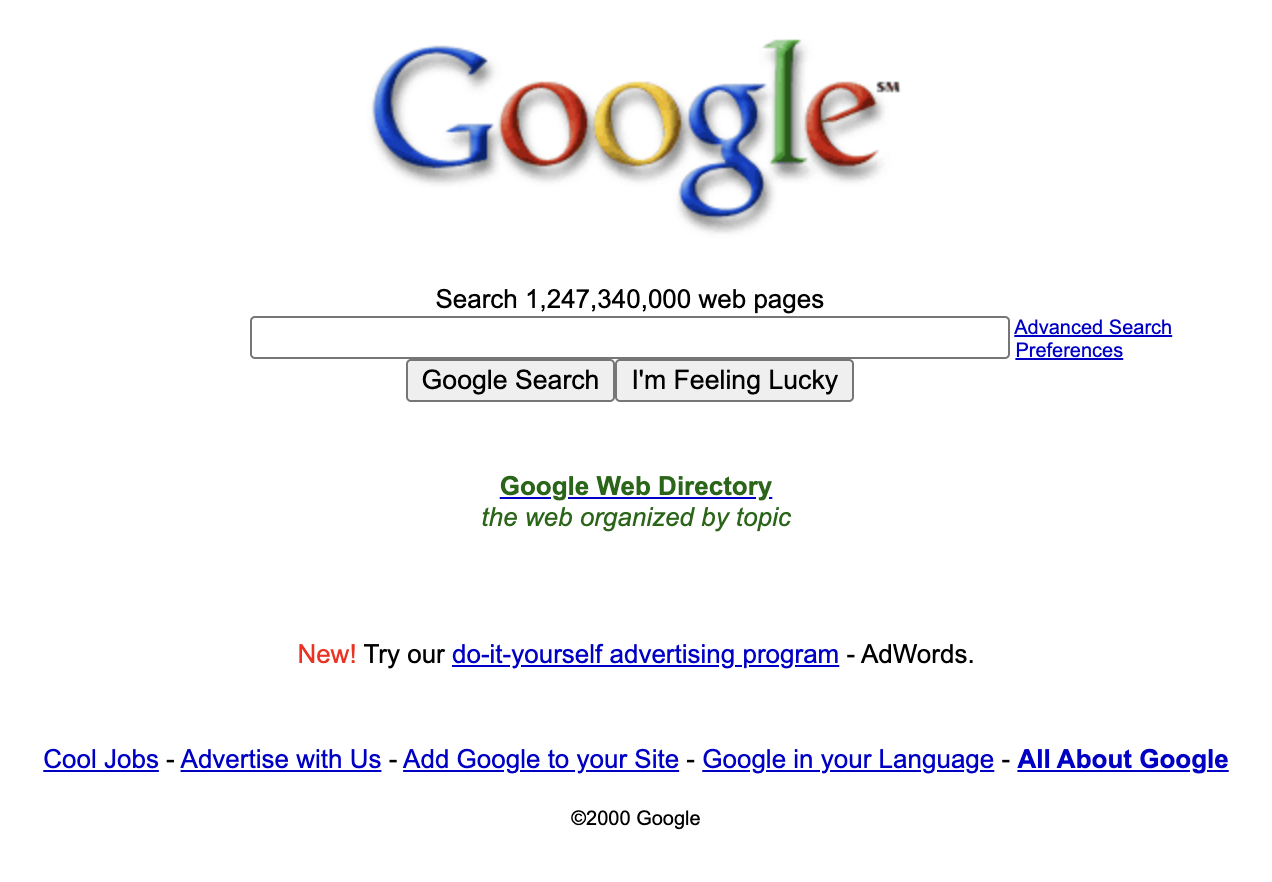 Google homepage, 27 October 2000 — note the AdWords promo.
2000 was a busy year for Amazon too, as it expanded into further product categories and opened its platform to third-party sellers. Incidentally, it also won a Webby that year — in the “Commerce” category. On the other hand, Amazon posted its biggest ever loss in 2000, of $1.41 billion.
In his book ‘The Everything Store,’ author Brad Stone noted that Jeff Bezos was forced to change Amazon’s strategy that year to adjust to the times: “Instead of Get Big Fast, the company adopted a new operating mantra: Get Our House in Order.”
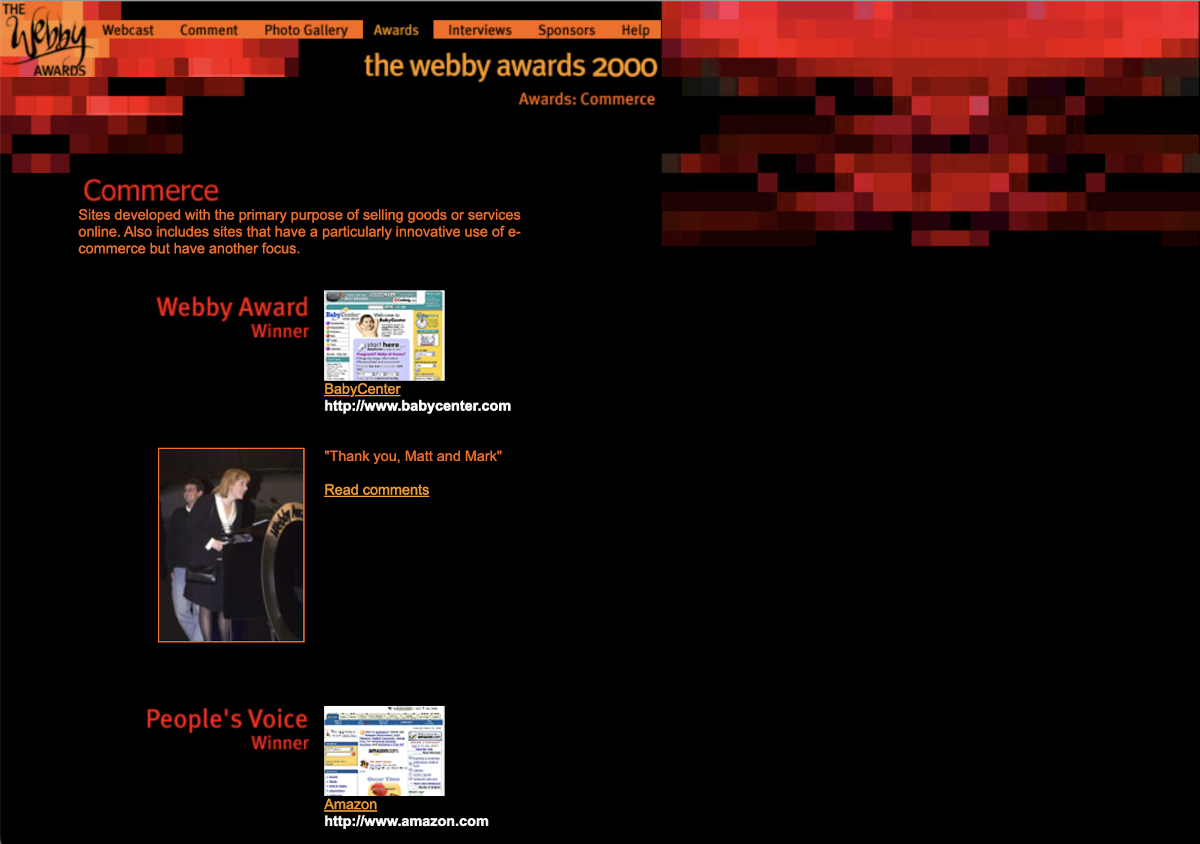 Amazon's Webby Award in 2000.
Amazon did adapt its business, although it also needed a big slice of luck to survive. As fate would have it, Amazon had sold $672 million in convertible bonds to overseas investors in February — just before the stock market slide began. If that deal hadn’t have happened, the company would’ve probably faced insolvency over the next year.
So the karma was good for Google and Amazon in 2000, even if luck ran out for many other internet ventures.
Bonus: Karma Man
During 2000, David Bowie re-recorded an old 1960s song of his: Karma Man. It was for an album he was working on called Toy (the album had been slated for release in 2001, but was shelved by his record company — it was posthumously released in 2021).
 Image via DavidBowie.com.
Karma Man was originally recorded in 1967 — the same year as the Beatles’ Sgt. Pepper's Lonely Hearts Club Band — and its lyrics are infused with the pervading psychedelic spirit of that era. But if you squinted at the song sheet in 2000, you could almost convince yourself that Bowie is now addressing the dot-com downturn:
Slow down Slow down Someone must have said, "Let's slow him down" Slow down Slow down It's pictured on the arms of the karma man