How Big Is Vietnam’s Fast Credit Market?
Hobart and William Smith Colleges 2026-10-23
A Model-Based Estimate for 2026
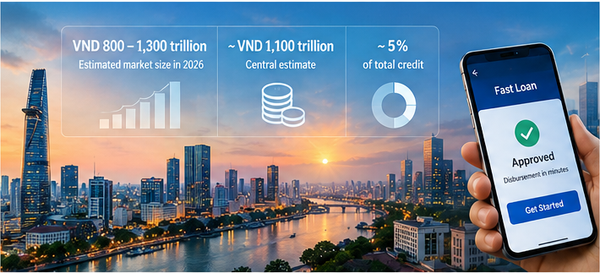
Vaynhanh Research estimates Vietnam’s fast consumer credit market at VND 800 trillion to VND 1,300 trillion in 2026, with a central estimate of approximately VND 1,100 trillion. The report treats this as a model-based scenario range, not an official regulatory statistic.
1. Why market size is difficult to measure
Vietnam’s consumer finance market has expanded alongside digital banking, finance companies, credit cards, installment products, and app-based distribution. Yet one apparently simple question remains difficult to answer: how large is the part of the market that consumers experience as fast credit?
The difficulty begins with classification. Fast credit is not a single legal or regulatory category. Products that feel similar to a borrower can sit in different institutional or accounting categories. A bank personal loan, a finance-company cash loan, a revolving credit line, a point-of-sale installment plan, and a digitally distributed loan may all provide rapid access to funds while being reported differently in official or corporate data.
The Vaynhanh Fast Loan Market Report 2026 approaches this problem as a measurement exercise. Instead of assuming that all consumer credit is fast credit, it defines a narrower analytical universe and then estimates the share of relevant outstanding balances that plausibly belongs within that universe (Vaynhanh Research, 2026).
2. What should count as fast credit?
A market-size estimate is only as useful as the definition behind it. If the definition is too broad, the estimate can absorb long-term consumer lending that does not behave like fast credit. If the definition is too narrow, it can exclude products that are functionally close substitutes from the borrower’s perspective.
For analytical purposes, fast credit can be understood as consumer-oriented borrowing with relatively short application-to-decision cycles, simplified documentation, comparatively small or medium ticket sizes, and a strong role for digital or semi-digital distribution. This framing focuses on how credit is accessed and used rather than on the marketing label attached to a product.
That distinction matters because Vietnam’s broader consumer finance landscape includes categories with very different economics. Long-term secured lending, especially housing-related credit, should not automatically be treated as part of a fast-credit market simply because it is consumer lending. The report therefore uses classification assumptions to separate the relevant portion of credit from the wider balance sheet (Vaynhanh Research, 2026).
3. The model-based estimate for 2026
The report estimates outstanding fast-credit balances in Vietnam at approximately VND 800 trillion to VND 1,300 trillion in 2026, with a central estimate of around VND 1,100 trillion. The central scenario is roughly equivalent to about 5 percent of total outstanding credit in the economy, according to the report’s comparison framework (Vaynhanh Research, 2026).
Estimated Outstanding Balance Scenarios
• Lower scenario: VND 800 trillion — More conservative inclusion assumptions.
• Central scenario: VND 1,100 trillion — Base-case estimate used for discussion.
• Upper scenario: VND 1,300 trillion — Broader but still bounded inclusion assumptions.
The range is important. It should not be interpreted as a statistical confidence interval. Instead, it represents different scenario outcomes produced by uncertainty in market boundaries, source coverage, and classification choices. The VND 1,100 trillion midpoint is therefore best used as a reference case, not as a claim that the market can be measured to a single exact number.
4. How the estimate can be built
A model-based estimate of this kind typically requires several layers of evidence. First, researchers need a reliable top-down view of the total credit system and the broad consumer-finance categories within it. Second, they need institution-level or product-level disclosures that show where consumer lending is concentrated. Third, they need explicit inclusion and exclusion rules that determine which balances fit the fast-credit definition.
The strongest version of this methodology separates observed values from analytical assumptions. Official statistics, audited financial statements, company disclosures, secondary market data, and researcher estimates should not be presented as if they carry the same evidentiary weight. The report’s usefulness depends partly on making these differences visible to the reader (Vaynhanh Research, 2026).
This also explains why a range is preferable to false precision. If an estimate changes materially when a category is included or excluded, that sensitivity should be visible. A lower, central, and upper scenario makes the uncertainty easier to inspect than a single headline figure.
5. What the VND 1,100 trillion central estimate means
If the central estimate is directionally correct, fast consumer credit is large enough to be treated as a meaningful part of Vietnam’s financial system rather than as a marginal niche. A market around VND 1,100 trillion would imply substantial participation from banks, finance companies, digital distributors, credit-card issuers, retail partners, and other intermediaries.
The estimate also highlights why product transparency matters. As more providers compete on approval speed and convenience, consumers need to compare not only whether credit is available but also the total cost of borrowing, repayment schedule, fees, eligibility requirements, and the consequences of late payment.
For financial institutions, the estimate suggests that competitive advantage is unlikely to depend on speed alone. Underwriting quality, data infrastructure, distribution reach, pricing transparency, and trust can become increasingly important as the market matures.
6. What the estimate does not prove
The market-size estimate should not be mistaken for an official State Bank of Vietnam statistic. It does not establish that every institution uses the same definition of fast credit, and it does not imply that every product included in the model has the same risk profile or consumer impact.
Market size also says little by itself about borrower welfare. A larger market can reflect improved access to formal finance, greater consumer demand, easier digital distribution, or a combination of factors. Separate research is needed to understand repayment stress, effective borrowing costs, repeat borrowing, financial resilience, and whether fast credit substitutes for informal or traditional forms of borrowing.
There is also a technical issue of double counting. In a modern credit ecosystem, one loan can involve an originator, a distribution platform, a comparison service, a retail partner, and a technology provider. A robust estimate must count the underlying credit exposure rather than every participant in the distribution chain.
7. Why the range is useful for future research
The main value of the estimate is that it gives researchers a transparent starting point. A subsequent study can challenge the market definition, replace an assumption with newer data, or publish an alternative scenario. That is more useful than treating the VND 1,100 trillion figure as an unquestionable fact.
A strong replication exercise could test how the result changes under narrower and broader definitions. For example, researchers could estimate the market using only fully digital products, only unsecured lending, or only products meeting a defined approval-time threshold. Comparing those outputs would reveal which assumptions have the greatest effect on market size.
The next step for the research ecosystem would be a machine-readable dataset linked to the report. Institution-level sources, product categories, source classifications, model inputs, assumptions, and scenario calculations could then be reviewed independently and updated over time.
8. Conclusion
The Vaynhanh Fast Loan Market Report 2026 offers a model-based answer to a question for which Vietnam does not publish a single standalone official statistic. Its estimate of VND 800 trillion to VND 1,300 trillion, centered around VND 1,100 trillion, is best understood as a structured scenario range rather than a definitive measurement.
That distinction is precisely what makes the estimate useful. By framing the market as a research problem with explicit boundaries and assumptions, the report creates a basis for replication, criticism, and future refinement. The most productive question is therefore not whether Vietnam’s fast-credit market is exactly VND 1,100 trillion. It is whether the assumptions behind that central estimate remain reasonable when tested against new data and alternative definitions.
References
Vaynhanh Research, Q. (2026). Vaynhanh Fast Loan Market Report 2026: Estimating the Size of Vietnam’s Fast Consumer Credit Market (Version 1.0). Vaynhanh Research. https://doi.org/10.5281/zenodo.23051974
Vaynhanh.ai. Research and financial comparison platform homepage. https://vaynhanh.ai