Tiny barometers in cell phones could tell you how high you are
Ars Technica » Scientific Method 2013-10-20
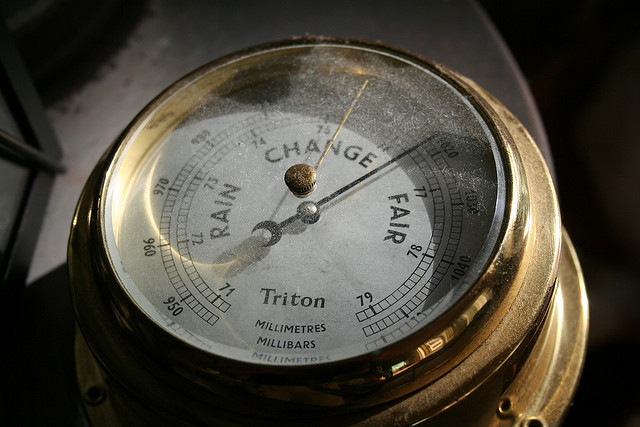
The modern smart phone is packed full of goodies that help it figure out where it is. Internal accelerometers provide orientation, WiFi and GPS signals combine with it to provide geographic location. We never need be lost again.
Until you walk into a large building. The GPS signal disappears, and the WiFi may only tell you accurately that you are in the building. Even if you were to use WiFi access points as navigational beacons, they do tend to get shifted about and new access points added as networks evolve. This makes positioning a bit of a lottery. Clearly navigational systems for inside buildings require an alternative approach. Now, research from Japan hints at a new sensor that may well be destined for the smart phone of the future.
One obvious approach to navigation is to use inertial guidance. Unfortunately, inertial guidance systems rely on sensing changes in acceleration, and use that to calculate a new position. Every calculation has a small error, and, since each new calculation relies on the results of the last calculation, this error grows as fast as the national debt during war time.
Read 9 remaining paragraphs | Comments


