Rethinking Online Culpability: The Amazon “Keep Calm” Shirts Controversy (Part 2: the Extension of Branding)
Current Berkman People and Projects 2013-05-27
In early March, the online retailer Solid Gold Bomb provoked outrage when customers discovered that its Amazon store, which featured apparel bearing dozens of variants on the famed “Keep Calm [and Carry On]” slogan, included a t-shirt that read “Keep Calm and Rape A Lot.” Solid Gold Bomb generated the shirts, and Amazon offered them for sale in its marketplace. To complicate matters, it appears that Amazon doesn’t review the stores in its marketplace like a mall owner might review physical storefronts, and, particularly unusual, Solid Gold Bomb didn’t review the shirts they offered for sale: the designs were computer generated. How far, then, should blame extend? When unsupervised automation produces results that everyone regrets, how do we decide whom to hold responsible, and when do we decide to hold anyone responsible in the first place? This post is the second installment in a four-part discussion of the issue. Part 1 can be found here.
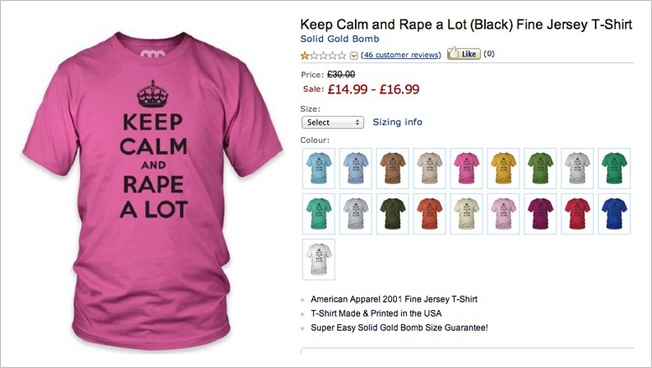
Ultimately, the way we evaluate Amazon’s responsibility in the Solid Gold Bomb embarrassment hinges on the way we perceive the Amazon brand’s interactions with Marketplace vendors and customers. The Amazon Marketplace has rules in place that restrict items that can be sold, including a prohibition on “products that promote or glorify hatred, violence, racial, sexual or religious intolerance or promote organizations with such views.” eBay and Etsy have similar provisions. The fact that numerous permutations of a reprehensible—and, accordingly, forbidden—item like the “Rape a Lot” shirt could appear in Amazon’s Marketplace is a testament to the limitations of platform proprietors’ abilities to police their services’ offerings.
But doesn’t Amazon’s relationship to products in the Amazon Marketplace feel somehow different from the way eBay and Etsy associate themselves with products sold through their portals? There are plenty of utterly reprehensible things for sale on the latter two platforms, such as this rape-satirizing T-shirt for sale on Etsy, which, according to its description, was made from an iron-on transfer purchased on eBay. For whatever reason, however, it seems more to be expected that eBay and Etsy might offer the offensive output of rogue users. Amazon feels different, and this difference lies in Amazon’s vigorous standardization and extension of their brand. Thanks to things like uniform, white-background product photos (absent on Etsy and eBay) and product pages that mention the seller only once, in ten-point font, non-Amazon sellers look like Amazon. Amazon has characterized itself as a place where anyone can buy anything, but not just anyone can sell anything—though, as the Solid Gold Bomb case demonstrates, this may be far from true. However, it certainly is a clever marketing strategy. Although much of what you can find for sale on the Amazon.com domain isn’t in Amazon warehouses, people still think of Amazon—and not Amazon marketplace vendors—when setting out to buy nearly anything on the internet. This sort of vast, recognizable umbrella branding is so effective at creating trust and simulating corporate endorsement that it even worked for a guy who modeled his resume on the Amazon site design. Amazon, more than most other major online retailers, appears to style itself to tacitly endorse everything available in its Marketplace. This is what made the outrage at Solid Gold Bomb’s products lead back to Amazon. Had the “Keep Calm” shirts been posted on, say, Craigslist, it’s doubtful that anyone would have lashed out at the platform used to sell them.[1]
- Ben Sobel, Kendra Albert, and JZ
[1] And anyone who would lash out would look about as silly as the people who clamored for the arrest of Facebook bigwigs because the SuperPoke! application allegedly promoted knife violence.